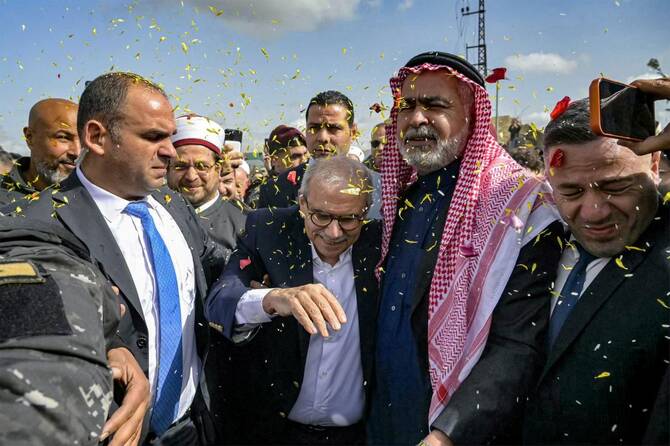
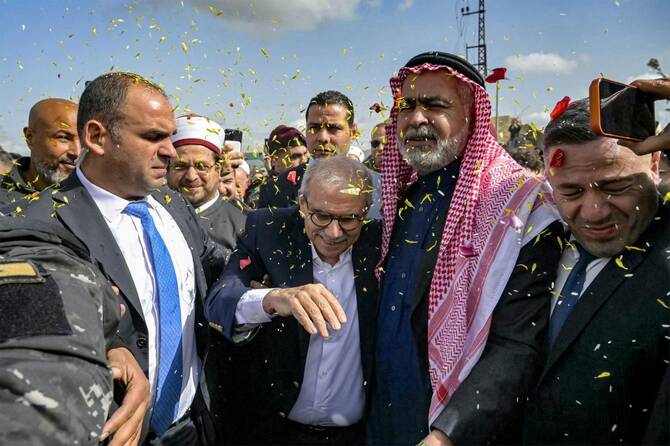
TAYR HARFA, Lebanon: Lebanese Prime Minister Nawaf Salam visited heavily damaged towns near the Israeli border on Saturday, pledging reconstruction.
It was his first trip to the southern border area since the army said it finished disarming Hezbollah there, in January.
Swathes of south Lebanon’s border areas remain in ruins and largely deserted more than a year after a US-brokered November 2024 ceasefire sought to end hostilities between Israel and the Iran-backed group.
Lebanon’s government has committed to disarming Hezbollah, and the army last month said it had completed the first phase of its plan to do so, covering the area between the Litani River and the Israeli border about 30 kilometers (20 miles) further south.
Visiting Tayr Harfa, around three kilometers from the border, and nearby Yarine, Salam said frontier towns and villages had suffered “a true catastrophe.”
He vowed authorities would begin key projects including restoring roads, communications networks and water in the two towns.
Locals gathered on the rubble of buildings to greet Salam and the delegation of accompanying officials in nearby Dhayra, some waving Lebanese flags.
In a meeting in Bint Jbeil, further east, with officials including lawmakers from Hezbollah and its ally the Amal movement, Salam said authorities would “rehabilitate 32 kilometers of roads, reconnect the severed communications network, repair water infrastructure” and power lines in the district.
Last year, the World Bank announced it had approved $250 million to support Lebanon’s post-war reconstruction, after estimating that it would cost around $11 billion in total.
Salam said funds including from the World Bank would be used for the reconstruction and rehabilitation projects.
The second phase of the government’s disarmament plan for Hezbollah concerns the area between the Litani and the Awali rivers, around 40 kilometers south of Beirut.
Israel, which accuses Hezbollah of rearming, has criticized the army’s progress as insufficient, while Hezbollah has rejected calls to surrender its weapons.
Despite the truce, Israel has kept up regular strikes on what it usually says are Hezbollah targets and maintains troops in five south Lebanon areas.
Lebanese officials have accused Israel of seeking to prevent reconstruction in the heavily damaged south with repeated strikes on bulldozers, excavators and prefabricated houses.
Visiting French Foreign Minister Jean-Noel Barrot on Friday said the reform of Lebanon’s banking system needed to precede international funding for reconstruction efforts.
The French diplomat met Lebanon’s army chief Rodolphe Haykal on Saturday, the military said.


![]()
Lebanon PM pledges reconstruction on visit to ruined border towns
Short Url
https://arab.news/ghxkt
Lebanon PM pledges reconstruction on visit to ruined border towns
- Visiting Tayr Harfa, around three kilometers from the border, and nearby Yarine, Salam said frontier towns and villages had suffered “a true catastrophe“
- He vowed authorities would begin key projects including restoring roads, communications networks and water in the two towns

Latest updates


© 2026 SAUDI RESEARCH & PUBLISHING COMPANY, All Rights Reserved And subject to Terms of Use Agreement.