

US condemns RSF drone attack on World Food Programme convoy in Sudan’s North Kordofan

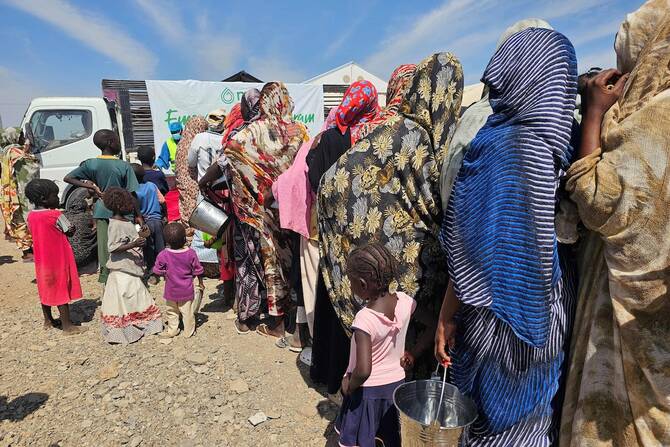
The conflict between Sudan’s army and the paramilitary Rapid Support Forces has killed tens of thousands, displaced 11 million and which the UN has described as one of the world’s worst humanitarian crises. (AFP file photo)
Short Url
Updated 07 February 2026
Follow

US condemns RSF drone attack on World Food Programme convoy in Sudan’s North Kordofan

  • ‘Destroying food intended for people in need and killing humanitarian workers is sickening’

WASHINGTON: The US condemned a drone attack Friday by the Rapid Support Forces (RSF) on a World Food Program (WFP) convoy in Sudan’s North Kordofan state that killed one person and injured three others.

“The United States condemns the recent drone attack on a World Food Program convoy in North Kordofan transporting food to famine-stricken people which killed one and wounded many others,” US Senior Adviser for Arab and African Affairs Massad Boulos wrote on X.

“Destroying food intended for people in need and killing humanitarian workers is sickening,” he wrote.


“The Trump Administration has zero tolerance for this destruction of life and of U.S.-funded assistance; we demand accountability and extend our condolences to all those affected by these inexcusable events and terrible war,” he added.

The Sudan Doctors Network said the convoy was struck by RSF drones in the Allah Karim area as it headed toward displaced people in El Obeid, the state capital.

The network described the attack as a “clear violation of international humanitarian law,” warning that it undermines efforts to deliver life-saving aid to civilians amid worsening humanitarian conditions across the country.

There was no immediate comment from the rebel group.

Of Sudan’s 18 states, the RSF controls all five states in the western Darfur region, except for parts of North Darfur that remain under army control. The army holds most areas of the remaining 13 states across the south, north, east and center of the country, including the capital, Khartoum.

The conflict between the army and the RSF, which erupted in April 2023, has killed thousands of people and displaced millions.


Israeli military says unintentionally struck UN agency truck in Gaza

Updated 07 March 2026
Follow

Israeli military says unintentionally struck UN agency truck in Gaza

  • “Our teams are taking extraordinary risks every day to keep humanitarian operations and life-sustaining services running,” UNOPS Executive Director Jorge Moreira da Silva said in ⁠a statement, calling for an investigation ‌into the incident

TEL AVIV: Israel’s ‌military said on Friday that a “firing component” launched by its navy unintentionally struck a fuel truck belonging ​to a United Nations agency in Gaza the previous day, an incident that prompted the agency to publicly call for a full investigation.
The United Nations Office for Project Services, which oversees fuel distribution in Gaza, said that the empty fuel truck ‌was struck ‌on Thursday around 5 ​a.m. ‌from ⁠the ​direction of the ⁠sea, causing damage to the vehicle. There were no injuries.
“Our teams are taking extraordinary risks every day to keep humanitarian operations and life-sustaining services running,” UNOPS Executive Director Jorge Moreira da Silva said in ⁠a statement, calling for an investigation ‌into the incident.
“They ‌should not have to do ​that under fire,” ‌he said.
In response to Reuters questions, ‌the Israeli military said that the incident occurred during defensive naval activity, and that a firing component deviated from its intended trajectory.
The fuel truck ‌sustained “minor damage,” the military said in a statement. The military did not ⁠say ⁠what type of munitions had been fired, or what had been the navy’s intended target.
“The incident was reviewed, and lessons were learned accordingly,” it said, without providing further details.
The fuel truck had been on its way to the Kerem Shalom crossing when it was struck, and the truck’s movements had been coordinated with Israeli ​authorities in advance, ​UNOPS said.