

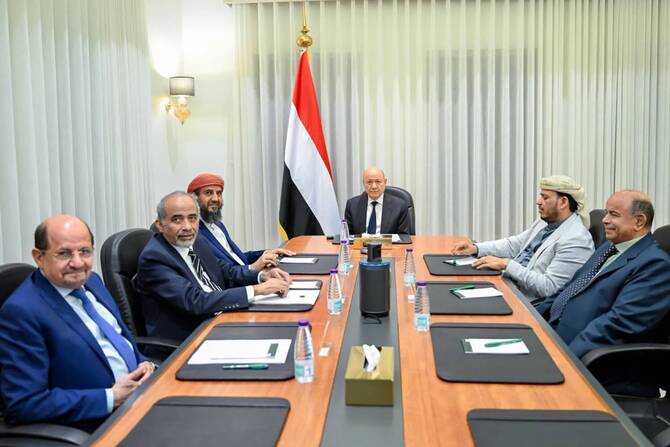

LONDON: Yemen’s newly formed government has drawn positive attention for granting key sovereign and revenue-generating ministries to figures from the country’s southern governorates, a move widely seen as an attempt to reflect political realities on the ground and address long-standing regional grievances.
Under the new cabinet lineup announced by Prime Minister Dr. Shaea’ Al-Zandani, several strategic portfolios — including finance, oil and minerals, transport, public works, electricity, and planning — have gone to ministers originating from southern and eastern regions, reinforcing the government’s message of inclusivity and national partnership at a critical moment in Yemen’s political trajectory.
The distribution of portfolios represents one of the clearest acknowledgments yet of the south’s central role in the country’s economic and administrative future, particularly as the government seeks to stabilize institutions, revive revenues and rebuild confidence in the state amid protracted conflict.

At the heart of the cabinet formation, officials stated, was the prime minister’s emphasis on nominating national experts based on competence rather than political affiliation. According to government sources, Al-Zandani sought to prioritize professional track records, administrative experience and technical expertise, while also ensuring a degree of social and geographic balance across Yemen’s diverse regions.
This approach marks a departure from previous cabinets that were often shaped primarily by political quotas, with the new government presenting itself as more technocratic in nature — a cabinet designed to manage recovery, reform and service delivery rather than factional competition.
The cabinet has also garnered media attention as it is the first time since 2014 that women have taken influential ministerial roles in a Yemeni government. The inclusion of women, alongside a noticeable presence of younger ministers and officials, has been widely interpreted as a symbolic and practical shift toward renewal within Yemen’s political class.
In particular, the appointment of a dedicated minister of women’s affairs has been highlighted as a significant step, underscoring the government’s stated recognition of women as half of society and its commitment to strengthening their participation in decision-making processes.
Officials argue that the move sends a clear signal that women’s issues are no longer treated as peripheral, but as a core component of governance, social protection and development policy.

Under the new cabinet lineup announced by Prime Minister Dr. Shaea’ Al-Zandani, several strategic portfolios have gone to ministers originating from southern and eastern regions. (SABA)
Beyond symbolism, the new cabinet features several fresh faces whose professional biographies have drawn attention. Among them are ministers with extensive academic backgrounds, long careers in public administration, international experience in finance, energy and development, and technocrats known for their work in institutional reform, infrastructure and service delivery.
Taken together, the appointments reflect an effort to combine experience with renewal, and regional representation with national outlook — a balance the government hopes will enhance its credibility at home and abroad.
While challenges remain formidable, particularly as the conflict drags on and economic pressures mount, the composition of the new cabinet suggests an attempt to reset governance priorities in Yemen, placing competence, inclusion and regional balance at the center of the state-building agenda.
Whether this approach translates into tangible improvements on the ground will depend less on symbolism and more on the government’s ability to turn expertise into action.


