

Syria, Russia discuss developing military cooperation

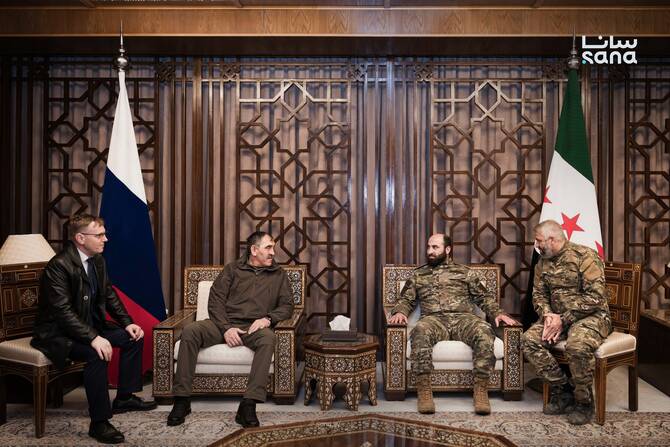
Syria’s Chief of General Staff Maj. Gen. Ali Al-Naasan and the Russian Deputy Defense Minister Yunus-Bek Yevkurov met in Damascus. (SANA)
Short Url
Updated 04 February 2026
Follow

Syria, Russia discuss developing military cooperation

  • Russian Deputy Defense Minister Yunus-Bek Yevkurov is visiting Syria to develop military cooperation

LONDON: Syria’s Chief of General Staff Maj. Gen. Ali Al-Naasan discussed military issues with Russian Deputy Defense Minister Yunus-Bek Yevkurov and his delegation on Wednesday.

Yevkurov is visiting Syria for several days to develop military cooperation that serves the common interests of both countries, according to Syria’s Defense Ministry.

In June, Syrian Defense Minister Maj. Gen. Murhaf Abu Qasr, Foreign Minister Asaad Al-Shaibani and General Intelligence Director Hussein Salameh met in Moscow with Russian Defense Minister Andrey Belousov to discuss bilateral cooperation.

Russia was a strong supporter of Bashar Assad’s former regime and played a crucial role in 2015 in halting the territorial gains of rebels during the Syrian conflict. In December 2024, it assisted Assad in fleeing the country to Moscow from Khmeimim air base near the coastal city of Latakia.

The new administration in Damascus, led by President Ahmad Al-Sharaa, has met Russian officials, including President Vladimir Putin, on several occasions to maintain ties with Russia and serve Syrian interests.


In major policy shift on Syria, UN Security Council lifts sanctions on Hayat Tahrir Al-Sham

Updated 28 February 2026
Follow

In major policy shift on Syria, UN Security Council lifts sanctions on Hayat Tahrir Al-Sham

  • Move reflects evolving Syrian political landscape in the post-Assad era, ending a global freeze on assets, travel ban and arms embargo

NEW YORK CITY: The UN Security Council on Friday removed Al-Nusra Front, the militant group that evolved into Hayat Tahrir Al-Sham, from its so-called Daesh and Al-Qaeda Sanctions List.

The move signals a major shift in international policy toward Syria’s evolving political landscape in the post-Assad era, and ends a global freeze on assets, travel ban and arms embargo that have been imposed on the group since 2014.

Al-Nusra Front and Hayat Tahrir Al-Sham were led by Ahmad Al-Sharaa, formerly Abu Mohammed Al-Julani, who is now Syria’s president and was a leading figure in the offensive that toppled the Assad regime.

The consensus decision by the Security Council’s sanctions committee was announced by the UK, which holds the presidency of the Security Council this month and was acting in the absence of the chair of the committee. It followed a request by the new Syrian authorities to delist “Al-Nusrah Front for the People of the Levant.”

The decision means measures that were applied to Hayat Tahrir Al-Sham under Security Council Resolution 2734, adopted in 2024, no longer apply. As a result, UN member states are notrequired to freeze the group’s funds, restrict the movement of its representatives, or block the supply or transfer of arms and related materiel.

Al-Nusra Front was added to the sanctions list for its ties to Al-Qaeda and involvement in the financing and execution of militant activities during the war in Syria. The UN initially continued to treat the group’s successor organization, Hayat Tahrir Al-Sham, as a listed alias.

Al-Sharaa has said the group severed all prior transnational jihadist links and is now solely focused on local Syrian matters.