

Jordanian anti-drugs authorities arrest 35 suspects in nationwide raids

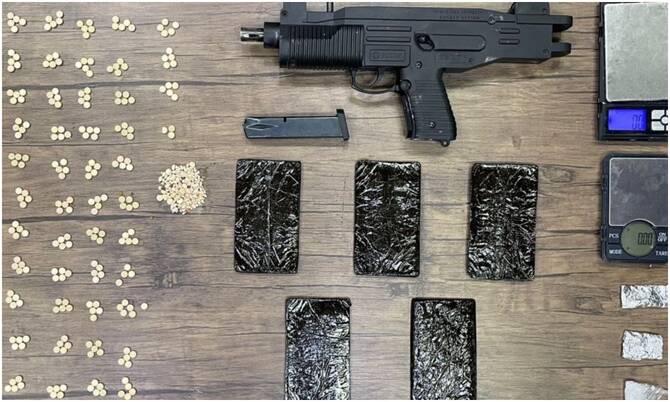
The suspects are linked to 13 criminal cases involving drugs and weapons. (Cropped image / X / @Police_Jo)
Short Url
Updated 01 February 2026
Follow

Jordanian anti-drugs authorities arrest 35 suspects in nationwide raids

  • Public Security Directorate said suspects are linked to 13 criminal cases involving drugs and weapons
  • In the capital, Amman, authorities handled seven major drug-related cases

LONDON: The Jordanian Anti-Narcotics Department arrested 35 suspects nationwide for drug production, dealing and smuggling, while seizing large quantities of drugs and firearms.

The Public Security Directorate on Sunday said that the suspects are linked to 13 criminal cases involving drugs and weapons, the Petra news agency reported.

Security forces conducted raids targeting drug dealers and promoters in several governorates, including Ma’an, where 10 wanted dealers were arrested. Additionally, two dealers were apprehended in Zarqa, and four suspects were arrested in Ajloun. The security forces in the southern Shouneh district raided three locations, arresting two suspects involved in marijuana cultivation.

In Amman, authorities handled seven major cases. A drug dealer was arrested with 17,000 narcotic pills, another with 18 blocks of hashish, and three traffickers were caught after a chase, resulting in the seizure of five blocks of hashish, 500 narcotic pills, crystal meth, and a firearm.

The fourth case in Amman led to the seizure of 1.25 kilograms of crystal meth, while the fifth resulted in the arrest of two traffickers with 14 blocks of hashish. In the sixth case, four dealers were arrested with 5 kg of marijuana, and the final case involved the seizure of six blocks of hashish from a dealer.

Authorities raided a site in the Ramtha District used by a drug dealer for distributing crystal meth. They arrested the suspect and seized 1.5 kg of the substance. In Mafraq, authorities arrested three drug promoters who were found with 4,000 narcotic pills after being tracked and raided.


Algeria inaugurates strategic railway to giant Sahara mine

President Tebboune attended an inauguration ceremony in Bechar. (AFP file photo)
Updated 02 February 2026
Follow

Algeria inaugurates strategic railway to giant Sahara mine

  • The mine is expected to produce 4 million tons per year during the initial phase, with production projected to triple to 12 million tons per year by 2030
  • The project is financed by the Algerian state and partly built by a Chinese consortium

ALGEIRS: Algerian President Abdelmadjid Tebboune on Sunday inaugurated a nearly 1,000-kilometer (621-mile) desert railway to transport iron ore from a giant mine, a project he called one of the biggest in the country’s history.
The line will bring iron ore from the Gara Djebilet deposit in the south to the city of Bechar located 950 kilometers north, to be taken to a steel production plant near Oran further north.
The project is financed by the Algerian state and partly built by a Chinese consortium.
During the inauguration, Tebboune described it as “one of the largest strategic projects in the history of independent Algeria.”
This project aims to increase Algeria’s iron ore extraction capacity, as the country aspires to become one of Africa’s leading steel producers.
The iron ore deposit is also seen as a key driver of Algeria’s economic diversification as it seeks to reduce its reliance on hydrocarbons, according to experts.
President Tebboune attended an inauguration ceremony in Bechar, welcoming the first passenger train from Tindouf in southern Algeria and sending toward the north a first charge of iron ore, according to footage broadcast on national television.
The mine is expected to produce 4 million tons per year during the initial phase, with production projected to triple to 12 million tons per year by 2030, according to estimates by the state-owned Feraal Group, which manages the site.
It is then expected to reach 50 million tons per year in the long term, it said.
The start of operations at the mine will allow Algeria to drastically reduce its iron ore imports and save $1.2 billion per year, according to Algerian media.