PIA owner says airline in talks with Boeing as privatization deal formally concludes

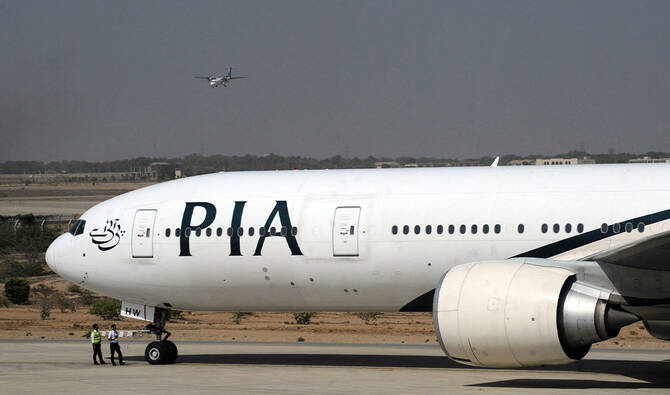
A London-bound state-run Pakistan International Airlines (PIA) plane taxies before take-off from Karachi International Airport in Karachi on April 21, 2010. (AFP)
Short Url
Updated 29 January 2026
Follow

PIA owner says airline in talks with Boeing as privatization deal formally concludes

  • PIA’s new owner Arif Habib vows to improve service delivery for passengers, buy new planes in days ahead 
  • Arif Habib Group secured 75 percent stake in PIA last month for $482 million after several rounds of bidding

ISLAMABAD: The new owner of the Pakistan International Airlines (PIA) said on Thursday that the airline was in talks with aerospace manufacturer Boeing as he vowed to expand its current fleet and ensure service revamp as the government formally concluded its privatization process.

A Pakistani consortium led by the Arif Habib Group secured a 75 percent stake in the PIA last month for Rs135 billion ($482 million) after several rounds of bidding, valuing the airline at Rs180 billion ($643 million). Pakistan had previously attempted to reform the debt-ridden airline, which had accumulated more than $2.8 billion in financial losses over the years. 

The Pakistani government and the Arif Habib Consortium signed the transaction documents for the PIA’s privatization during a televised ceremony in Islamabad. The event was attended by Prime Minister Shehbaz Sharif, senior cabinet members and Chief of Defense Forces Field Marshal Syed Asim Munir. 

“The money that will go into the airline will improve its services, new planes will be bought and you will see a big difference very soon,” Arif Habib, the chairman of the consortium, said. 

“We have held a very extensive meeting with Boeing, we are holding a meeting with Airbus tomorrow (Friday). We are also exploring other options,” he added. 

Habib vowed the airline will meet the prime minister’s expectations as far as the PIA’s performance is concerned, saying the government’s patronage would be “critical.”

Sharif congratulated the nation on the signing of the transaction documents, hoping Habib and his team would ensure PIA improves its performance, punctuality, cabin service and ground service in the days to come. 

Once considered among Asia’s leading carriers, PIA struggled with chronic mismanagement, political interference, overstaffing, mounting debt and operational issues that led to a 2020 ban on flights to the European Union, UK and the US after a pilot licensing scandal. The EU and the UK lifted the bans, providing fresh momentum to the carrier.

In an exclusive interview to Arab News last month, Habib said PIA’s new management plans to more than triple its fleet to 64 aircraft from the existing 19 in up to eight years.

He also said the consortium may look to buy the government’s remaining 25 percent stake and offer part of it to a “strategic investor,” preferably a foreign airline, to make PIA more competitive.


Pakistan’s Mahnoor Omer named among TIME’s ‘Women of the Year’ for 2026

Updated 01 March 2026
Follow

Pakistan’s Mahnoor Omer named among TIME’s ‘Women of the Year’ for 2026

  • Omer moved a Pakistani court against the so-called ‘period tax’ in Sept. 2025 which has since sparked a national debate
  • Taxes on sanitary pads in Pakistan can add up to 40 percent to retail price, UNICEF says only around 12 percent women use such products

ISLAMABAD: Pakistani women’s rights activist Mahnoor Omer, who fought against taxes on menstrual products, has been named among the TIME magazine’s ‘Women of the Year’ for 2026.

Omer’s efforts have been recognized alongside 16 activists, artists, athletes and businesswomen in the TIME’s Women of the Year 2026 list, including Olympic gold medalist Sydney McLaughlin-Levrone and Oscar-nominated filmmaker Chloe Zhao.

Dissatisfied with the efforts to educate Pakistani girls about sexual violence, Omer founded the Noor Foundation at the age of 14 and held her own workshops with village girls about everything from climate change to menstruation, according to the TIME magazine.

Two years later, a conversation with a domestic worker about the price of pads made her realize that not everyone could afford these essentials. She moved a court against the so-called “period tax” in Sept. 2025 and the case has sparked a national debate on the subject, considered a taboo by many in Pakistan, since its first hearing late last year.

“A decade and one law degree after her interest in activism was sparked, Omer, now 25, is putting her passion and expertise to work in the name of gender equity,” TIME wrote about Omer on its website.

Taxes imposed on sanitary products in Pakistan can add up to 40 percent to the retail price. UNICEF estimates just 12 percent of women in the country use commercially produced pads or tampons. The alternative, using cloth, risks health impacts including rashes and infections, and can make it impossible for girls to attend school while menstruating.

Omer’s suit, which awaits the government response, has sparked a national discussion. She says she spoke about menstruation to her father and male cousins, who thanked her for standing up for their daughters.
The 25-year-old, who is currently enrolled in a master’s degree in gender, peace, and security at the London School of Economics, sees this case as just the first of many.

“I’m not free until every woman is free,” she was quoted as saying by TIME. “I want to leave no stones unturned in terms of what I can do with the next few decades, as a lawyer for the women in my country and gender minorities in general.”