

Nearly 60% of employers have difficulty finding skilled workers, World Bank official says

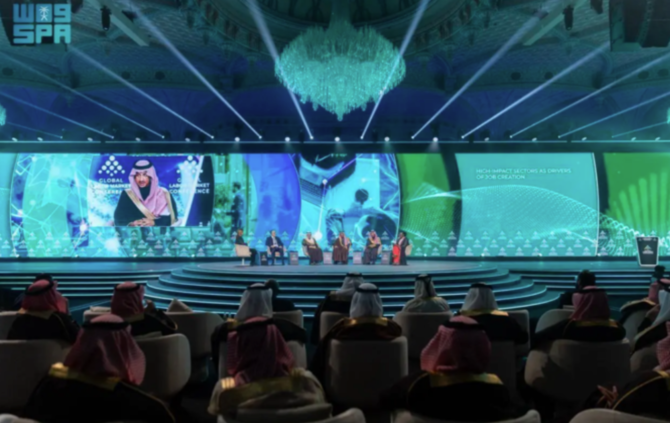
Skill shortages remain a major constraint on business growth, said a World Bank official on the sidelines of the Global Labor Market Conference in Riyadh. (SPA)
Short Url
Updated 28 January 2026
Follow

Nearly 60% of employers have difficulty finding skilled workers, World Bank official says

  • Luis Benveniste: We find that people lack opportunities to upskill or reskill in a rapidly changing labor market
  • Benveniste: There won’t be a jobs revolution without a skills revolution

RIYADH: Skill shortages remain a major constraint on business growth, with nearly 60 percent of employers reporting difficulty finding workers with relevant skills and capabilities, a World Bank official told Arab News.

On the sidelines of the Global Labor Market Conference in Riyadh on Tuesday, Luis Benveniste, senior adviser and acting global director for education and skills at the World Bank, said: “We find that people lack opportunities to upskill or reskill in a rapidly changing labor market, because of automation, because of digital transformation, because of climate change, jobs are changing, and so people are not able to acquire the skills that are relevant.”

He said that an estimated 70 percent of children in low and middle income countries are unable to read an age-appropriate paragraph with comprehension by the age of 10, making it harder to develop job-relevant skills later in life.

“In the absence of those foundational skills, it’s much harder to get those job-relevant skills that will enable them to open up to a fruitful, thriving career,” Benveniste said, adding that the gap often becomes more pronounced as young people enter the labor market.

He said addressing the challenge begins with expanding access to high-quality early childhood education, including proper nutrition and learning stimulation, and supporting teachers to use evidence-based teaching methods to strengthen literacy and numeracy.

He also pointed out the importance of closer coordination between governments, educators, and employers to better align training with labor market demand.

This includes engaging the private sector in curriculum development, improving labor market data systems, and expanding opportunities for apprenticeships and on-the-job training.

“More and more we see results-based financing approaches so that skilling institutions get rewarded not just for training people, but for ensuring that people who have been trained find jobs and hold those jobs six to 12 months after finalizing their training programs,” he said.

Benveniste highlighted the role of short-cycle training and micro-credentials, which allow workers to step in and out of the labor market to build flexible, stackable qualifications over time, helping them move up the job ladder.

He said that improved access to scholarships and training loans is also needed to ensure low-income learners are not excluded.

Tackling unemployment, particularly among youth and women, will require sustained collaboration between the public and private sectors, he said, adding that neither can respond to the scale of labor market change alone.

“There won’t be a jobs revolution without a skills revolution,” Benveniste said, emphasizing the need to invest in priority growth sectors such as manufacturing, agribusiness, and healthcare to ensure workers gain the capabilities required for the jobs of the future.

Speaking to Arab News, Samer Al-Kharashi, director of the UN Tourism Regional Office for the Middle East, said tourism has become a key tool for rural development and job creation, noting that a large share of the world’s poorest populations live in rural areas and are more likely to be in informal or vulnerable employment.

“Eighty-four percent of the world’s poor live in rural areas, (and) those people are twice as likely to be in informal or vulnerable employment.

“If you compare that 80 percent of them versus 44 percent in urban areas, that means that there is very important area that needs the focus of the mutual work from governments, international organizations and private sectors.”

Al-Kharashi said expanding tourism in rural regions can help create jobs, empower women and youth and support small and medium enterprises, but that it requires capacity-building, training, infrastructure and entrepreneurship support, alongside the adoption of digital and sustainable tools, including artificial intelligence.

He said the Kingdom’s tourism sector offers strong potential for Saudi entrepreneurs and SMEs, noting that local knowledge, culture, and technology skills are key assets for attracting visitors seeking authentic experiences.

“One of every 10 jobs is in tourism,” Al-Kharashi said, adding that the sector has moved from a recovery phase into a period of sustained expansion and growth, creating new opportunities in different segments of the industry.

“We can see that in numbers, tourism to national numbers have been raised in 2025 to 1.52 billion, with an increase of 4 percent from last year. So the sector is booming very strong. A lot of opportunities (are) coming. We can see that in depth.” 

He said the tourism industry is largely driven by the private sector, with governments and national organizations playing a regulatory and enabling role to ensure that development preserves the environment and supports the empowerment of women and youth.


Saudi Arabia witnessing comprehensive cultural development, says expert

Updated 14 February 2026
Follow

Saudi Arabia witnessing comprehensive cultural development, says expert

  • Clotilde Entrecanales of Acciona hails pace of change in Kingdom

JEDDAH: Museums, exhibitions and art centers play a crucial role in the development of free and educated societies such as the one now burgeoning in Saudi Arabia, an expert has told Arab News.

Clotilde Entrecanales, the Spanish art historian and cultural executive who heads Acciona Living & Culture, a leading creator of technology-driven interactive museums, exhibits and events, said the Kingdom is making efforts to expand the role of culture development to show the world the greatest possible cultural offer.

She added that the Kingdom has quickly infused new energy into the region, and is rapidly establishing itself as a global cultural hub through massive investment in world-class museums, public art and international events, aligning with its 2030 vision.

She said: “With around 70 percent of the population under 30, cultural consumption looks very different than in Europe or the US. These spaces can’t feel like quiet, isolated institutions … they need to be fast, dynamic, brave and deeply connected to the city, blending into everyday urban life rather than sitting apart from it.”

Asked about the role of these sites in the evolving global cultural landscape, particularly in emerging cultural hubs like Saudi Arabia, Entrecanales said: “Our vision is to be a purpose-led partner for cultural and entertainment institutions, helping them be more relevant, connected, inclusive and sustainable.”

She added: “In emerging cultural hubs like Saudi Arabia, that approach feels especially relevant. The cultural transformation underway is moving fast — with major heritage and cultural destinations being developed and opened to the world.”

Speaking about her impression of the Kingdom’s approach to blending heritage with modernity face, Entrecanales said: “Others who attempt to achieve this balance often end up turning heritage into a theme, a layer of storytelling or a cultural program. What feels different about Saudi’s approach is how much pressure there is to treat heritage as the foundation, not just the surface.

“When you’re building at this speed and scale, there’s always a risk that history becomes a backdrop instead of a backbone. The projects that work best are the ones that slow down just enough to let the past set the rhythm for the present.”

Regarding opportunities and challenges, she said: “The opportunity is nothing less than positioning Saudi Arabia as a global cultural center. The challenge, as always, lies in balancing the speed and scale of that ambition with long-term sustainability and a sense of authenticity that remains credible and rooted.”

She added: “You can really feel this in places like the Islamic Arts Biennale, which shows hundreds of historical artefacts of the Islamic world, while re-framing them through contemporary scenography and designs by some of the best design studios in the world; or in AlUla, a world-class heritage site that hosts a major contemporary platform like Desert X, allowing ancient context and present-day artistic practice to coexist in a way that feels genuine.”

Under her guidance, ACCIONA Cultura aspires to create museums and cultural experiences that function as landmarks while fostering sustainable, inclusive and immersive interactions.

She elaborated on how the company is integrating technology, culture, and sustainability to preserve and promote the region’s cultural heritage: “We always start with human connection and storytelling: what’s the story, what should people leave with? Tech comes later.”

Recently, ACCIONA Cultura has been involved in significant projects in Saudi Arabia and is looking forward for more.

She said: “Right now, for example, we’re designing and curating a museum gallery where the entire space is shaped by the practice of a Saudi artist. Another example is the Net Zero exhibition at the King Abdulaziz Center for World Culture (Ithra), where we brought together Saudi and international artists to explore sustainability and our relationship with the planet, including voices like Dina Haddadin, Mohammed Al-Faraj, and Zahrah Al-Ghamdi.”

She added: “One of the projects I’m most proud of isn’t a museum, but our NEXT IN Summit, which we’ve hosted in two editions in our ACCIONA Campus in Madrid, highlighting the Kingdom’s unprecedented cultural momentum as it builds future-facing institutions with a startup mindset.”

About further collaboration with Saudi Arabia, she said: “Let’s just say … something’s definitely simmering in the kitchen.”

Commenting on being recognized among the Blooloop 50 Museum Influencers for 2025, she said: “It means a lot. More than anything, it feels like a nod to the years of teamwork and dedication behind Acciona Cultura, rather than to me personally.”