

Saudi minister emphasizes environment as key to public health, economic growth 

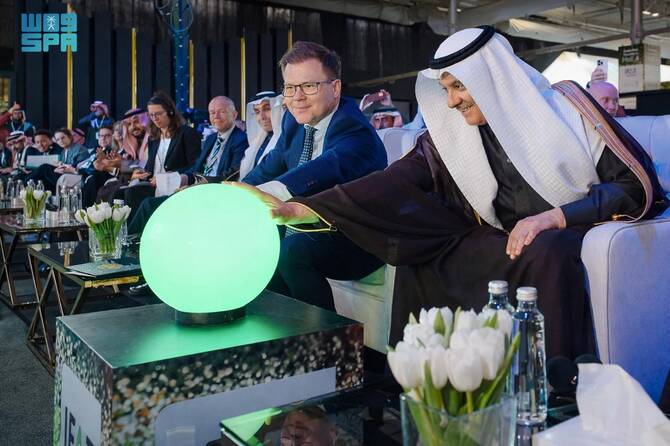
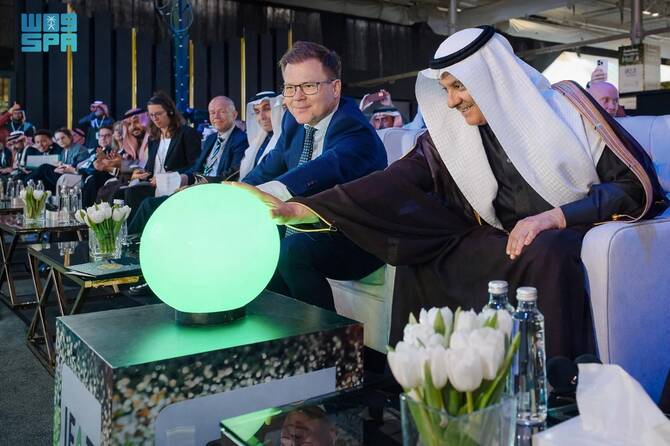
Minister of Environment, Water and Agriculture Abdulrahman Al-Fadhli opened the IFAT Saudi Arabia conference and exhibition in Riyadh. (SPA)
Short Url
Updated 27 January 2026
Follow

Saudi minister emphasizes environment as key to public health, economic growth 

  • Riyadh conference features more than 450 exhibitors from 35 countries displaying sustainability efforts 
  • Abdulrahman Al-Fadhli highlights Kingdom’s environmental achievements and Vision 2030 goals

RIYADH: Minister of Environment, Water and Agriculture Abdulrahman Al-Fadhli said Saudi Arabia considers the environment vital for public health and economic growth, noting that Vision 2030 has been key in revitalizing ecosystems and advancing sustainability in the Kingdom’s national transformation.

He made the remarks during the opening of the IFAT Saudi Arabia conference and exhibition in Riyadh, which brought together global leaders in the circular economy, decision-makers, and investors, highlighting Saudi Arabia’s role in promoting environmental action, knowledge exchange, and partnerships in water and waste management.

Running until Jan. 28, the exhibition focuses on waste management, environmental services, and water, presenting the latest technologies, solutions, and best practices, the Saudi Press Agency reported.

With more than 450 exhibitors from 35 countries and 10 national pavilions, the exhibition highlights the Kingdom’s role as a regional hub for environmental and sustainability sectors.

Visitors explore solutions in waste management, recycling, water treatment, and circular-economy applications, supporting the Kingdom’s sustainability goals and enhancing resource efficiency.

The minister noted significant advancements in the water sector, citing an integrated system covering production, transportation, distribution, treatment, and reuse, with a capacity exceeding 16 million cubic meters per day.

Saudi Arabia also operates one of the world’s largest water transport networks and currently reuses about 33 percent of treated water to support environmental sustainability and improve resource efficiency.

Al-Fadhli highlighted the achievements of the Saudi Green Initiative, which has rehabilitated more than 500,000 hectares of degraded land, planted more than 151 million trees, and expanded protected land and marine areas to about 18 percent, with a target of 30 percent by 2030.

He also noted the establishment of a national regulator for waste management and a comprehensive framework for the waste value chain. The sector offers more than 500 investment opportunities, projected to reach hundreds of billions of riyals over the next 25 years, supported by more than 900 facilities in the Kingdom.

Al-Fadhli expressed hope that the conference would foster partnerships and practical solutions, strengthen the waste management system, and advance the circular economy for a sustainable future.

The National Center for Waste Management signed several memoranda of understanding on the sidelines of IFAT Saudi Arabia to strengthen cooperation in waste management, sustainability, and circular economy practices.

The MoUs reflect the center’s efforts to expand strategic partnerships and enhance institutional integration in line with the Kingdom’s Vision 2030 goals to protect the environment, improve quality of life, and advance the circular economy.


Experimental farm in Al-Lith looks into future of Saudi Arabian agriculture

Updated 02 February 2026
Follow

Experimental farm in Al-Lith looks into future of Saudi Arabian agriculture

  • Research initiative reflects strategic transformation

JEDDAH: An experimental farm in Saudi Arabia’s Al-Lith Governorate is one of the research initiatives reflecting the strategic transformation taking place in the Kingdom’s agricultural sector.

The farm uses highly efficient, sustainable production models that combine scientific research with commercial application, contributing to strengthening the country’s food security system and the sustainability of water resources.

Located in the Ghumaiqa Center on an area of about 10 hectares, the cutting-edge farm is a testing platform for modern agricultural technologies that tackle the challenge of water scarcity.

The farm includes developed open fields and modern greenhouses, supported by smart irrigation encompassing drip and sprinkler irrigation alongside surface and subsurface technologies.

All the systems operate via smart controls that enable the monitoring of water consumption and ensure improved efficiency, thereby achieving a balance between agricultural production and water conservation.

The farm also uses treated and diluted low-salinity seawater.

It aims to diversify agricultural water sources, reduce reliance on freshwater, and open new horizons for agriculture in coastal and semi-arid environments.

A view of the experimental farm in Al-Lith. (SPA)

The project represents a promising investment opportunity in the field of smart agriculture, enabling the development of commercially scalable production models, particularly for high-value vegetables and fruits, while reducing operational costs associated with water and energy, enhancing the economic feasibility of future agricultural projects.

In addition, the project contributes to transferring and localizing agricultural expertise, supporting local food supply chains, and creating an attractive environment for agricultural investment.

This aligns with Sustainable Development Goals and enhances the efficiency of the private sector in adopting innovative agricultural solutions.

Yahya bin Abdulrahman Al-Mahabi, the director of the Ministry of Environment, Water and Agriculture office in Al-Lith Governorate, told the Saudi Press Agency that the project represented the future of agriculture in the Kingdom.

He explained that the vision was based on investing in technology, enhancing the return on water per unit, and integrating scientific research with investment opportunities.

Al-Mahabi spoke of the experimental farm as a modern, scalable and replicable model applicable in several regions of the Kingdom, particularly in coastal environments.

Al-Mahabi highlighted the Ministry of Environment, Water and Agriculture’s commitment to supporting distinctive projects that contributed to achieving food security while developing rural areas and enhancing agricultural production efficiency, in line with the objectives of the Kingdom’s Vision 2030.