

Pakistan’s maritime sector records $360 million profits in 2025 — minister

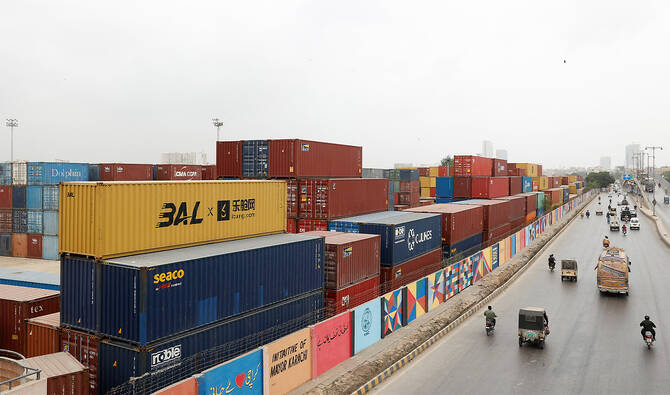
Vehicles move past a warehouse yard with shipping containers near port area in Karachi, Pakistan, on July 31, 2025. (REUTERS/File)
Short Url
Updated 24 January 2026
Follow

Pakistan’s maritime sector records $360 million profits in 2025 — minister

  • The reforms aimed to improve port efficiency, cut costs and implement long-delayed policies to position Pakistan as trade, logistics hub
  • In 2025, Karachi Port handled a record 54 million tons of cargo, while average vessel dwell time was cut by 24-36 hours, minister notes

KARACHI: Pakistan’s maritime sector posted a record Rs100 billion ($360 million) profit in 2025 following a year of sweeping reforms, Maritime Affairs Minister Junaid Anwar Chaudhry said on Saturday.

In recent years, Islamabad has taken a number of reforms to improve port efficiency, cut costs and cleared long-delayed policies to position the South Asian country as a regional trade and logistics hub.

Outlining his ministry’s annual performance, Chaudhry described 2025 as a “transformative year” marked by more than two dozen initiatives spanning legislation, digitization, infrastructure development and human resources.

In 2025, Karachi Port handled a record 54 million tons of cargo, while average vessel dwell time was cut by 24-36 hours through closer coordination among port authorities, customs and other agencies aimed at an average turnaround of five days, according to the minister.

“These reforms are modernizing our ports, shipping and fisheries to unlock the true potential of the blue economy,” the minister said, adding that Pakistan had aligned its regulatory framework with international standards, including conventions of the International Maritime Organization and the Hong Kong Convention on ship recycling.

He said a central plank of the overhaul was the finalization of the National Maritime Policy, which brings shipping, ports, fisheries and maritime security under a single framework to guide sustainable growth.

“The government also approved a National Shipping Policy aimed at expanding the Pakistan-flagged fleet to reduce reliance on foreign carriers, a longstanding drain on foreign exchange,” he added.

Pakistan concluded stakeholder consultations on the National Fisheries and Aquaculture Policy, which targets annual seafood exports of $2 billion and the creation of around two million jobs across coastal communities and allied industries, according to the minister.

Cost-cutting measures delivered substantial savings, Junaid Chaudhry said, and added: Reduced overtime at the Karachi Port Trust alone saved about Rs70 million a month, while the abolition of 2,152 redundant posts across maritime entities lowered human resource costs by billions of rupees.

“The Karachi Port Trust and the Port Qasim Authority reclaimed about 150 acres of encroached land valued at roughly Rs110 billion, while Port Qasim recovered an additional eight acres,” the minister stated.

Chaudhry said they introduced the Pakistan Maritime Century Framework 2047–2147 to advance the maritime sector, established an Artificial Intelligence Maritime Secretariat to monitor ports, shifted to paperless governance through a 100 percent e-office rollout, integrated the Pakistan Single Window with the Port Community System to streamline trade procedures, and introduced an electronic public asset disposal system to enhance transparency and efficiency.

The reform agenda supported several United Nations Sustainable Development Goals, including decent work and economic growth, industry and infrastructure, responsible consumption, life below water and strong institutions, according to the minister.

“Sustained implementation will be key to maintaining the momentum of these achievements, and the gains made in 2025 provide a strong foundation for turning Pakistan’s long coastline and strategic location into a durable blue economic advantage,” he added.


Pakistan, Canada explore deeper trade, mining and agriculture cooperation

Updated 5 sec ago
Follow

Pakistan, Canada explore deeper trade, mining and agriculture cooperation

  • The development comes as Pakistan seeks to boost trade, foreign investment to strengthen its more than $400 billion economy
  • Both sides reviewed the evolving global economic landscape, underscored the need for adaptive trade strategies, Islamabad says

KARACHI: Pakistani and Canadian officials have discussed ways to deepen cooperation in trade, mining and agriculture, the Pakistani commerce ministry said on Saturday, with both sides seeking to expand economic ties.

The statement came after Pakistani Commerce Minister Jam Kamal Khan’s meeting with Canadian High Commissioner to Pakistan Tarik Ali Khan that focused on expanding bilateral cooperation in trade, investment, mining, agriculture, energy and emerging sectors.

Pakistan, which is recovering from a prolonged economic meltdown under a $7 billion International Monetary Fund (IMF) program, has sought to boost trade, foreign investment to strengthen its more than $400 billion economy.

“During the meeting, both sides reviewed the evolving global economic landscape and underscored the need for adaptive trade strategies amid shifting supply chains and geopolitical realignments,” the Pakistani commerce ministry said in a statement.

“The federal minister emphasized Pakistan’s intent to diversify partnerships and attract quality foreign investment, particularly in value-adding and export-oriented sectors.”

A major focus of discussions was cooperation in the mining and minerals sector. Pakistan has vast mineral resources, including Reko Diq copper-gold mine, which is one of the world’s largest undeveloped mines.

The Reko Diq project, located in the Balochistan province, is also being developed by Canadian mining giant Barrick Gold in partnership with Pakistan’s federal and provincial governments.

Commerce Minister Khan highlighted Pakistan’s growing interest in developing small and medium-scale mining projects and stressed the importance of modern exploration techniques, surveying expertise and responsible mining governance.

“The Canadian high commissioner noted Canada’s global leadership in mining services and exploration technologies and expressed willingness to support Pakistan through capacity-building initiatives, technical assistance and business-to-business matchmaking,” the commerce ministry said.

“In this context, both sides discussed Pakistan’s participation in the Prospectors & Developers Association of Canada (PDAC) conference in Toronto, with an emphasis on linking Pakistani miners with reputable Canadian exploration companies and service providers.”

The meeting also covered agricultural cooperation, with particular reference to the recent resumption of Canadian canola exports to Pakistan, according to the statement. The two sides acknowledged the successful arrival of initial shipments and agreed to work closely on addressing regulatory and procedural bottlenecks to ensure smooth and timely imports.

“Discussions further explored potential cooperation in dairy and livestock development, including animal genetics, modern dairy farming technologies and disease-control mechanisms, aimed at enhancing productivity and quality standards in Pakistan,” the commerce ministry added.

“On the energy front, the Canadian High Commissioner raised issues related to Canadian investments in renewable energy projects in Pakistan and stressed the importance of regulatory predictability and timely approvals to sustain investor confidence. Both sides also reviewed progress on the Pakistan–Canada Bilateral Investment Treaty (BIT) and agreed on the need to maintain momentum in negotiations to encourage greater Canadian investment.”