

KFC Arabia and TBWA\RAAD’s Saudi campaign wins big at TikTok Ad Awards 2025

(Supplied)
Short Url
Updated 23 January 2026
Follow

KFC Arabia and TBWA\RAAD’s Saudi campaign wins big at TikTok Ad Awards 2025

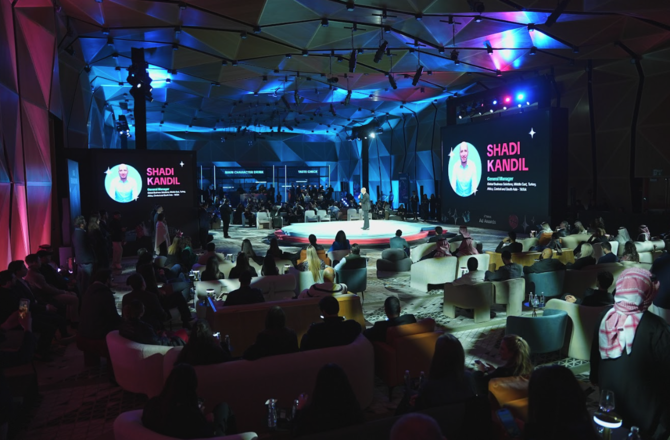
DUBAI: TikTok announced the winners of the TikTok Ad Awards 2025 at a ceremony held at the King Abdullah Financial District Conference Center in Riyadh on Wednesday, celebrating advertising campaigns on the platform from across the Middle East.

The top honor, G.O.A.T. (“Greatest of All Time”), which celebrates the best overall campaign combining creativity, media performance and proven effectiveness, went to the Saudi campaign “Om Bdr — 12th Ingredient,” developed by TBWA\RAAD for KFC Arabia.

The campaign was born out of Saudi user behavior on TikTok, which saw users dusting a seasoning created by a local cook named Om Bdr onto their KFC chicken. Picking up on this trend, KFC partnered with Om Bdr, adding her seasoning as its unofficial 12th spice.

Instead of focusing on trends or virality, the brand listened to its audience and “made the creator a partner,” said Ahmed Arafa, chief marketing officer at KFC Arabia.

He added: “This campaign was about respecting where the idea came from, crediting the community that discovered it, and turning cultural momentum into something real. Om Bdr’s seasoning belonged on our menu because our customers put it there first.”

The campaign emphasized authenticity, moving away from high-production studio shoots to filming inside actual KFC outlets, with minimal setup and featuring Om Bdr as herself.

As a result, KFC Arabia recorded its highest sales mix to date, while Om Bdr sold out of her own seasoning following the campaign.

“Om Bdr — 12th Ingredient” also won Gold in the Goal Digger category, which celebrates work that delivers measurable results, and Silver in the Community Core category, which highlights campaigns driven by creator and community collaborations.

The two firms also collaborated on another campaign, “Nuggets — Nugg it. Dip it. Crunch it.”, which ran across Saudi Arabia, the UAE and Qatar, and won Bronze in the Sound On category.

The campaign centered on a looping audio track paired with videos focusing on picking, dipping and eating a nugget.

TikTok said the campaign promoted creator participation, with users adapting and reworking the audio in ways that felt native to the platform.

Saudi-based creative agency Habbar’s campaign, “14 Feb: Judgement Day!”, for online gift delivery service Floward, won Silver in the Goal Digger category.

The campaign took a humor-led approach to reflect the pressure and last-minute decision-making often associated with Valentine’s Day gifting, using creator collaborations and video formats designed to encourage sharing and commenting.

Other notable campaigns included “My Like First” by Lux, which ran in Saudi Arabia and the UAE and won Gold in the Community Core category, as well as “How I Crunch It” by Bugles, created by MRM and UM, which won Bronze in the Sound On category.

“The Ad Awards winners of this year show what’s possible when brands embrace TikTok not just as a media platform, but as a creative canvas,” said Shadi Kandil, general manager of global business solutions for the Middle East, Turkiye, Africa, Central and South Asia at TikTok.


How media reshapes the rules of diplomacy

Updated 03 February 2026
Follow

How media reshapes the rules of diplomacy

  • International envoys discuss influence diplomacy, misinformation, and the growing need for credible storytelling
  • Dya-Eddine Said Bamakhrama: The Saudi Media Forum itself is a tool of influence diplomacy, projecting the Kingdom’s image and soft power to the world

RIYADH: As dialogue surrounding the media’s influence across all sectors continues at the fifth edition of the Saudi Media Forum, some of the Kingdom’s ambassadors took to the stage to discuss diplomacy in an age of greater transparency.

A major topic on the panelists’ minds was “influence diplomacy,” an evolution of traditional diplomacy shaped by modern realities, said Ambassador of Djibouti to the Kingdom and Dean of the Diplomatic Corps Dya-Eddine Said Bamakhrama.

Influence diplomacy draws on soft power, he said. It uses tools such as arts and culture, sports, education, and humanitarian work to serve political interests and enhance credibility.

According to Bamakhrama, Saudi Arabia harnesses that influence through international forums, cultural initiatives, and a growing global sports presence.

“The Saudi Media Forum itself is a tool of influence diplomacy, projecting the Kingdom’s image and soft power to the world,” he said. “When a child in Africa or Latin America wears the jersey of a Saudi football club, that is influence diplomacy reaching far beyond borders.”

South African Ambassador to the Kingdom Mogobo David Magabe added that every country seeks to project an image that accurately reflects its culture, values, and identity to the world through food, music, cinema, civil society engagement, and cultural exchange.

However, Magabe warned that influence diplomacy must respect legal frameworks, avoid interfering in internal affairs, and operate transparently and ethically.

Spain’s Ambassador to the Kingdom Javier Carbajosa Sanchez echoed those remarks in saying that influence diplomacy can be a positive tool when it is ethical, disciplined, and grounded in facts.

Media has historically played a generally positive role in shaping public opinion, he said. But the rise of digital platforms requires a more responsible hand.

Diplomatic communication must follow rules, training, and ethical limits. “Propaganda may work temporarily, but credibility is what endures,” Sanchez said.

The ambassadors also highlighted that media today, particularly digital media, was a key actor in diplomacy, not just an observer.

While credibility depends on truthful and consistent narratives, digital platforms also enable the rapid spread — and exposure — of falsehoods.

“In today’s connected world, lies are exposed faster than ever,” Bamakhrama added.

Propaganda-based diplomacy no longer survives in the age of digital transparency. Instead, an effective diplomatic narrative relies on diplomats and policymakers’ understanding of the audience’s mindset, honest and clear communication of facts, and giving the necessary context for events.

Truth, he said, does not always require full disclosure, but it does not tolerate deception.

And the truth is especially paramount during times of crisis. The ambassadors agreed that false narratives collapse during conflict, and unchecked narratives can escalate crises beyond control.

“During conflict, responsibility must be shared between governments and media institutions,” Sanchez said.

Misinformation, the speed of news cycles, and the pressure to respond instantly were cited by the South African ambassador as the biggest challenges facing influence diplomacy today.

Accurate storytelling weighed heavily on speakers’ minds in the forum, especially in an era when messages can diverge between digital and traditional media.

Many of the same concerns surfaced in “Television and Streaming Platforms: Conflict or Opportunity?”, a panel focused on journalism and broadcasting, where media leaders examined how misinformation and competition are reshaping television.

Tareq Al-Ibrahim, director of MBC 1 and MBC Drama Channels and chief content officer at MBC Shahid platform, said that social media is both a bridge and competitor to television.

“It allows us to reach wider and more diverse audiences, but it also competes for people’s time,” he said.

In addition to audiences being larger, more fragmented, and more demanding, news organizations must now not only compete with other newsrooms, but with every other form of content on social platforms.

Despite this, professional journalism still holds great value and reaches wide audiences — if it adapts.

Al-Ibrahim added that competition was essential, not just for platforms, but for the entire value chain: “From writers to cameramen to directors, competition raises everyone’s standards.”

He also pointed to the evolution of Arabic content over the last decade as driven by competition from Netflix, Shahid, and other regional and global platforms.

Amjad Samhan, head of social media at Al Arabiya news network, described what the network’s transition was like from television to social media.

The challenge, he said, was figuring out how to deliver news to people who are not actively looking for news.

One solution was to transform long-form TV content into fast, digital formats. “We built a parallel digital newsroom with the same standards and principles,” Samhan shared.

When the question of social media influencers was brought up, Samhan argued: “The real competition is not with influencers. It’s with low-quality content. Credibility is what distinguishes news institutions from content creators.”

Journalism is built on trust, resources, and responsibility while influencers often lack verification and accountability, he said.

Reflecting on what the rise of digital platforms means for television, Al-Ibrahim said they are not alternatives, but complementary partners.

“Television creates shared moments; platforms create personalized experiences,” and the average consumer could greatly benefit from both.