Saudi Arabia ‘ideal partner’ in shaping next wave of intelligent age, communication minister tells WEF

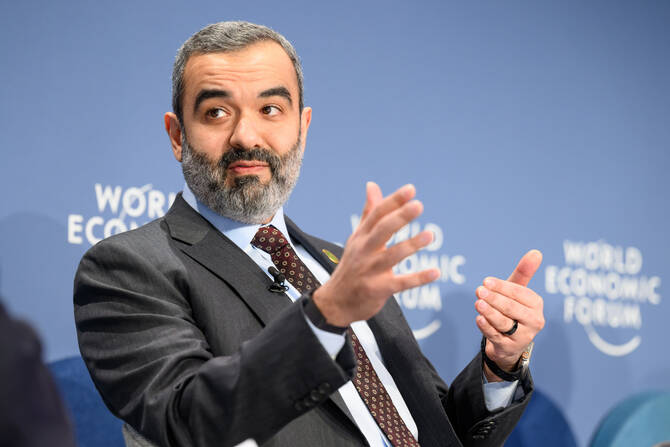
Abdullah Al-Swaha, Saudi minister of communication and information technology, was speaking during a panel discussion at the World Economic Forum in Davos. (WEF/SBlaser)
Short Url
Updated 23 January 2026
Follow

Saudi Arabia ‘ideal partner’ in shaping next wave of intelligent age, communication minister tells WEF

  • Abdullah Al-Swaha said aim was to “help the world achieve the next $100 trillion by energizing the intelligence age”

DAVOS: Saudi Arabia has accelerated efforts in “energizing the intelligent age,” making the Kingdom the world’s ideal partner in shaping the next wave of the technological age, said the minister of communication and information technology.

Speaking during a panel discussion at the World Economic Forum in Davos, Abdullah Al-Swaha said the aim was to “help the world achieve the next $100 trillion by energizing the intelligence age.”

He said the Kingdom was expanding global partnerships for the benefit of humanity and highlighted both local and international achievements.

“We believe the more prosperous the Kingdom, the Middle East, is, the more prosperous the world is. And it is not a surprise that we fuel 50 percent of the digital economy in the kingdom or the region,” he told the audience. He added the Kingdom fueled three times the tech force of its neighbors and, as a result, 50 percent of venture capital funding.

Al-Swaha said Saudi Arabia was focused both on artificial intelligence acceleration and adoption. At home, he said, the Kingdom was doubling the use of agentic AI in the public and private sector to increase worker productivity tenfold. He also cited the world’s first fully robotic heart transplant, which was conducted in Saudi Arabia.

“If we double down on talent, technology, and build trust with partners, we can achieve success,” he said. “And we are following the same blueprint for the intelligence age.”

He said the Kingdom aimed to be a “testbed” for innovators and investors. Rapid technological adoption and investment have boosted Saudi Arabia’s non-oil economy, with non-oil activities accounting for 56 percent of GDP and surpassing $1.2 trillion in 2025, ahead of the Vision 2030 target.

In terms of adoption, Al-Swaha said the Kingdom had introduced the Arabic-language AI model, Allam, to be adopted across Adobe product series. It has also partnered with Qualcomm to bring the first hybrid AI laptop and endpoints to the world.

“These are true testimonies that the kingdom is not going local or regional; we are going global,” he said.


OpenAI’s Altman says world ‘urgently’ needs AI regulation

Updated 12 sec ago
Follow

OpenAI’s Altman says world ‘urgently’ needs AI regulation

  • Sam Altman, head of ChatGPT maker OpenAI, told a global artificial intelligence conference on Thursday that the world “urgently” needs to regulate the fast-evolving technology
NEW DELHI: Sam Altman, head of ChatGPT maker OpenAI, told a global artificial intelligence conference on Thursday that the world “urgently” needs to regulate the fast-evolving technology.
An organization could be set up to coordinate these efforts, similar to the International Atomic Energy Agency (IAEA), he said.
Altman is one of a host of top tech CEOs in New Delhi for the AI Impact Summit, the fourth annual global meeting on how to handle advanced computing power.
“Democratization of AI is the best way to ensure humanity flourishes,” he said on stage, adding that “centralization of this technology in one company or country could lead to ruin.”
“This is not to suggest that we won’t need any regulation or safeguards,” Altman said.
“We obviously do, urgently, like we have for other powerful technologies.”
Many researchers and campaigners believe stronger action is needed to combat emerging issues, ranging from job disruption to sexualized deepfakes and AI-enabled online scams.
“We expect the world may need something like the IAEA for international coordination of AI,” with the ability to “rapidly respond to changing circumstances,” Altman said.
“The next few years will test global society as this technology continues to improve at a rapid pace. We can choose to either empower people or concentrate power,” he added.
“Technology always disrupts jobs; we always find new and better things to do.”
Generative AI chatbot ChatGPT has 100 million weekly users in India, more than a third of whom are students, he said.
Earlier on Thursday, OpenAI announced with Indian IT giant Tata Consultancy Services (TCS) a plan to build data center infrastructure in the South Asian country.