

Israeli strike kills 3 journalists in Gaza, as media watchdog reports near-record number in jail

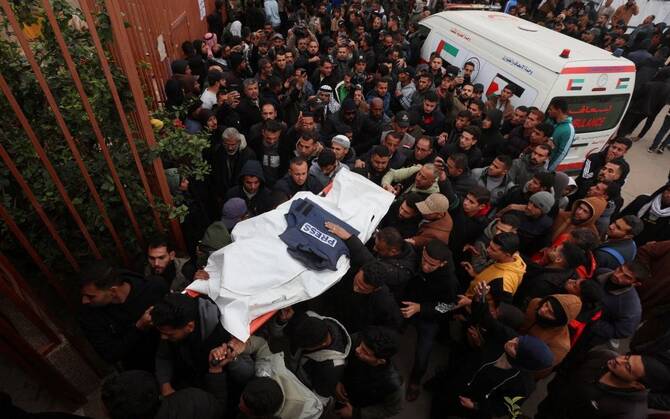
Mourners carry the body of one of the Palestinian journalists killed in an Israeli airstrike, Khan Younis, southern Gaza Strip, Jan. 21, 2026. (Reuters)
Short Url
Updated 21 January 2026
Follow

Israeli strike kills 3 journalists in Gaza, as media watchdog reports near-record number in jail

  • Mohammed Salah Qashta, Abdul Raouf Shaat and Anas Ghneim were using a drone camera to document aid distribution when a vehicle was targeted
  • Deaths coincide with publication of a Committee to Protect Journalists report that reveals 330 journalists are imprisoned worldwide

LONDON: An Israeli airstrike killed three journalists in Gaza on Wednesday, the territory’s civil defense agency said. Their deaths came as a report revealed the number of journalists imprisoned worldwide remains close to a record high.

The agency said the bodies of Mohammed Salah Qashta, Abdul Raouf Shaat and Anas Ghneim were taken to Al-Aqsa Martyrs Hospital in Deir Al-Balah following the airstrike in Al-Zahra, southwest of Gaza City.

Shaat had regularly contributed photographs and video footage to Agence France-Presse, though he was not on assignment at the time, the news agency said.

The Israeli military said its troops had identified “several suspects who operated a drone affiliated with Hamas” in central Gaza and attacked them because of the threat they posed. The details were under review, it added.

An eyewitness said the journalists were using a drone to document the distribution of aid by the Egyptian Relief Committee in the Gaza Strip when a strike hit one of the committee’s vehicles.

“A vehicle belonging to the Egyptian Committee was targeted during a humanitarian mission, resulting in the martyrdom of three individuals,” said Mohammed Mansour, a spokesperson for the organization.

All vehicles belonging to the committee bear its logo, he added, and he accused Israeli soldiers of “criminally” targeting the vehicle.

Meanwhile, a newly published report by the Committee to Protect Journalists stated that as of Dec. 1, 2025, 330 journalists were imprisoned worldwide, down from a record 384 at the end of 2024 but still close to historic highs.

Israel, which is holding 29 journalists, all of them Palestinians, ranked third on the list of countries with the most detained media workers, after China (50) and Myanmar (30). Nearly one in five jailed journalists reported they had been subjected to torture or beatings.

“Autocracies and democracies alike are locking up journalists to quash dissent and stifle independent reporting,” the committee’s CEO, Jodie Ginsberg, said.

The Hamas-run health ministry in Gaza said Israeli forces had killed at least 466 Palestinians since the ceasefire agreement took effect in November. The Committee to Protect Journalists reported that 127 journalists and other media workers were killed in the course of their work during 2025, the vast majority of them in Gaza.

* With agencies


UAE outlines approach to AI governance amid regulation debate at World Economic Forum

Updated 22 January 2026
Follow

UAE outlines approach to AI governance amid regulation debate at World Economic Forum

  • Minister of State Maryam Al-Hammadi highlights importance of a robust regulatory framework to complement implementation of AI technology
  • Other experts in panel discussion say regulators should address problems as they arise, rather than trying to solve problems that do not yet exist

DUBAI: The UAE has made changes to 90 percent of its laws in the past four years, Maryam Al-Hammadi, minister of state and the secretary-general of the Emirati Cabinet, told the World Economic Forum in Davos on Wednesday.

Speaking during a panel discussion titled “Regulating at the Speed of Code,” she highlighted the importance of having a robust regulatory framework in place to complement the implementation of artificial intelligence technology in the public and private sectors.

The process of this updating and repealing of laws has driven the UAE’s efforts to develop an AI model that can assist in the drafting of legislation, along with collecting feedback from stakeholders on proposed laws and suggesting improvements, she said.

Although AI might be more agile at shaping regulation, “there are some principles that we put in the model that we are developing that we cannot compromise,” Al-Hammadi added. These include rules for human accountability, transparency, privacy and data protection, along with constitutional safeguards and a thorough understanding of the law.

At this stage, “we believe AI can advise but still (the) human is in command,” she said.

Authorities in the UAE are aiming to develop, within a two-year timeline, a shareable model to help other nations learn and benefit from its experiences, Al-Hammadi added.

Argentina’s minister of deregulation and state transformation, Federico Sturzenegger, warned against overregulation at the cost of innovation.

Politicians often react to a “salient event” by overreacting, he said, describing most regulators as “very imaginative of all the terrible things that will happen to people if they’re free.”

He said that “we have to take more risk,” and regulators should wait to address problems as they arise rather than trying to create solutions for problems that do not yet exist.

This sentiment was echoed by Joel Kaplan, Meta’s chief global affairs officer, who said “imaginative policymakers” often focus more on risks and potential harms than on the economic and growth benefits of innovation.

He pointed to Europe as an example of this, arguing that an excessive focus on “all the possible harms” of new technologies has, over time, reduced competitiveness and risks leaving the region behind in what he described as a “new technological revolution.”