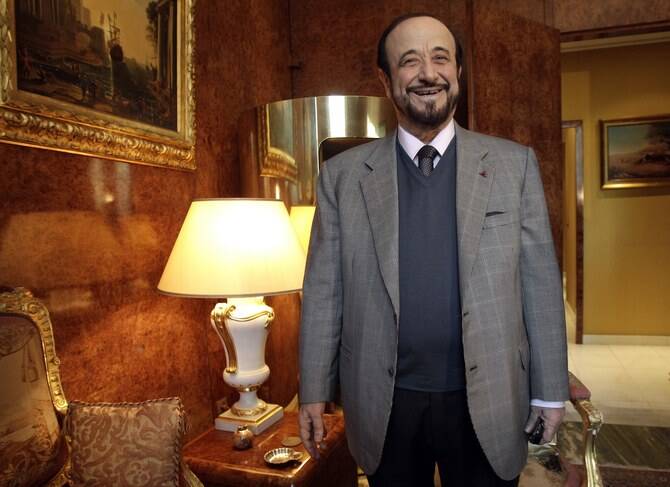
DAMASCUS: Rifaat Assad, uncle of deposed Syrian ruler Bashar Assad and dubbed the “Butcher of Hama” for suppressing an uprising in the 1980s, has died aged 88, two sources close to the family said Wednesday.
Once a pillar of the Assad family’s dynastic rule, Rifaat “died after suffering from influenza for around a week,” one source who worked in Syria’s presidential palace for over three decades told AFP.
A second source, an ex-officer of Syria’s army in the Assad era, confirmed the death, saying Rifaat had moved to the United Arab Emirates after his nephew’s government was toppled by rebels in December 2024, without specifying if he died there.
Rifaat’s role in a February 1982 massacre as part of a crackdown on an armed revolt by Islamist group the Muslim Brotherhood earned him the nickname “the Butcher of Hama,” referring to the central Syrian city.
His brother Hafez Assad, who ruled Syria at the time, launched the campaign, which government forces carried out under the command of Rifaat, who was the head of the elite “Defense Brigades.”
The death toll from 27 days of violence, which took place under a media blackout, has never been formally established, though estimates range from 10,000 to 40,000.
Swiss prosecutors had accused Rifaat of a long list of crimes, including ordering “murders, acts of torture, inhumane treatment and illegal detentions” while an officer in the Syrian army.
He also served as vice president under his brother Hafez but went into exile in 1984 after a failed attempt to overthrow him, moving to Switzerland then France.
He later presented himself as an opponent of his nephew Bashar, who succeeded Hafez in 2000.
In 2021, he returned to Syria from France to escape a four-year prison sentence for money laundering and misappropriation of Syrian public funds.
Two years later, he appeared in a family photo alongside Bashar, the ruler’s wife Asma and other relatives.
Shortly after Bashar’s ouster, Rifaat crossed into Lebanon and then flew out of Beirut airport, a Lebanese security source said at the time, without specifying his final destination.


![]()


Syria’s Rifaat Assad, ‘Butcher of Hama’, dies aged 88, sources say
Short Url
https://arab.news/4bmv3
Syria’s Rifaat Assad, ‘Butcher of Hama’, dies aged 88, sources say
- Once a pillar of the Assad family’s dynastic rule, Rifaat “died after suffering from influenza for around a week“
- Swiss prosecutors had accused Rifaat of a long list of crimes


Iran urges US to drop ‘excessive demands’ to reach deal
- Longtime adversaries Iran and the United States held their third round of Omani-mediated nuclear talks on Thursday in Geneva
- Both Iran and Oman cited progress after the talks, with technical discussions scheduled for Monday in Vienna
TEHRAN: Iran’s Foreign Minister Abbas Araghchi said on Friday that in order to reach a deal, the United States will have to drop its “excessive demands,” after the two sides held talks in Geneva.
In a phone call with Egypt’s top diplomat Badr Abdelatty, Araghchi said “success in this path requires seriousness and realism from the other side and avoidance of any miscalculation and excessive demands.”
Araghchi did not clarify what demands he was referring to, but Washington has pointed to Iran’s ballistic missile program and has repeatedly described Tehran’s uranium enrichment capability as a red line.
US President Donald Trump said on Wednesday that Tehran had “already developed missiles that can threaten Europe and our bases overseas, and they’re working to build missiles that will soon reach the United States of America.”
Also on Wednesday, US Secretary of State Marco Rubio said Iran is “not enriching right now, but they’re trying to get to the point where they ultimately can,” adding that Tehran “refuses” to discuss its ballistic missile program and “that’s a big problem.”
Iran has repeatedly said its missile program is part of its defensive capabilities and has ruled out abandoning uranium enrichment, insisting its nuclear program is solely for peaceful purposes.
Longtime adversaries Iran and the United States held their third round of Omani-mediated nuclear talks on Thursday in Geneva, seeking to avert military escalation as Washington expands its military build-up in the region.
Both Iran and Oman cited progress after the talks, with technical discussions scheduled for Monday in Vienna ahead of a fourth round expected next week.
In a phone call with Egypt’s top diplomat Badr Abdelatty, Araghchi said “success in this path requires seriousness and realism from the other side and avoidance of any miscalculation and excessive demands.”
Araghchi did not clarify what demands he was referring to, but Washington has pointed to Iran’s ballistic missile program and has repeatedly described Tehran’s uranium enrichment capability as a red line.
US President Donald Trump said on Wednesday that Tehran had “already developed missiles that can threaten Europe and our bases overseas, and they’re working to build missiles that will soon reach the United States of America.”
Also on Wednesday, US Secretary of State Marco Rubio said Iran is “not enriching right now, but they’re trying to get to the point where they ultimately can,” adding that Tehran “refuses” to discuss its ballistic missile program and “that’s a big problem.”
Iran has repeatedly said its missile program is part of its defensive capabilities and has ruled out abandoning uranium enrichment, insisting its nuclear program is solely for peaceful purposes.
Longtime adversaries Iran and the United States held their third round of Omani-mediated nuclear talks on Thursday in Geneva, seeking to avert military escalation as Washington expands its military build-up in the region.
Both Iran and Oman cited progress after the talks, with technical discussions scheduled for Monday in Vienna ahead of a fourth round expected next week.
Latest updates


© 2026 SAUDI RESEARCH & PUBLISHING COMPANY, All Rights Reserved And subject to Terms of Use Agreement.