

‘Negotiations with Iran have to happen,’ Steve Witkoff tells Arab News

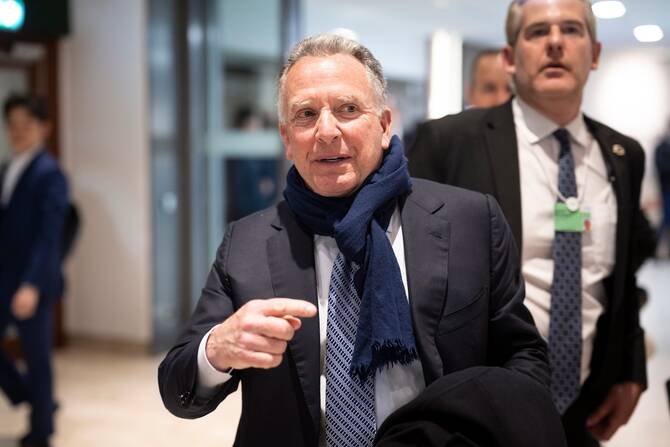
Iran must come and sit at the diplomatic table, US Special Envoy to the Middle East Steve Witkoff told Arab News. (AP)
Short Url
Updated 22 January 2026
Follow

‘Negotiations with Iran have to happen,’ Steve Witkoff tells Arab News

  • US special envoy to the Middle East: ‘If Iran goes, so the region goes’

DAVOS: Iran must come and sit at the diplomatic table, US Special Envoy to the Middle East Steve Witkoff told Arab News on Wednesday on the sidelines of the World Economic Forum in Davos.

“That has to happen. It’s important. If Iran goes, so the region goes, and so we have to get that straight,” the envoy said.

Since the outbreak of anti-government demonstrations, US President Donald Trump has repeatedly urged Iran’s leaders to halt the violent crackdown on protesters, vowing “very strong action” if executions go ahead. He has also called on Iranians to keep demonstrating and “take over institutions,” declaring that “help is on the way.”

Although Trump has so far stepped back from direct military intervention (at least since June’s attack on Iranian nuclear facilities), tensions remain high and a diplomatic breakthrough has proved elusive. On Tuesday, Davos organizers announced that the invitation to Iranian Foreign Minister Abbas Araghchi had been rescinded, citing “the tragic loss of lives of civilians in Iran over the past few weeks.”

Araghchi condemned the move, accusing the forum of “blatant double standards” and of bowing to Western pressure. The decision came as the newly created Gaza peace board drew mixed reactions from governments already wary of further inflaming regional sensitivities.

Despite the fraught context, Witkoff insisted that the Middle East was moving in the right direction.

“I think it’s amazing what’s happening. Everybody is, I think, working together towards peace. Everyone’s bought into presidents Trump’s ideas about border peace, and I think I’m very hopeful.”

More than ten countries have reportedly signed on to the main “Board of Peace” (chaired by Trump), which carries a reported budget of $1 billion. Saudi Arabia has welcomed the initiative but as of Wednesday had not released any official statement.

European leaders in Davos appeared more skeptical, with France’s Emmanuel Macron, Germany’s Friedrich Merz, UK Prime Minister Keir Starmer and Italy’s Giorgia Meloni all reported to be weighing whether to decline the invitation.

Witkoff, alongside six others on the seven-member executive board (including Marco Rubio, Jared Kushner and Tony Blair), are expected to focus on diplomacy and investment while overseeing Gaza’s on-the-ground administration through the “Gaza Executive Board” and a national committee involving Palestinian technocrats.

Further announcements on participation are expected on Thursday following a fresh round of diplomatic maneuvering in Davos, as capitals weigh the board’s potential impact on existing UN-led efforts.


Iraqi lawmakers to elect president Tuesday, PM appointment next

Updated 3 sec ago
Follow

Iraqi lawmakers to elect president Tuesday, PM appointment next

BAGHDAD: Iraq’s parliament will meet on Tuesday to elect the country’s new president, who will then appoint a prime minister expected to be Nouri Al-Maliki after he was endorsed by the largest Shiite bloc.
By convention, a Shiite Muslim holds the post of prime minister, the parliament speaker is Sunni and the largely ceremonial presidency goes to a Kurd.
Parliamentary speaker Haibat Al-Halbussi announced on Sunday that the new parliament will convene on Tuesday to elect a president, according to the official INA press agency.
The president will then have 15 days to appoint a prime minister, who is usually nominated by the largest Shiite bloc formed through post-election alliances.
On Saturday, the Coordination Framework alliance — whose Shiiite factions have varying links to Iran — endorsed former prime minister and powerbroker Al-Maliki as the country’s next premier.
The alliance, to which Al-Maliki belongs, spoke of his “political and administrative experience and his record in running the state.”
Kurdish parties have yet to agree on a presidential candidate, who must be endorsed by other blocs and win a two-thirds majority in parliament.
The presidency is usually held by the Patriotic Union of Kurdistan (PUK). This year, the rival Kurdistan Democratic Party (KDP) named its own candidate: Foreign Minister Fuad Hussein.
Although Maliki’s endorsement effectively guarantees him the post, forming a new government remains a daunting challenge that could drag on for months and still fail.
The designated premier has one month to form a government and present it to parliament for a vote of confidence.
The 75-year-old Maliki, a shrewd politician, is set to return to power at a time of seismic changes in the Middle East, as Tehran’s regional influence wanes and tensions with Washington rise.
Government formation in Iraq must balance internal political dynamics and power-sharing among major parties, all under the continued influence of Iraq’s two main allies: Iran and the United States.
A close Iran ally, Al-Maliki will be expected to address Washington’s longstanding demand that Baghdad dismantle Tehran-backed factions, many of which are designated terrorist groups by the US.
Last month, Iraqi officials and diplomats told AFP that Washington demanded the eventual government exclude Iran-backed armed groups, even though most of them hold seats in parliament, and have seen their political and financial clout increase.
But Iraq is struggling with weak economic growth and cannot risk punitive measures by the US, which has already sanctioned several Iraqi entities, accusing them of helping Tehran evade sanctions.