

Saudia airline receives 27m passengers during 2025 

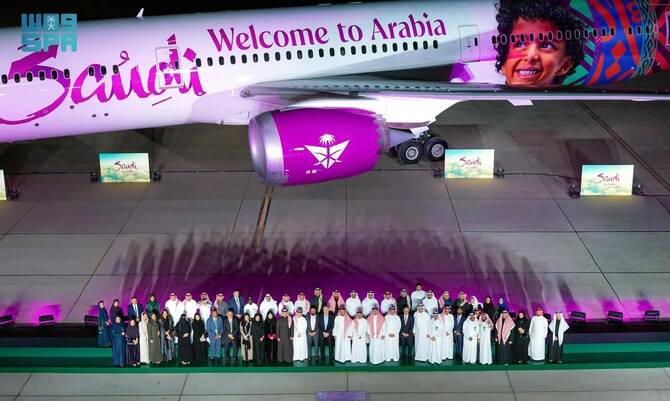
The announcement was made during the launch of a Saudia aircraft adorned with the “Spirit of Saudi” logo at Saudia Technic’s maintenance, repair and overhaul village in Jeddah. SPA
Short Url
Updated 21 January 2026
Follow

Saudia airline receives 27m passengers during 2025 

RIYADH: Collaboration between Saudi Arabia’s national carrier Saudia and the Saudi Tourism Authority in 2025 resulted in the Kingdom receiving approximately 27 million tourists and visitors from 24 countries on Saudia flights.

Khaled Tash, Group chief marketing officer of Saudia, praised the partnership with the STA, noting that it will contribute to reaching the target of 150 million tourists by 2030, following the achievement of the initial target in 2023. 

The announcement was made during the launch of a Saudia aircraft adorned with the “Spirit of Saudi” logo at Saudia Technic’s maintenance, repair and overhaul village in Jeddah. 

The launch forms part of the strategic partnership with the STA aimed at enhancing the Kingdom’s position as a global tourism destination. 

The aircraft will fly to 25 destinations worldwide during 2026, serving as a mobile promotional platform reflecting authentic Saudi hospitality and supporting Vision 2030 goals to attract visitors from around the world.   

In a statement to the Saudi Press Agency, Tash said the aircraft selected for the partnership is the Boeing B787-9, designed for long-haul flights to some of the Kingdom’s farthest destinations, including Jeddah–Washington routes, as well as East Asia and China. 

For his part, Abdullah Al-Dakhil, the official spokesperson for the STA, affirmed that air connectivity is a key pillar of the tourism sector. He pointed out that the aim of this partnership, utilizing the international Boeing B787-9 aircraft, which attracts visitors from around the world, is to make the aircraft, with all its amenities, a creative promotional platform for travelers during their journey to Saudi Arabia. 

This will allow them to experience authentic Saudi hospitality even before arriving in the Kingdom, where diverse destinations, seasons and international events await year-round. 

Saudi Arabia is investing billions of dollars as part of its Vision 2030 plan to diversify its economy away from fossil fuels, boosting its private sector, and enhancing connectivity, as well as solidifying its role in the global aviation industry.  

As part of the plan, the Kingdom aims to serve 330 million passengers across more than 250 destinations and transport 4.5 million tonnes of air cargo by 2030. 


Saudi stocks rise above 11,000 as energy shares lead gains  

Updated 11 sec ago
Follow

Saudi stocks rise above 11,000 as energy shares lead gains  

RIYADH: Saudi Exchange’s benchmark Tadawul All Share Index climbed above 11,000 on Sunday, led by energy and materials stocks despite geopolitical uncertainty from ongoing tensions between US-Israel and Iran across the region. 

As of 12:30 p.m. Saudi time, the benchmark index had advanced 224.80 points, or 2.09 percent, to 11,001.12. The MSCI Tadawul Index rose 26.96 points, or 1.84 percent, to 1,488.86, while the Kingdom’s parallel market, Nomu, slipped 0.05 percent to 22,485.78. 

The gains came as Gulf markets reacted to heightened tensions between the US-Israel alliance and Iran, prompting investors to shift toward sectors more resilient to higher oil prices and supply disruptions. 

Saudi Aramco was among the strongest performers, with its share price rising 4.56 percent to SR27.06 as of 12:30 p.m. Saudi time. 

Speaking to Arab News, Tony Hallside, CEO of STP Partners, said: “Energy producers and oilfield services typically outperform on higher crude, while the pain concentrates in airlines, shipping, petrochemicals, and any sector with high fuel or logistics intensity.” 

Century Financial chief investment officer Vijay Valecha told Arab News that energy companies such as Saudi Aramco could see their share prices rise under current market conditions. 

“At the sector level, energy and petrochemical companies are likely to remain relatively resilient due to stronger pricing. In contrast, sectors such as real estate, consumer discretionary, banking, and capital markets would likely see short-term volatility and profit-taking as investors adopt a more cautious stance,” said Valecha. 

He added that elevated energy prices could also increase global inflationary pressures and create uncertainty in supply chains, potentially weighing on broader economic activity. 

Stock exchanges across the Gulf Cooperation Council also showed signs of recovery on March 6, with the Bahrain Bourse edging up 0.24 percent and the Muscat Stock Exchange gaining 1.44 percent. 

The Qatar Stock Exchange, however, declined 0.15 percent. 

UAE equities were closed on Sunday due to an official holiday. 

On March 6, the Dubai Financial Market index fell for a fifth straight session, down 3.2 percent, or 197.49 points, to 5,917.22. It declined 9.01 percent for the week. 

The Abu Dhabi Securities Exchange general index fell for a seventh consecutive session, dropping 1.4 percent, or 141.49 points, to 9,903.36 on March 6. 

“UAE equities ended the week lower as the widening conflict involving the US, Israel, and Iran continued to weigh heavily on risk sentiment. Dubai and Abu Dhabi stocks slid further upon reopening on Wednesday, pressured by regional tensions after the two-day break,” Valecha said in a separate statement. 

He added: “Banking and property stocks have been the largest drags as investors reassessed and questioned whether the market had priced in too much resilience. The shift in perception followed missile and drone attacks on Dubai over the weekend, which undermined the idea that the city remained insulated from global tensions.”