Nearly 5m Catholics join Sinulog, Philippines’ largest religious festival

Filipinos participate in the Sinulog festival in Cebu City, Jan. 18, 2026. (Cebu City Public Information Office)
Short Url
Updated 18 January 2026
Follow

Nearly 5m Catholics join Sinulog, Philippines’ largest religious festival

  • Festival blends Catholic elements with local rituals preceding Spanish colonization
  • It centers around Santo Nino, one of the most venerated images in the Philippines

MANILA: Nearly 5 million people filled the streets of Cebu City with music and dance on Sunday, as they participated in Sinulog, the largest religious festival in the Philippines, commemorating the introduction of Christianity.

Observed on the third Sunday of January, Sinulog marks the 1521 event when Portuguese explorer Ferdinand Magellan gifted a statue of the Santo Nino, the child Jesus, to Rajah Humabon, the native king of Cebu, who became the first local ruler to convert to Christianity.

The original statue is housed in the Basilica Minore del Santo Nino, the country’s oldest Roman Catholic church. It was founded in 1565, shortly after the arrival of the Spaniards and the beginning of Spanish colonization of the Philippines, which also resulted in Catholicism becoming its dominant religion.

Santo Nino has become one of the most venerated images and is present in many churches across the country. Every year, Catholics from across the country visit Cebu City to express their devotion.

On Sunday, 4.7 million of them gathered for the Sinulog parade, according to data from Cebu City Disaster Risk Reduction and Management Office.


Filipinos participate in the Sinulog festival in Cebu City, Jan. 18, 2026. (Cebu City Public Information Office)

Kristine Magnifica, a recent bar passer, arrived from Iloilo, some 200km from Cebu, to show gratitude for her success.

“Joining the Sinulog is my way of thanking him,” she said. “It’s not purely leisurely because joining these activities entails a lot of patience. And it’s really, really tiring considering that the sun is up and the walk is far.”

Sunday’s festival was the culmination of days of processions and special masses.

“It’s actually an accumulation of activities. You can probably say that the Cebuanos have been very, very busy for the past 10 days attending masses, processions, and activities that were actually conducted by the Basilica del Santo Nino,” Magnifica said.

“Today is the grand festival parade where participants from different municipalities and islands and regions in the country come to Cebu.”

The word “sinulog” comes from the Cebuano word “sulog,” meaning “movement of water,” and refers to the distinctive forward-backward dance steps that mimic the flow of a river.

The dance, which is performed during the festival, dates to pre-colonial times and highlights the region’s maritime culture. Its role in Catholic devotion is a fusion of Filipino culture and Christianity.

“Recent studies show that it’s very similar to the Tausug war dance … It was performed by our ancestors before the coming of the Spaniards,” said Dr. Xiao Chua, public historian and lecturer at De La Salle University.

“They were using it already for rituals, to ask for rain, and they began offering the Sinulog dance to Santo Nino … From a war dance, it became a prayer dance in Cebu.”

The public festival in Cebu City, however, is a relatively recent development. According to Chua, it was due to renewed devotion to Santo Nino around the 400th anniversary of the Christianization of the Philippines in 1965.

The Sinulog festival became a tourist attraction in the early 1980s, when it started to be organized by the local government.

For Chua, the public display of devotion is very much in line with Filipino culture and values such as paki-kipag kapwa-tao — respect, empathy, and concern for others — and bayanihan — community spirit, which are reflected in all large religious events.

“It’s part of the Filipino phenomenon,” he said. “(In) all of those festivals, you’re going to see that people want to worship together.”


Bangladesh’s Yunus announces resignation, end of interim govt

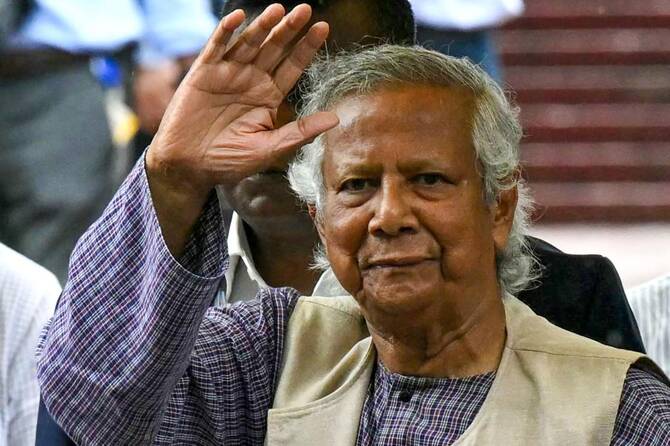
Bangladesh’s interim leader Muhammad Yunus stepped down on February 16, 2026 in a farewell broadcast to the nation.
Updated 7 sec ago
Follow

Bangladesh’s Yunus announces resignation, end of interim govt

  • Yunus handed over power after congratulating the Bangladesh Nationalist Party and its leader Tarique Rahman

DHAKA: Bangladesh’s interim leader Muhammad Yunus stepped down on Monday in a farewell broadcast to the nation before handing over to an elected government.
“Today, the interim government is stepping down,” the 85-year-old Nobel Peace Prize winner said.
“But let the practice of democracy, freedom of speech, and fundamental rights that has begun not be halted.”
Yunus returned from self-imposed exile in August 2024, days after the iron-fisted government of Sheikh Hasina was overthrown by a student-led uprising and she fled by helicopter to India.
“That was the day of great liberation,” he said. “What a day of joy it was! Bangladeshis across the world shed tears of happiness. The youth of our country freed it from the grip of a demon.”
He has led Bangladesh as its “chief adviser” since, and now hands over power after congratulating the Bangladesh Nationalist Party (BNP) and its leader Tarique Rahman on a “landslide victory” in elections last week.
“The people, voters, political parties, and stakeholder institutions linked to the election have set a commendable example,” Yunus said.
“This election has set a benchmark for future elections.”
Rahman, 60, chief of the BNP and scion of one of the country’s most powerful political dynasties, will lead the South Asian nation of 170 million.
Rebuilt institutions’
Bangladeshi voters endorsed sweeping democratic reforms in a national referendum, a key pillar of Yunus’s post-uprising transition agenda, on the same day as the elections.
The lengthy document, known as the “July Charter” after the month when the uprising that toppled Hasina began, proposes term limits for prime ministers, the creation of an upper house of parliament, stronger presidential powers and greater judicial independence.
“We did not start from zero — we started from a deficit,” he said.
“Sweeping away the ruins, we rebuilt institutions and set the course for reforms.”
The referendum noted that approval would make the charter “binding on the parties that win” the election, obliging them to endorse it.
However, several parties raised questions before the vote, and the reforms will still require ratification by the new parliament.
The BNP alliance won 212 seats, compared with 77 for the Jamaat-e-Islami-led alliance, according to the Election Commission.
Jamaat chief Shafiqur Rahman conceded on Saturday, saying his Islamist party would “serve as a vigilant, principled, and peaceful opposition.”
Newly elected lawmakers are expected to be sworn in on Tuesday, after which Tarique Rahman is set to become Bangladesh’s next prime minister.
Police records show that political clashes during the campaign period killed five people and injured more than 600.
However, despite weeks of turbulence ahead of the polls, voting day passed without major unrest and the country has responded to the results with relative calm.