

Pakistani stocks jump over 3,500 points amid US-Iran de-escalation reports

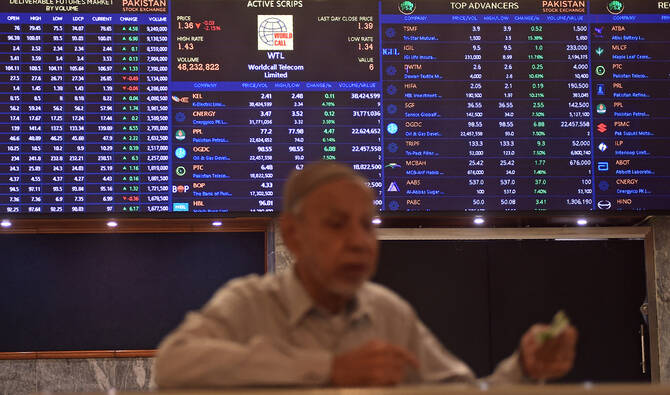
A stock broker watches share prices during a trading session at the Pakistan Stock Exchange (PSX) in Karachi on July 31, 2023. (AFP/File)
Short Url
Updated 16 January 2026
Follow

Pakistani stocks jump over 3,500 points amid US-Iran de-escalation reports

  • KSE-100 index gains 3,642.50 points, or 2.01 percent, to close at 185,098.83
  • Market has gained momentum in recent months on strong institutional buying

ISLAMABAD: The Pakistan Stock Exchange (PSX) surged more than 3,500 points on Friday, with analysts attributing the gains to reports of easing tensions between the United States and Iran that are seen as pivotal for regional stability.

The KSE-100 index gained 3,642.50 points or 2.01 percent to close at 185,098.83, up from the previous close of 181,456.33.

The development comes amid public unrest in Iran over worsening economic conditions, with reports suggesting a death toll of over 2,500 and arrests of more than 15,000 people in a government crackdown.

US President Donald Trump has threatened to intervene while encouraging the anti-government protesters to take control of Iranian institutions. However, he softened his stance on Thursday, saying the Iranian authorities had no plans to execute the demonstrators.

“Bullish activity witnessed in the earnings season at PSX amid reports of US-Iran de-escalation,” Ahsan Mehanti, the Chief Executive Officer at Arif Habib Commodities, told Arab News.

“Speculations over further SBP [State Bank of Pakistan] policy easing amid falling government bond yields acted as a catalyst in the bullish close at PSX,” he added.

Earlier on Friday, the US imposed sanctions on five Iranian officials it accused of being behind the crackdown on protests, saying that it was tracking funds of Iranian leaders being wired to international banks.

Pakistan’s stock market has gained momentum in recent months as broad institutional buying has boosted investor confidence amid ongoing economic reforms under international lending programs.

Around 135,000 new investors have joined the PSX over the last 18 months.

Earlier this month, Pakistani stocks climbed to a fresh all-time high with the benchmark KSE-100 Index crossing the 186,000-point mark for the first time ever.


Pakistan tax revenue rises in January as direct taxes drive growth

Updated 5 sec ago
Follow

Pakistan tax revenue rises in January as direct taxes drive growth

  • Federal tax collection grows 16% year-on-year at the outset of 2026, led by income tax gains
  • Seven-month revenues reach Rs.7.18 trillion as authorities bank on recovery in manufacturing

ISLAMABAD: Pakistan’s Federal Board of Revenue (FBR) on Saturday reported a strong pickup in tax collection in January, driven by a sharp rise in direct taxes, as the government seeks to shore up public finances under a reform-led revenue mobilization drive.

The tax authority collected a provisional Rs1.02 trillion ($3.65 billion) in January, up 16% from Rs.873 billion ($3.14 billion) in the same month last year, surpassing the six-month average growth rate of 10-11%, according to an official statement.

“This month’s tax performance reveals a nuanced and strategically significant fiscal outcome, characterized by substantial increase in direct taxation, modest growth in indirect and excise streams and an overall healthy and improved performance in January 2026,” the statement said.

“It also reinforces the credibility of reform-driven revenue mobilization and transformation plan of FBR,” it added.

Income tax collection rose 26% to Rs483 billion ($1.74 billion) from Rs381 billion ($1.37 billion) a year earlier, reflecting what the FBR described as the impact of enforcement measures and efforts to unlock revenue tied up in litigation.

Sales tax receipts increased 12% to Rs360 billion ($1.30 billion) from Rs322 billion ($1.16 billion) last year, which the tax authority linked to signs of recovery in large-scale manufacturing.

The FBR said the results underscored the effectiveness of its reform program, including the use of digital infrastructure and enforcement tools to improve compliance and expand the tax base, while encouraging voluntary taxpayer participation.

Cumulatively, the FBR collected Rs7.18 trillion ($25.83 billion) in the first seven months of the 2026 fiscal year, compared with Rs6.49 trillion ($23.36 billion) in the same period last year.

The tax authority said it was optimistic that continued recovery in manufacturing would help it meet its full-year revenue targets, adding that it aimed to maintain momentum in the remaining months of the fiscal year.