

Pakistan, Qatar leaders discuss Middle East tensions amid Iran crisis

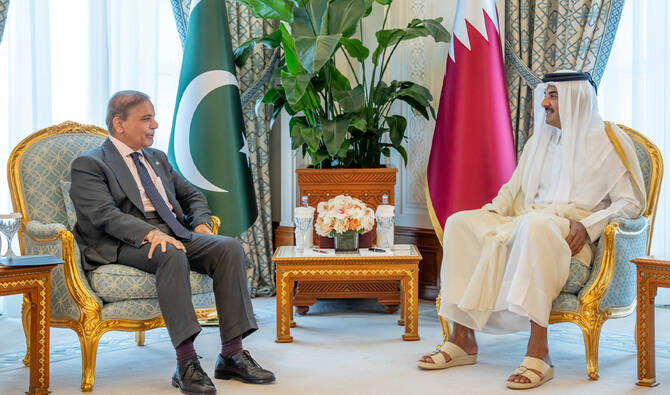
Pakistan Prime Minister Shehbaz Sharif meets Qatar’s Emir Sheikh Tamim bin Hamad Al-Thani (right) in Doha, Qatar, on September 13, 2025. (PID/File)
Short Url
Updated 14 January 2026
Follow

Pakistan, Qatar leaders discuss Middle East tensions amid Iran crisis

  • Iran has warned of retaliation against US military bases in region if Washington intervenes in support of anti-government protests
  • United States on Wednesday withdrew some personnel from Mid East key bases, including Al Udeid Air Base, according to Reuters

ISLAMABAD: Pakistani Prime Minister Shehbaz Sharif spoke by telephone on Wednesday with Qatar’s Emir Sheikh Tamim bin Hamad Al Thani, discussing regional developments as tensions escalated in the Middle East following warnings from Iran over potential US military action.

The phone call comes as Iran warned it would retaliate against US military bases in the region if Washington intervenes in support of anti-government protesters, prompting the United States to withdraw some personnel from key bases, including Al Udeid Air Base, according to Reuters.

For Pakistan, a wider escalation could have economic and security implications, including pressure on energy supplies, shipping routes and regional trade, as well as potential risks to Pakistani workers and businesses across the Gulf. Islamabad has traditionally sought to balance relations with Iran, Gulf Arab states and the United States, and analysts say heightened tensions could complicate that diplomacy at a time when Pakistan remains dependent on external financing, remittances and stable energy imports.

According to a statement from the Prime Minister’s Office, Sharif and Al Thani expressed satisfaction with the trajectory of Pakistan-Qatar relations and reaffirmed their commitment to strengthening bilateral ties. 

“Recent developments in the Middle East were also discussed,” a statement from Sharif’s office said. “The Prime Minister appreciated Qatar’s constructive and proactive role in promoting peace, dialogue, and mediation across the region, and acknowledged its meaningful efforts to defuse tensions through diplomatic solutions.”

Sharif also assured the Qatari leadership that Pakistan would also continue “to play a positive role in maintaining regional peace and stability.”

Tensions are high in the Middle East, with Iranian officials having said Tehran has conveyed messages to regional states, including Saudi Arabia, the United Arab Emirates and Turkiye, warning that US bases in those countries could be attacked if Iran is struck. Direct contacts between Iranian and US officials have reportedly been suspended.

The unrest in Iran, sparked by demonstrations over worsening economic conditions, has escalated into the most violent internal challenge faced by the Islamic Republic since the 1979 revolution, according to Western officials and rights groups. Iranian authorities have accused the United States and Israel of fomenting the protests, which they describe as acts of terrorism.

Human rights organizations have reported thousands of deaths and arrests amid a sweeping crackdown by Iranian security forces, while Western governments say Iran’s leadership remains in control but under unprecedented pressure.

Qatar, which maintains close ties with both Washington and Tehran and has played a mediating role in multiple regional crises, has emerged as a key diplomatic hub as fears grow of a wider regional escalation involving US forces, Iran and its allies.


Curfew extended in Gilgit-Baltistan, probe ordered after deadly Khamenei protests

Updated 03 March 2026
Follow

Curfew extended in Gilgit-Baltistan, probe ordered after deadly Khamenei protests

  • At least 15 people were killed in clashes with law enforcement agencies over the weekend in Gilgit-Baltistan
  • Government also announces a de-weaponization campaign, crackdown on hate speech and cybercrime in region

ISLAMABAD: The government in Pakistan’s Gilgit-Baltistan (GB) region on Tuesday extended a curfew in Gilgit district and ordered a judicial probe into violent protests over the killing of Iranian Supreme Leader Ali Khamenei in US-Israeli strikes last week, an official said.

At least 15 people were killed in clashes with law enforcement agencies over the weekend in GB, where protesters torched and vandalized several buildings, including United Nations regional offices, an army-run school, software technology park and a local charity building.

The violence prompted regional authorities to impose curfew in Gilgit and Skardu districts on March 2-4 as officials urged people to stay indoors and cooperate with law enforcers, amid widespread anger in Pakistan, particularly among members of the Shiite minority, over Khamenei’s killing.

On Tuesday, the GB government convened to review the situation and announced the extension of curfew in Gilgit among a number of security measures as well as ordered the establishment of a judicial commission to investigate the weekend violence in the region.

“The government has made it clear that the law will strictly take its course against elements involved in vandalism at government institutions, private properties and incidents of vandalism in Gilgit and Skardu and no kind of mischief will be tolerated,” Shabbir Mir, a GB government spokesperson, said in a statement.

“In view of the security situation, curfew will remain in force in Gilgit, while the decision to extend the curfew in Skardu will be taken keeping the ground realities and the changing situation in view.”

The statement did not specify how long the curfew will remain in place in Gilgit.

Besides the formation of the judicial commission to investigate the violent clashes, the government also decided to launch a large-scale de-weaponization campaign in the entire Gilgit district, for which relevant institutions have been directed to immediately complete all necessary arrangements, according to Mir.

In addition, a crackdown has been ordered on hate speech, spread of fake news and cybercrime.

“The aim of these decisions is to ensure the rule of law, protect the lives and property of citizens and crack down on miscreants,” he said. “Approval has also been given to immediately survey the affected infrastructure and start their restoration work on priority basis.”

Demonstrators in Pakistan’s southern port city of Karachi also stormed the US Consulate on Sunday, smashing windows and attempting to burn the building. Police responded with batons, tear gas, and gunfire, leaving 10 people dead and more than 50 injured.

Pakistani authorities have since beefed up security at US diplomatic missions across the country, including around the US consulate building in Peshawar, to avoid any further violence.