

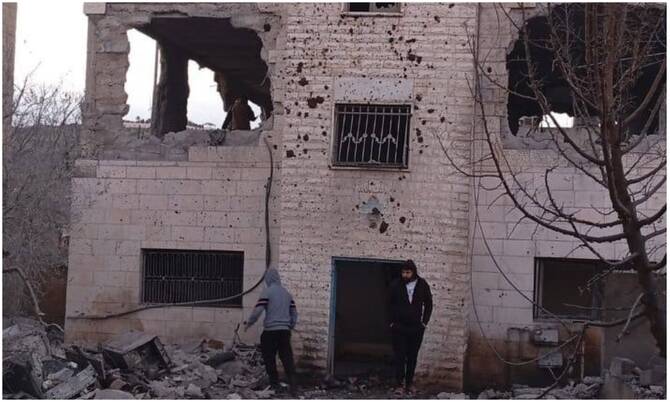
Israeli forces detonate house of detainee Abu Al-Rab near Jenin

The house belonged to the detainee Ahmed Abu Al-Rab in Qabatiya, according to Wafa news agency. (Wafa)
Short Url
Updated 14 January 2026
Follow

Israeli forces detonate house of detainee Abu Al-Rab near Jenin

  • Abu Al-Rab family received a demolition notice in January

LONDON: Israeli forces detonated a house on Wednesday in the Palestinian town of Qabatiya, located south of Jenin, in the occupied West Bank.

The house belonged to the detainee Ahmed Abu Al-Rab in Qabatiya, according to Wafa news agency.

Israeli forces used explosives to demolish the house, causing damage to several neighboring homes and forcing multiple families to evacuate their residences in the area before the detonation.

The Abu Al-Rab family received a demolition notice in January. Overnight, Israeli forces raided several houses in Qabatiya, arresting multiple individuals before carrying out the demolition, the Wafa added.

It has now been almost a year since Israel launched a military campaign in the Jenin Governorate in retaliation for the bombing of empty buses in Tel Aviv, allegedly carried out by a Palestinian from the area last February. The campaign resulted in the deaths of over 60 Palestinians and the demolition of more than 600 houses, displacing 22,000 people.


Libya brings in Western traders in blow to Russian fuel flows

Updated 6 sec ago
Follow

Libya brings in Western traders in blow to Russian fuel flows

  • The tenders will further reduce Russian product imports into Libya
  • Russian fuel exports to Libya have fallen to around 5,000 bpd in 2026 from 56,000 bpd in 2024–2025

LONDON: Global oil firms and traders including Vitol, Trafigura and TotalEnergies have won tenders to supply Libya with gasoline and diesel as the country grants large Western players wider access and reduces imports of Russian fuel, three trading sources told Reuters.
Libya is in the process of overhauling its oil sector 15 years after the fall of leader Muammar Qaddafi and years of civil wars.
The country produces some 1.4 million barrels a day of crude but lacks the infrastructure to refine it, leaving it reliant on fuel imports.
After issuing upstream licensing rounds for the first time in 20 years in an effort to grow crude output to 2 million bpd, Africa’s second-largest oil producer is now changing how it sells its oil ⁠and buys the ⁠fuel it requires.
Rather than swapping fuel imports for crude exports, it has instead awarded tenders to cover its fuel needs.
In the tenders in recent weeks, which have not previously been reported, Vitol won the rights to supply 5-10 gasoline cargoes a month and some diesel volumes, three traders familiar with the results said.
Trafigura and TotalEnergies also won the right to supply fuel, two of the three traders said. Reuters could not establish the exact volumes.
Vitol, Trafigura, and TotalEnergies declined to ⁠comment. Libya’s state-owned National Oil Corporation did not immediately respond to a request for comment on the tenders.

RUSSIAN IMPORTS DROPPING
The tenders will further reduce Russian product imports into Libya as Western firms source their volumes from refineries in the Mediterranean.
Russian fuel exports to Libya have fallen to around 5,000 bpd in 2026 from 56,000 bpd in 2024–2025, when it was the dominant supplier, according to live data from global analytics firm Kpler.
Italy has become Libya’s top fuel supplier this year with 59,000 bpd, mainly from the ISAB and Sarroch refineries run by Trafigura and Vitol, the Kpler data showed.
Moscow has relied heavily on Africa, Asia and South America for fuel sales after its refined products were banned from the West under sanctions linked to the war in Ukraine. The ⁠Kremlin has also seen ⁠its oil exports to India and Turkiye fall under US pressure, pushing more oil toward China.
Overall fuel exports into Libya from all sources have averaged around 186,000 bpd since the start of 2024.

FIRMS ALSO GAIN ACCESS TO CRUDE EXPORTS
Libya will also change the way it handles crude exports, the sources said.
Swiss-based trading firm BGN, previously a key exporter, will see crude liftings fall sharply, all three traders said, as big Western players will be allocated export rights.
Small Swiss-based trader Transmed Trading also picked up several crude cargoes in January and will keep lifting volumes in coming months, two of the three sources said.
Transmed and BGN did not immediately respond to requests for comment. Libya also signed a 25-year oil-development deal with TotalEnergies and ConocoPhillips in January, involving more than $20 billion in foreign-financed investment.