

China confirms J-10CE fighter scored first combat success in May India-Pakistan conflict

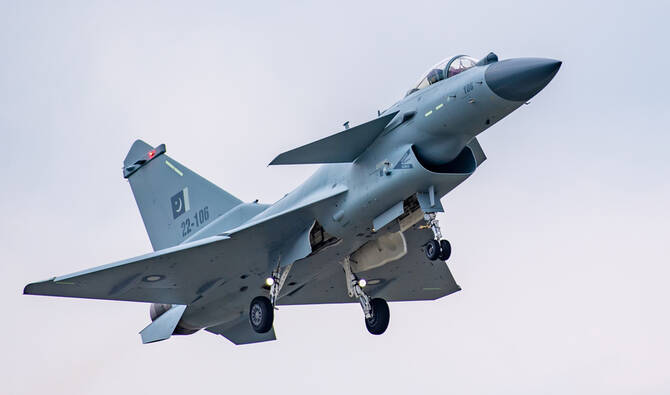
The photo shows a Pakistan Airforce pilot conducting a test flight of a J-10CE fighter jet shortly before it is delivered to the Pakistan Air Force on March 11, 2022. (Courtesy: AVIC/ file)
Short Url
Updated 13 January 2026
Follow

China confirms J-10CE fighter scored first combat success in May India-Pakistan conflict

  • Pakistan claimed victory in the standoff and said it had shot down six Indian aircraft, including French-made Rafale jets
  • Beijing says J-10CE’s combat success abroad demonstrates domestically produced equipment is ‘practical, easy to use’

ISLAMABAD: China has confirmed that its J-10CE fighter jet achieved first combat success during a brief India-Pakistan military conflict in May 2025, Chinese state news agency Xinhua reported on Monday.

The intense, four-day standoff saw Pakistan and India attack each other with missiles, fighter jets, drones and artillery, killing nearly 70 people on both sides.

Islamabad claimed victory in the standoff, saying it had shot down six Indian aircraft, including French-made Rafale jets. India acknowledged losses but did not specify a number.

Citing China’s State Administration of Science, Technology and Industry for National Defense, Xinhua reported that Chinese J-10CE jets shot down “multiple aircraft” in mid-May, without naming any country.

“In mid-May, the country’s export-oriented J-10CE fighter jet achieved its first combat victory, shooting down multiple aircraft in air combat without suffering any losses itself,” the state news agency said.

“The J-10CE’s combat success abroad fully demonstrates that domestically produced aviation equipment is practical and easy to use, possessing strong competitiveness compared to similar foreign equipment, and can also drive other domestically produced aviation equipment to enter the international market.”

The J-10CE fighter jet is an all-weather, single-engine, single-seat, multi-role fighter jet developed by China. The India-Pakistan conflict in May offered the world a first real glimpse into how advanced Chinese military technology performs against proven Western hardware.

A rising military superpower, China hasn’t fought a major war in more than four decades but has raced under President Xi Jinping to modernize its armed forces, pouring resources into developing sophisticated weaponry and cutting-edge technologies. It has also extended that modernization drive to Pakistan, long hailed by Beijing as its “ironclad brother.”

Pakistan’s Defense Minister Khawaja Asif this month said Islamabad has witnessed a surge in aircraft orders after the May standoff with India and, if materialized, they could end the country’s reliance on the International Monetary Fund (IMF).

“Right now, the number of orders we are receiving after reaching this point is significant because our aircraft have been tested,” Defense Minister Asif told Pakistan’s Geo News channel.

“We are receiving those orders, and it is possible that after six months we may not even need the IMF.”

Pakistan markets the Chinese co-developed JF-17, also flown during the May conflict, as a lower-cost multi-role fighter and has positioned itself as a supplier able to offer aircraft, training and maintenance outside Western supply chains.

The JF-17s have figured in a deal with Azerbaijan and the $4 billion weapons pact with the Libyan National Army. Pakistan is also eyeing a defense pact with Bangladesh that could include the Super Mushshak training jets and JF-17s, as ties improve with Dhaka.


Police kill five militants, foil plan to block highway in Pakistan’s southwest

Updated 5 sec ago
Follow

Police kill five militants, foil plan to block highway in Pakistan’s southwest

  • The militants were killed in an intelligence-based operation in Mastung district of Balochistan
  • Search, combing operations are underway to apprehend accomplices of militants who fled the scene

QUETTA: Pakistan’s counterterrorism police on Monday said they had killed five militants, who were planning to block the Quetta–Sibi highway and target security forces, in an intelligence-based operation in the southwestern Balochistan province.
The operation took place in Mastung district when militants affiliated with the Balochistan Liberation Army (BLA) were planning to carry out “subversive activities” against security forces and the public, according to a CTD spokesperson.
CTD received credible intelligence that armed BLA militants had taken positions near Mastung’s Dasht area to block the Quetta–Sibi highway and target security forces and civilian traffic. Acting swiftly on the information, CTD teams moved into the area. The militants opened indiscriminate fire upon sighting CTD personnel.
“During the encounter, five unknown terrorists were shot dead, while other accomplices managed to flee, taking advantage of the rugged and mountainous terrain,” the CTD spokesperson said in a statement.
Balochistan, which borders Iran and Afghanistan, has long been the site of a separatist insurgency and witnessed a series of high-profile militant attacks last year. In March, the BLA hijacked a passenger train and the siege killed at least 60 people, while in May, a suicide bombing in Khuzdar killed several children on a school bus.
The separatists accuse the central government of stealing their resources to fund development in Punjab. The federal government denies the allegations and says it is working for the uplift of local communities in Balochistan, where China has been building a deep-sea port as part of its Belt and Road Initiative.
Officials found seven hand grenades, five sub-machine guns with live rounds and three motorcycles from the scene, according to the CTD statement.
“Search and combing operations are underway to apprehend the fleeing terrorists and dismantle the remaining network,” it read.