

Pioneering Asharq Al-Awsat journalist Mohammed al-Shafei dies at 74

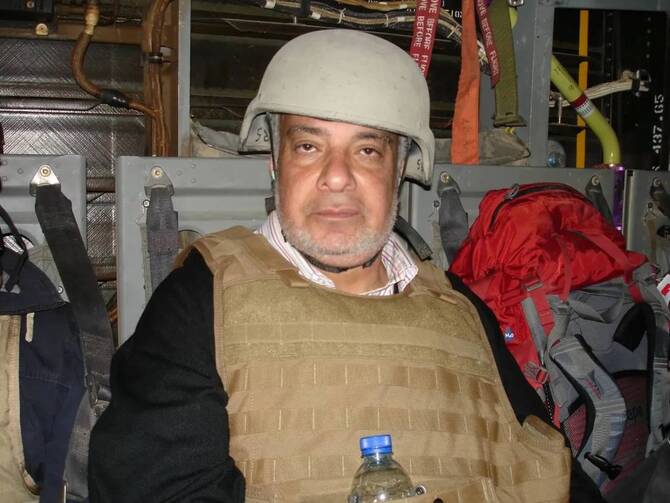
Mohammed al-Shafei on board a military plane bound for Afghanistan. (Asharq Al-Awsat)
Short Url
Updated 08 January 2026
Follow

Pioneering Asharq Al-Awsat journalist Mohammed al-Shafei dies at 74

  • Egyptian was known for his fearless coverage of terrorist, extremist groups
  • One of handful of reporters to interview Taliban leader Mullah Omar in 1970s

LONDON: Mohammed al-Shafei, one of Asharq Al-Awsat’s most prominent journalists, has died at the age of 74 after a 40-year career tackling some of the region’s thorniest issues.

Born in Egypt in 1951, al-Shafei earned a bachelor’s degree from Cairo University in 1974 before moving to the UK, where he studied journalism and translation at the University of Westminster and the School of Oriental and African Studies.

He began his journalism career at London-based Arabic papers Al-Muslimoon and Al-Arab — both of which are published by Saudi Research & Publishing Co. which also owns Arab News — before joining Al-Zahira after Iraq’s 1990 invasion of Kuwait.

Al-Shafei joined Asharq Al-Awsat in 1991 and spent 15 years on the sports desk before shifting to reporting on terrorism. He went on to pioneer Arab press coverage in the field, writing about all aspects of it, including its ideologies and ties to states like Iran.

His colleagues knew him for his calm demeanor, humility and meticulous approach, marked by precise documentation, deep analysis and avoidance of sensationalism.

Al-Shafei ventured fearlessly into terrorist strongholds, meeting senior terrorist leaders and commanders. In the 1970s he was one of only a handful of journalists to interview Mullah Omar, the leader of the Taliban, and conducted exclusive interviews with senior figures within Al-Qaeda.

He also tracked post-Al-Qaeda groups like Daesh, Hay’at Tahrir al-Sham and Boko Haram, offering pioneering analysis of Sunni-Shiite extremism and how cultural contexts shaped movements across Asia and Africa.

During the war on Al-Qaeda, he visited US bases in Afghanistan, embedded with international forces, and filed investigative reports from active battlefields — rare feats in Arab journalism at the time.

He interviewed Osama bin Laden’s son, highlighting a humanitarian angle while maintaining objectivity, and was among the few Arab journalists to report from Guantanamo, where his interviews with Al-Qaeda detainees shed light on the group’s operations.

Al-Shafei married a Turkish woman in London in the late 1970s, with whom he had a son and daughter. He was still working just hours before he died in London on Dec. 31.


Paris exhibition marks 200 years of Le Figaro and the enduring power of the press

Updated 17 January 2026
Follow

Paris exhibition marks 200 years of Le Figaro and the enduring power of the press

  • The exhibition celebrated the bicentennial of Le Figaro, offering visitors a rare opportunity to step inside the newspaper’s vast historical archive

PARIS: One of France’s most influential newspapers marked a major milestone this month with a landmark exhibition beneath the soaring glass nave of the Grand Palais, tracing two centuries of journalism, literature and political debate.
Titled 1826–2026: 200 years of freedom, the exhibition celebrated the bicentennial of Le Figaro, offering visitors a rare opportunity to step inside the newspaper’s vast historical archive. Held over three days in mid-January, the free exhibition drew large crowds eager to explore how the title has both chronicled and shaped modern French history.
More than 300 original items were displayed, including historic front pages, photographs, illustrations and handwritten manuscripts. Together, they charted Le Figaro’s evolution from a 19th-century satirical publication into a leading national daily, reflecting eras of revolution, war, cultural change and technological disruption.
The exhibition unfolded across a series of thematic spaces, guiding visitors through defining moments in the paper’s past — from its literary golden age to its role in political debate and its transition into the digital era. Particular attention was paid to the newspaper’s long association with prominent writers and intellectuals, underscoring the close relationship between journalism and cultural life in France.
Beyond the displays, the program extended into live journalism. Public editorial meetings, panel discussions and film screenings invited audiences to engage directly with editors, writers and media figures, turning the exhibition into a forum for debate about the future of the press and freedom of expression.
Hosted at the Grand Palais, the setting itself reinforced the exhibition’s ambition: to place journalism firmly within the country’s cultural heritage. While the exhibition has now concluded, the bicentennial celebrations continue through special publications and broadcasts, reaffirming Le Figaro’s place in France’s public life — and the enduring relevance of a free and questioning press in an age of rapid change.