

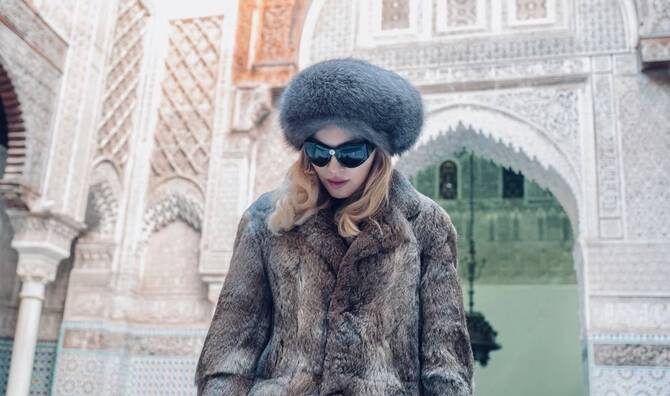
Madonna enjoys a holiday in Morocco

On Instagram recently she shared glimpses of the trip with her 20.1 million followers. (Instagram)
Short Url
Updated 31 December 2025
Follow

Madonna enjoys a holiday in Morocco

  • Visit blends culture, fashion, architecture, ritual
  • Shares images of boyfriend and twin daughters

DUBAI: Pop icon Madonna has been spending time in Morocco, sharing a series of images that document a richly layered visit across the country, blending culture, fashion, architecture and ritual.

On Instagram recently she shared glimpses of the trip with her 20.1 million followers. The visit appears to span several locations and moods. In one set of images, Madonna is seen exploring local markets lined with rows of leather goods stacked floor to ceiling.

Dressed for winter, she wears a long fur coat and matching hat, carrying a large woven tote, blending into the earthy tones and textures of the space.


A post shared by Madonna (@madonna)


Another moment highlights Morocco’s famed hospitality, with a traditional mint-tea service captured mid-pour. A server in ceremonial attire pours tea from an ornate silver teapot into colorful glasses, set against an intricately tiled interior.

Architectural details feature prominently throughout her photo series. Several images focus on elaborately decorated interiors, from carved plaster walls and geometric zellige tilework to arched ceilings and mosaic floors.

One wide shot shows a grand seating area lined with patterned cushions beneath an ornate archway, showcasing the craftsmanship and symmetry that define traditional Moroccan design.

A dramatic candlelit dinner scene adds another layer to the journey. Set under tall arches, the long dining table has candelabras, crystal glassware and traditional dishes, while a white horse stands calmly at the far end of the space.

Madonna also shared a close-up portrait taken in soft light, wearing statement sunglasses, diamond earrings and a fur-collared coat, offering another fashion moment within the travel narrative.

In the final images, Madonna is photographed lighting candles inside what appears to be a historic religious or sacred space.

She captioned the post: “Moroccan Holiday.”

The singer also offered fans a look at her festive celebrations, sharing images from a photoshoot with her boyfriend, Akeem Morris, and her 13-year-old twin daughters, Stella and Estere.

Posing in front of a red backdrop decorated with a Christmas tree and disco balls, she wears a white satin mini dress with lace-trimmed short sleeves, square neckline and playful hemline, styled with fishnet tights, gold satin opera gloves and her signature glamour.


Mini op-ed: Why emotional wellbeing is not only an individual concern in Arab societies

Updated 57 min 13 sec ago
Follow

Mini op-ed: Why emotional wellbeing is not only an individual concern in Arab societies

ABU DHABI: Across much of the world, emotional wellbeing is now being discussed in similar ways with familiar language: self-care, boundaries, resilience.

These terms have helped people speak more openly about stress and mental health, often for the first time. That matters. But the language also carries an assumption, one that is not always questioned. It suggests that healing begins, and largely takes place, within the individual.

In many Arab societies, that idea does not fully apply. The self is rarely experienced in isolation. Identity forms early through family life, shared responsibility, and social roles that extend beyond personal choice.

Sophie Gregoire Trudeau and Nancy Zabaneh. (Supplied) 

Emotions are often managed in relation to others, not apart from them. This difference has practical consequences, particularly as pressure and uncertainty.

Wellbeing is not just something that happens on a mat or during a six-day retreat, it shows itself in daily life, in our relationships, in how we respond under pressure, and in the choices we make when no one is watching.

That observation runs counter to a global trend that treats emotional health as a private task.

Western approaches have introduced useful tools, including emotional vocabulary, self-reflection, and psychological insight. But when these ideas travel without adaptation, they can overlook the social structures that shape behavior in societies where family and community play a central role.

Healing often begins with the individual in the West. In the East, the sense of self is more closely tied to family, community, and spirituality. Both are powerful — wellbeing lives where self-awareness meets belonging.

In the Gulf, fast economic growth, changing work patterns, and constant digital connection have altered how people live and relate to one another. Traditional support systems still play an important role, but they are under pressure.

At the same time, imported wellness language can feel out of place when it prioritizes inward focus over shared responsibility.

In this region, community and compassion belong together and remain a source of balance and meaning. Emotional awareness, in this setting, is less about self-improvement and more about how people treat one another, whether at home, at work, or during moments of stress.

The UAE has begun to reflect this broader view at a policy level. The National Strategy for Wellbeing 2031 frames emotional and mental health as a part of social wellbeing, not simply personal coping.

That emphasis is reinforced by the government’s designation of 2026 as the Year of Family, which places family relationships at the center of social stability and long-term wellbeing.

Together, these initiatives point to the vital role of families, schools, and workplaces, while leaving open the question of how collective responsibility and individual needs should be balanced in practice.

If there is one message, it is that wellbeing begins with connection to ourselves, to each other, and to what we value most.

As emotional awareness becomes a global language, its meaning will continue to shift. The task ahead may not be choosing between individual insight and collective care, but recognizing where each works, where it falls short, and how the two can exist alongside one another.

Nancy Zabaneh is a Dubai-based wellbeing educator and trauma-informed facilitator of Palestinian origin who has lived and worked in the UAE for more than 25 years. Sophie Gregoire Trudeau is a Canadian author and mental health advocate and has a decade of experience in the public eye as Canada’s former first lady. They are writing ahead of the Kayan Wellness Festival in Abu Dhabi.