

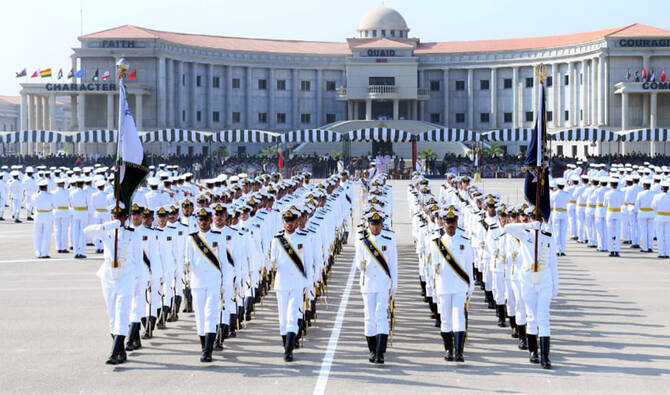
Bahraini commander witnesses Pakistan Navy passing-out parade in Karachi

Commissioning Term marching off during 124th Midshipmen and 32nd SSC Course Commissioning Parade at Pakistan Naval Academy, Karachi, on December 27, 2025. (PID)
Short Url
Updated 28 December 2025
Follow

Bahraini commander witnesses Pakistan Navy passing-out parade in Karachi

  • Rear Admiral Ahmed Mohamed bin Ali says it is a matter of immense pleasure for him to review commissioning of personnel at his alma mater
  • The training you have received has prepared you to step into a challenging yet deeply satisfying career, he tells young officers, midshipmen

ISLAMABAD: Rear Admiral Ahmed Mohamed Ebrahim Al bin Ali, commander of Royal Bahrain Naval Force, witnessed passing-out parade of Pakistan Navy’s 124th Midshipmen and 32nd Short Service Commission Course in Karachi, where he spoke with the newly inducted officers.

The passing-out parade was held at the Pakistan Naval Academy, at which Commandant Commodore Zia-ur-Rehman congratulated 90 midshipmen and 38 cadets who had completed short service commission after going through academic and training phases.

In his address, Rear Admiral Ali said it was a matter of immense pleasure for him to review the commissioning of personnel at his alma mater, the Pakistan Naval Academy, which he had joined as a cadet in February 1983.

“You must be confident and self-assured that you have been trained at one of the best naval academies of the region. The training you have received at Pakistan Naval Academy has prepared you to step into a challenging yet deeply satisfying career,” he told the young officers and midshipmen.

“It has equipped you with essential military and academic skills and you should spare no effort to build up on these to achieve excellence in your professions.”

Pakistan armed forces have long been training cadets and officers from friendly countries. Currently, the Pakistan Naval Academy is training future officers from Bahrain, Djibouti, Iraq, Sri Lanka and Turkiye.

The Bahraini commander said that being here as the chief guest had taken him back to yesteryears and he would have flashbacks of the familiar sounds and aura of this naval academy.

“I cannot help but marvel at the wonderful transformation that has taken place since my days,” he said.

Pakistan and Bahrain have maintained close diplomatic, security, trade and defense relations and have undertaken joint training and security initiatives, besides regular high-level exchanges.

Bahrain’s Read Admiral Ali met Pakistan Naval Chief Admiral Naveed Ashraf earlier this week, according to Pakistan Navy. They discussed matters of mutual interest, regional maritime security and avenues for bilateral naval cooperation.

Earlier in Sept., Pakistan and Bahrain agreed to enhance cooperation in naval training and regional maritime security operations. During the same month, the Bahraini Chief of Defense Staff Lt. Gen. Thiab Saqer Abdulla Al-Nuaimi met with Pakistan’s Air Chief Marshal Zaheer Ahmed Baber Sidhu and expressed Bahrain’s interest in learning from the PAF’s experience in multi-domain operations.


Pakistan says defense pact with Saudi Arabia elevated brotherly ties to ‘new heights’

Updated 25 February 2026
Follow

Pakistan says defense pact with Saudi Arabia elevated brotherly ties to ‘new heights’

  • Pakistan, Saudi Arabia signed strategic defense pact last year pledging aggression against one will be treated as attack on both
  • Deputy PM Ishaq Dar says enduring bonds with Islamic and Arab nations form vital pillar of Pakistan’s foreign policy 

ISLAMABAD: Deputy Prime Minister Ishaq Dar said on Wednesday that Pakistan’s defense pact with Saudi Arabia elevated its brotherly ties with the Kingdom to “new heights,” stressing that close ties with Arab and Islamic nations form a key pillar of Islamabad’s foreign policy. 

Pakistan and Saudi Arabia signed a Strategic Mutual Defense Agreement on Sept. 17 last year, pledging that aggression against one country would be treated as an attack on both, enhancing joint deterrence and formalizing decades of military and security cooperation.

Both nations agreed in October 2025 to launch an economic cooperation framework to strengthen trade and investment ties. 

“In the Middle East, our landmark Strategic Mutual Defense Agreement with Saudi Arabia has elevated our brotherly ties to new heights,” Dar said while speaking at the Pakistan Governance Forum 2026 event in Islamabad. 

The Pakistani deputy prime minister was speaking on the topic “Navigating International Relations Amidst Changing Geo-Politics.”

Dar noted that Pakistan has reinforced partnerships with other Middle Eastern nations such as the UAE, Qatar, Jordan, Oman, Egypt and Bahrain. He said these partnerships have yielded “concrete agreements” in investment, agriculture, infrastructure, and energy sectors. 

“Our enduring bonds with Islamic and Arab nations form a vital pillar of our foreign policy, and we will continue to expand our partnerships across Asia, Latin America, and Africa,” he said. 

Dar pointed out that the presidents of Kazakhstan, Uzbekistan and Kyrgyzstan have undertaken visits to Pakistan in recent months, reflecting Central Asian nations’ desire to boost cooperation with Islamabad.

On South Asia, the Pakistani deputy PM said Pakistan has successfully transformed its fraternal ties with Bangladesh into “a substantive partnership.”

“Similarly, the trilateral mechanism involving China, Pakistan, and Bangladesh has been launched with a view to expanding and deepening regional cooperation and synergy,” the Pakistani minister said. 

He said Islamabad has strengthened its “all-weather” partnership with China via the second phase of the multi-billion-dollar China-Pakistan Economic Corridor agreement and “unwavering support” from both sides for each other’s core interests. 

Dar said Pakistan had also reinvigorated its partnership with the US, advancing cooperation in trade, technology, investment, and regional stability. 

“This calibrated approach has enhanced our ability to navigate complexity with skill and confidence, ensuring that our national interests are served without compromising our core foreign policy principles,” he said.