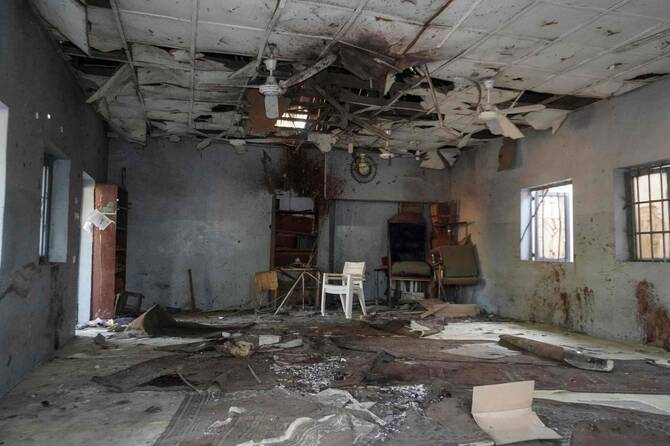
Police suspect suicide bomber behind Nigeria’s deadly mosque blast

Nigeria police said Thursday that they suspected a suicide bomber was behind the blast that killed several worshippers in a mosque on Christmas eve in the country’s northeastern Borno state. (AFP)
Short Url
Updated 25 December 2025
Follow

Police suspect suicide bomber behind Nigeria’s deadly mosque blast

  • Nigeria police said Thursday that they suspected a suicide bomber was behind the blast that killed several worshippers in a mosque on Christmas eve in the country’s northeastern Borno state

MAIDUGURI: Nigeria police said Thursday that they suspected a suicide bomber was behind the blast that killed several worshippers in a mosque on Christmas eve in the country’s northeastern Borno state.
A police spokesman put the death toll at five, with 35 wounded. A witness on Wednesday told AFP that eight people were killed.
The bomb went off inside the crowded Al-Adum Juma’at Mosque at Gamboru market in the capital city of Maiduguri, as Muslim faithful gathered for evening prayers around 6:00 p.m. (1700 GMT), according to witnesses and the police.
“An unknown individual, whom we suspect to be a member of a terrorist group, entered inside the mosque, and while prayer was ongoing, we recorded an explosion,” police spokesman Nahum Daso told journalists.
Daso said in a statement late on Wednesday that the “incident may have been a suicide bombing, based on the recovery of fragments of a suspected suicide vest and witness statements.”
Police officials have been deployed to markets, worship centers and other public places in the wake of the blast.
Nigeria has been battling a jihadist insurgency since 2009 by jihadist groups Boko Haram and an offshoot, Islamic State West Africa Province (ISWAP), in a conflict that has killed at least 40,000 and displaced around two million from their homes in the northeast, according to the UN.
Although the conflict has been largely limited to the northeastern region, jihadist attacks have been recorded in other parts of the west African nation.
Maiduguri itself — once the scene of nightly gunbattles and bombings — has been calm in recent years, with the last major attack recorded in 2021.


Ukraine toils to restore power and heat, Zelensky warns of new attack

Updated 8 sec ago
Follow

Ukraine toils to restore power and heat, Zelensky warns of new attack

  • Russia has systematically attacked Ukraine’s energy system since it invaded its neighbor in 2022 and the air strikes have intensified in recent months

KYIV: Emergency crews toiled to restore heat and power to beleaguered Kyiv residents on Monday, more than ​three days after Russian strikes on energy targets, and President Volodymyr Zelensky warned that new air attacks could be imminent.
Officials said hundreds of apartment blocks in the capital remained without heat despite round-the-clock efforts by the crews. Humanitarian centers, dubbed “resilience points,” were open for people to keep warm and charge electronic devices.
Russia has systematically attacked Ukraine’s energy system since it invaded its neighbor in 2022 and the air strikes have intensified in recent months.
Zelensky, speaking in ‌his nightly video ‌address, said a program was being launched to ‌raise ⁠wages ​and provide ‌support for participants in emergency work brigades.
He issued a new warning to heed air raid alerts as night-time temperatures sank to minus 15 Celsius (5 F) or lower.
“There is intelligence information. The Russians are preparing a new massive strike,” he said.
“Drones to exhaust air defense systems and missiles. They want to take advantage of the cold. The strike may occur in the coming days. Please take care of ⁠yourselves. Protect Ukraine.”
Deputy Prime Minister Oleksiy Kuleba, writing on Telegram, said 90 percent of Kyiv’s apartment buildings ‌have had heating restored, leaving fewer than 500 dwellings ‍still to be connected.
Mayor Vitali Klitschko ‍put the number with no heating at 800, most on the west ‍bank of the Dnipro River. He said a meeting of the Kyiv city council would be convened on Thursday to debate the most pressing issues facing residents.
Prime Minister Yulia Svyrydenko, presenting the program for bonus payments, said the work conducted by emergency ​crews stood “at the very limit of human endurance, often involving life-threatening risks across the entire country.
“This applies to specialists who, in freezing ⁠conditions, go directly to the sites of strikes and restore supplies of heat, electricity, water and gas.”
Residents made their way to one of the humanitarian centers on the east bank of the river in the evening — two tents pitched on a small area of open ground.
They charged their devices and chatted, while outside, the din of whining generators filled the air.
“It’s dark in the apartment. I have an electric stove, so it’s impossible to heat up lunch or dinner, or make tea,” said Kateryna Zubko, 67, an engineer who has lived without power, heating and water since the latest attack.
“We support each other. Ukrainians are such ‌resilient people, I think that this war will end someday, it can’t go on forever.”