


DAMASCUS: Twinkling trees, festive markets, and decorations hanging from shop doors and balconies mark the Christmas season this year in Syria’s Christian neighborhoods — though celebrations remain more modest than before the war.
“The atmosphere is better than last year,” said Sahar Safar, a member of the Sisterhood of Our Lady of Damascus Church, recalling the air of uncertainty after the swift and sudden fall of the Assad regime’s 55-year strangle of the country on Dec. 8, 2024.
“Back then people were afraid, but this year there is relief and joy.”
Opposition factions, followed by the new Syrian government, have repeatedly assured Christian communities of their safety and pledged protection after the 14-year civil war. With that, Christmas festivities spread across Syria, with Muslims and Christians joining together to express a renewed desire for peace and fraternity.

A young woman takes a selfie behind the statue of the Virgin Mary atop a hill overlooking the town of Maaloula in the Damascus countryside. (Ali Haj Suleiman)
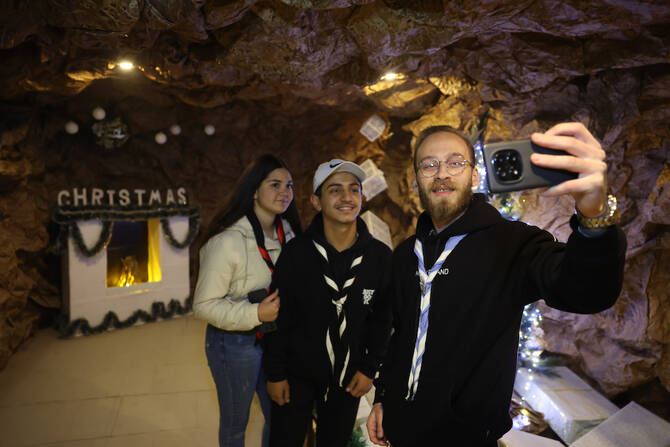
Safar smiled as she photographed the Nativity scene set up in the basement of St. Elias Church in Damascus’s Dweilaa district, a site struck by a terrorist attack on June 22 that killed 25 people and injured at least 63 others.
However, the attack did little to sow sectarian violence among Muslims and Christians. “We celebrate together every year. Muslims visit our church, light candles, and God accepts prayers from everyone,” she told Arab News.
At the Greek Orthodox Church, parishioners continued their tradition of building Damascus’s largest Nativity grotto, a project that took two months. “This is our 21st grotto — we make one every year,” said Samir Dieb, a scout group member.
Visitors, both Muslim and Christian, flocked to see it. “We were shaken by the bombing, but we must be strong, rejoice, and spread joy,” Dieb added.

A visitor to the Nativity grotto in the basement of St. Elias Greek Catholic Church in Damascus’ Douilaa district lights a candle in prayer. (Ali Haj Suleiman)
The Syrian government, at the time, condemned the attack and offered condolences. In a statement, Syrian President Ahmad Al-Sharaa condemned the “heinous” attack and vowed that those involved would face justice.
“We all stand today as one, rejecting oppression and crime in all its forms, and we pledge to the afflicted that we will work day and night,” said Al-Sharaa.
A day after the bombing, two of the suspects were killed and six others arrested in a security operation on a Daesh cell in Damascus.
In the months that followed, security forces accompanied Christians during their holidays across Syria to ensure their protection, though their presence left some feeling uneasy.
Syria hosts some of the world’s oldest Christian communities, with 11 denominations including Orthodox, Catholic, and Protestant, as well as some of the oldest towns and places of worship.
Among the most notable is Maaloula, a town near Damascus where residents who follow Islam and Christianity still speak Aramaic, the language of Christ.

Two children sit for a photo on Santa’s illuminated sleigh in the Christmas Village of Mezze, Damascus. (Ali Haj Suleiman)
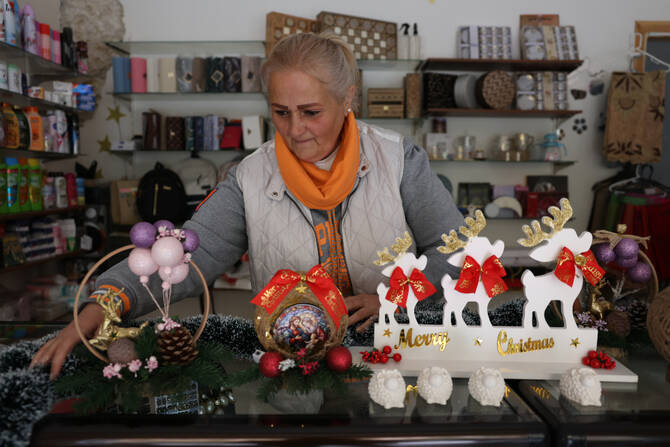
Lina Haddad and her sister Nasreen prepared handmade decorations for their small shop on the hillside.
“The key elements of Syrian Christmas decor are the grotto and the tree topped with a star,” Lina said, noting that this year’s tree was adorned with butterflies instead of traditional ornaments. “In the past, people cared more about decorations than they do today.”
Nasreen recalled how Maaloula once glowed during the holidays, with Muslims and Christians decorating homes together. “The former regime fueled hostility between communities for its own benefit,” she said.
The regime had invoked minority protection to justify its crackdown on the reform-driven uprising, using clerics of all faiths to bolster its image as a legitimate ruler — forcing Christians into a position supporting its brutal campaign against the opposition.
Since then, economic hardship has overshadowed festivities. “Priorities changed,” Nasreen said. “People focused on food and children’s education rather than decorations.”
The World Bank estimates the Syrian pound lost more than 300 times its value between 2011 and 2024, with more than 69 percent of Syrians living in poverty since 2022 and one in four suffering extreme poverty — unprecedented before the war.
Each Damascus neighborhood has its own character. Some show no signs of Christmas or New Year, while others sparkle with lights and music.

Scouts from the Monastery of Our Lady of Saidnaya perform music during the Christmas tree lighting festivities in the town of Saidnaya, Damascus countryside. (Ali Haj Suleiman)
In Mezzeh, a “Christmas Village” featured fireworks, dance troupes dressed as snowmen and cartoon characters, and bustling crowds shopping and taking photos.
In Bab Touma, Qassaa, and Bab Sharqi, decorations were more traditional, with wreaths, red and white ornaments, and men dressed as Santa greeting families.
Aya Al-Mahdi, a Muslim university student, paused with friends near the Roman Catholic Church to admire the lights. “This Christmas feels special — the air even seems cleaner after the regime’s fall,” she said.
“We grew up together as Muslims and Christians in Damascus. Our holidays are shared.”
Nearby, Siham Shaar enjoyed the charity bazaar organized by the church. “Most of my friends are Christian. I love the atmosphere, the joy, and walking these streets with loved ones,” she said.
At the Syriac Catholic Church, Father Boutros Harira spoke of hope for Syria’s future. “The main fear is domination by the Muslim majority without giving the minorities their rights, but we are all citizens of one homeland. Some have stirred sectarianism, but we must live in peace,” he said.

A group dressed as Santa Claus dances during the Christmas tree lighting festivities at the Monastery of Our Lady of Saidnaya. (Ali Haj Suleiman)
He praised President Al-Sharaa’s approach as “excellent,” while stressing the need for patience until security is restored and Christians who emigrated during the war return. “We want those who left to come back so we can build Syria into a modern nation together.”
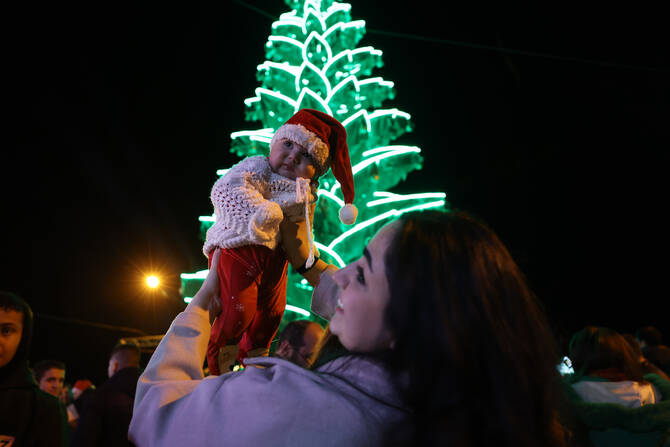
On a hilltop in Saydnaya stands the Church of the Lady of Saydnaya, much of its old halls carved into the stone, beside the town’s grand mosque. The call to Maghrib prayer mingled with church bells and scout music as crowds gathered around the region’s largest Christmas tree.
Sheikh Abdullah Ismail joined Christian clergy and nuns to watch the lighting ceremony. “All believers should rejoice in the birth of Christ,” he told Arab News. “Holding to Muslim identity does not conflict with exchanging greetings during social holidays, especially Christmas.”
The evening included a play on Christ’s birth, dances, fireworks, and the tree lighting. Muslims and Christians cheered together. “Our joys and sorrows are shared — we gather out of love and harmony,” Sheikh Abdullah said. “We all pray for peace and security across our land.”