



AMMAN: As Christmas approaches in Jordan, Fairouz’s popular Christmas hymn “Laylet Eid” (Jingle bells) plays softly in shopping malls, while large, brightly decorated Christmas trees dominate hotel lobbies and public spaces in Amman.
The festive atmosphere is familiar, but for many Jordanian Christians, celebrations this year feel more restrained, shaped by economic pressures and the continued weight of regional conflict.
“This must be at least the fifth year in a row that the world feels sad and chaotic,” said Diana Haddad, a 32-year-old active member of her church community in Amman.
“After the pandemic, then the cost-of-living crisis, and now ongoing wars in the region, it hasn’t felt right to be fully joyful when so much suffering is happening around us.”
Since 2023, the war in Gaza and the broader situation in Palestine have had a particular impact on how Christmas is marked in Jordan.
While the holiday has traditionally been a time of family gatherings, church activities, and public celebrations, many families have opted for quieter observances as an expression of solidarity and reflection.
In 2023, Jordan’s Council of Church Leaders announced the cancellation of all Christmas festivities, including bazaars, scout parades, children’s gift distributions, and decorative initiatives, in solidarity with the people of Gaza.
“I really respected that decision,” Haddad said. “It felt like the right thing to do.”
Although some public celebrations have gradually returned, churches continue to place greater emphasis on community support rather than festivity as the region reels from political turmoil.
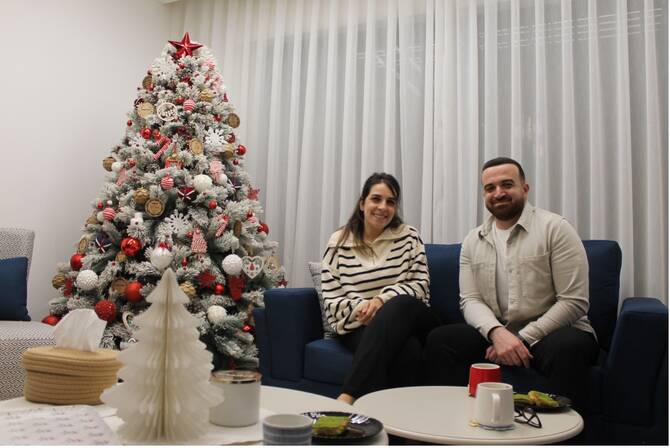
Haddad and her 36-year-old husband Peter Nimri, both actively involved in church initiatives, said that while charity work continues throughout the year, the Christmas season traditionally includes winter aid distributions, food parcels, bazaars, and children’s activities.

Diana Haddad, 32, and Peter Nimri, 36, are dedicating this Christmas to supporting communities of neighboring countries. (Rawan Baybars)
In recent years, however, many of these initiatives have been adapted to offer support to regional neighbors.Nimri explained that gift boxes prepared for children attending Christmas prayers were instead sent to children in Gaza and Syria for the second year in a row.
In another case, a planned children’s lunch at a fast-food franchise was canceled, with the allocated budget redirected to families in Gaza.
“The community supported this decision,” Haddad said. “They appreciated that their children were being introduced to empathy and solidarity at a young age.”
Nimri added that churches in Jordan view all residents within their parish areas as their responsibility, regardless of faith.
Aid is provided regularly to families in need, though distribution methods have changed. “Instead of cash, we now use supermarket and clothing vouchers to ensure basic needs are met,” he said.
Christmas in Jordan also reflects a contrast between public and private celebrations. Aws Shawareb, a 21-year-old university student working as an usher at a Christmas market in Amman, described the festive season as one embraced by Jordanians from all religions.
“Christians and Muslims enjoy the season together,” he said. “Even in small shops around Amman, you see elements of Christmas. It’s a nice demonstration of unity.”
In a sign of this unity and harmony, Jordan’s Crown Prince Al-Hussein bin Abdullah II, joined the festive Christmas tree lighting ceremony at Peace Square in Madaba last week, with performances by Latin and Orthodox scout bands.
Despite the flashy public celebrations, Shawareb believes that “the real Christmas happens at home with family and friends.”

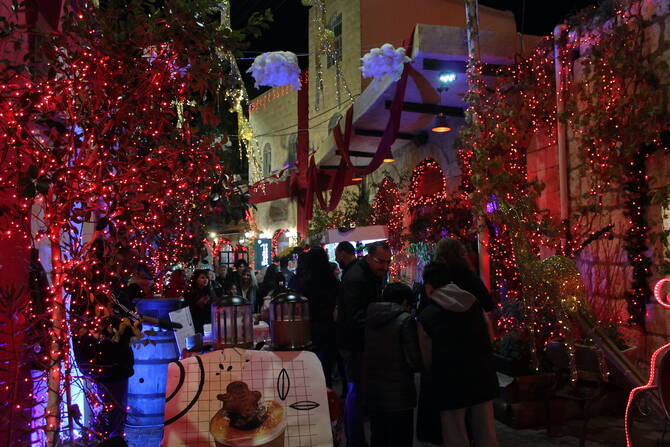
Street lights adorn Amman's streets though citizens say they are opting for a more somber Christmas. (Rawan Baybars)
This sentiment resonates beyond the capital. Mary Giragossian, a 42-year-old Armenian Jordanian who grew up in Aqaba, said the Christmas atmosphere there has always felt more subdued compared to Amman.
“Still, I loved Christmas growing up,” she said. “It was about family gatherings, being together, and the feeling of warmth, even without big decorations.”
From elaborate decorations and expensive gifts to carefully styled Christmas dinners, Giragossian said while joyfulness is important, it is important not to lose the essence of Christmas or forget its spiritual meaning.
Nimri agreed, noting that Christmas has become part of a broader trend of seasonal consumerism. “It’s similar to how Ramadan or Mother’s Day are used as promotional opportunities,” he said.
For many families, Christmas Day itself reflects this balance. Shawareb spends the morning with his family and the evening celebrating with friends. Yet he expressed discomfort with the influence of social media on the holiday.
“Some people post just to show off outfits and expensive gifts,” he said. “Christmas should be about family togetherness.”
Social media has also reshaped how traditions are presented, particularly when it comes to food. Haddad laughed as she referenced the popularity of sophisticated cheese platters online.
“They’re chic, but completely new to our celebrations,” she said.

Christmas street decorations in Amman, Jordan. (Rawan Baybars)
Some traditions, however, remain unchanged. Christmas Eve dinners still feature roasted turkey and large pots of waraq dawali — stuffed grape leaves — prepared for family gatherings.
Nimri, who grew up in Zarqa, recalled that his experience of Christmas as a child differed significantly from that of his cousins in the US.
Today, he believes his four-year-old son Amir enjoys greater exposure to festive celebrations, particularly since the family lives in Amman, where public decorations and events are more visible.
While Amman remains the center of Christmas activity, Haddad noted that social media has narrowed the gap between the capital and other cities by giving more people access to festive ideas and decorations.
Still, caution remains. “It’s important to preserve the spiritual meaning and the story behind Christmas,” she said.
For many Jordanian Christians, Christmas this year is less about spectacle and more about continuity, maintaining faith, community, and compassion amid uncertainty.
Reserved celebrations, they say, have become a way to hold on to hope while remaining mindful of the suffering that continues to shape the region.


