

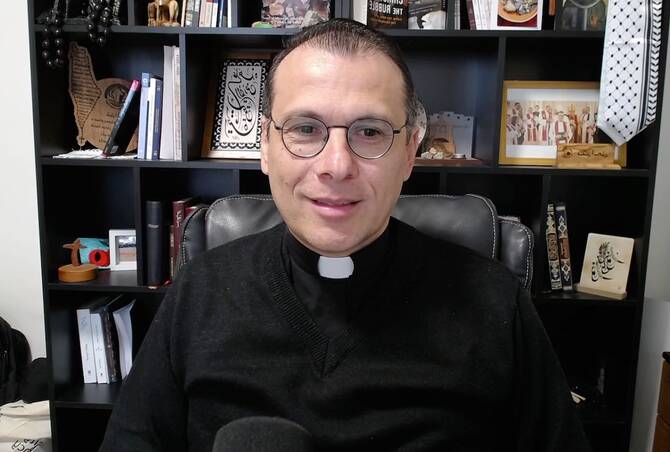



RAMALLAH: When Rev. Dr. Munther Isaac speaks about resistance, he does not begin with theology. He begins with memory.
Growing up in the Palestinian town of Beit Sahour, often referred to as the Shepherd’s field, during the First Intifada, Isaac remembers fear and excitement intertwined — the thrill of collective action and the dread of military retaliation.
Beit Sahour, a predominantly Christian town southeast of Bethlehem, became known internationally in the late 1980s for its campaign of nonviolent civil disobedience under the slogan “No taxation without representation.”
“I was a child,” Isaac recalls. “I remember the excitement of participating in the popular committees — and the fear. Fear of being shot, fear of soldiers coming to the house.”
The resistance was not abstract. It reached directly into his family’s life. Israeli authorities confiscated the family car in exchange for unpaid taxes from their pharmacy.
Soldiers raided homes across the town, seizing televisions and appliances. When they came to the Isaacs’ house, they found little — the family had hidden their belongings at a relative’s home.
“They asked my father where the television was,” Isaac told Arab News. “He told them it was broken.” The Israeli soldiers scoffed, saying it seems “all the televisions in Beit Sahour are broken.”
These childhood memories — of curfews, neighbors sharing bread, families running from house to house to survive — would later form the emotional foundation of Isaac’s theology: a faith inseparable from lived reality.
Though young, Isaac remembers clearly the first martyrs of Beit Sahour.
He recalls Edmond Ghanem, who was killed when a stone dropped by Israeli soldiers from a rooftop struck his head, and Iyad Abu Sa’da, who was shot by Israelis and whose death left a deep mark on the community.
“These were not distant events,” Isaac said. “They happened in front of our homes, in our streets. Even as children, we felt it.”
The First Intifada shaped not only Isaac’s political consciousness, but his understanding of faith as something public, communal, and rooted in responsibility and sacrifice. That understanding would later define his ministry.
Long before his sermons reached global audiences, Isaac was known locally for something quieter: music.
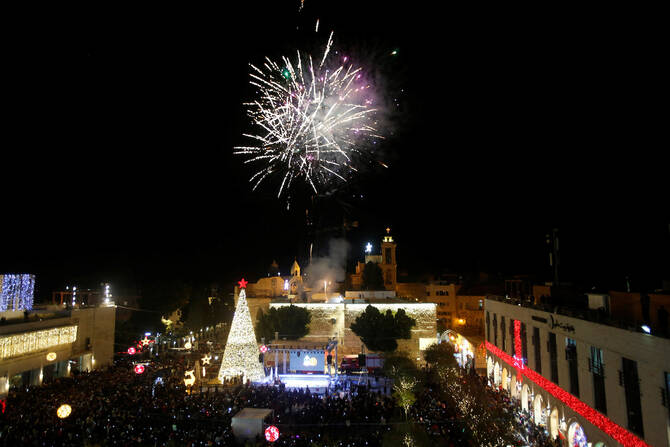
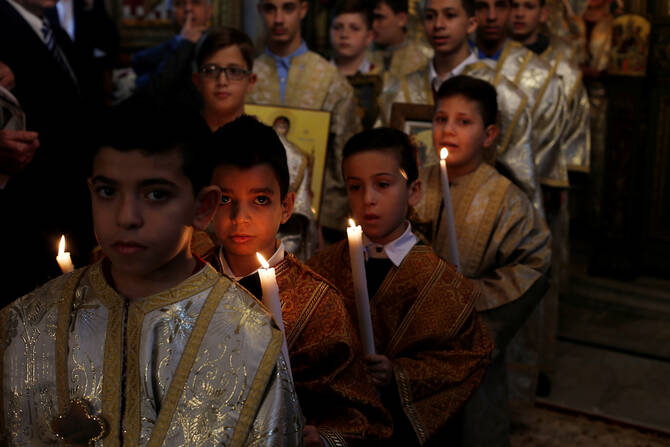
As a young man, he led the Bethlehem Bible College choir which participated in Christmas celebrations in Bethlehem’s Manger Square. The choir members sang carols wearing the Palestinian keffiyeh and traditional embroidered Palestinian dress.
“This was intentional,” he said. “Christianity in Palestine is not separate from Palestinian identity. We are as proud of our nationality as we are of our faith.”
For Isaac, hymn-singing was never escapist. It was rooted in place and history.
“Singing was born here,” he said. “David sang in Bethlehem. The angels at Christmas sang praises for the birth of Christ. So we have been continuing a tradition thousands of years old.”
Years later, Isaac would co-lead one of the most consequential faith-based initiatives to emerge from Palestine: the “Christ at the Checkpoint” conference.
Launched with Alex Awad, a Palestinian-American pastor and dean of students at the Bethlehem Bible College, the conference posed a deceptively simple question: If Christ were standing at a military checkpoint today, where would he stand?
“The idea was to connect faith to reality,” Isaac said. “To challenge theological interpretations that ignore the lived experience of Palestinians.”
The conference directly confronted Christian Zionism — a theological movement, particularly influential among Western evangelicals, that offers unconditional religious support for Israel.
Rather than engaging in abstract doctrinal debates, “Christ at the Checkpoint” focused on consequences: how theology shapes policy, politics, and daily life.
Over time, the conference grew beyond evangelical dialogue. It became a platform for Palestinian Christian voices to challenge racism, colonialism, and theological frameworks that sanctify oppression.
“Hundreds participated in each edition,” Isaac said. “And I am convinced it planted seeds. What we see today — cracks in the once-solid wall of evangelical Zionism — did not happen overnight.”
If “Christ at the Checkpoint” challenged theology, “Christ in the Rubble” shattered complacency.
The phrase emerged from a sermon Isaac delivered in Bethlehem shortly after the Israeli bombing of Gaza’s St. Porphyrius Church, one of the world’s oldest Christian sites, in October 2023.
Members of his own congregation were grieving. A woman had lost her sister in the attack.
Isaac turned to the crucifix. “I see God under the rubble, in the operating rooms, with the afflicted,” he told the congregation.
The phrase spread rapidly. “God is under the rubble” became a viral expression, adopted far beyond its original context.
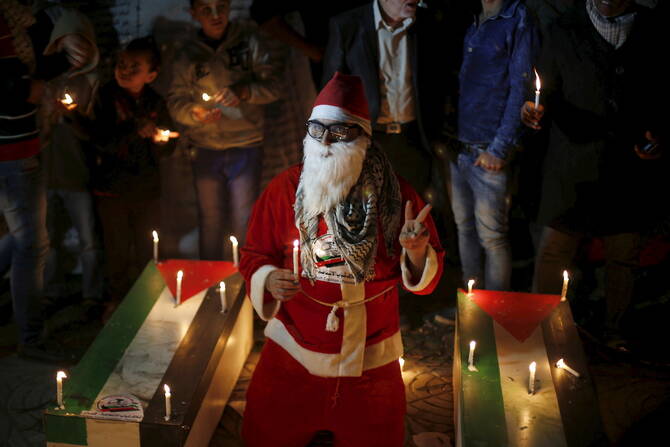
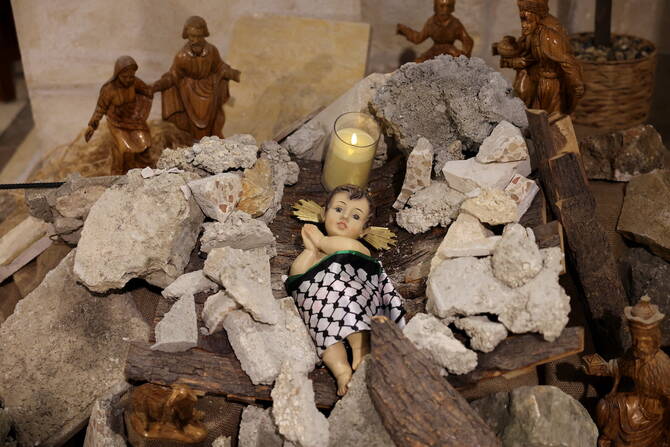
When Bethlehem’s churches debated whether to cancel Christmas celebrations amid the devastation in Gaza, Isaac proposed an alternative: a nativity scene made of rubble. The infant Jesus was wrapped in a keffiyeh.
“It wasn’t meant as a political provocation,” he said. “It was a message of faith. Christ stands in solidarity with the suffering — because he was born into suffering.”
The image reverberated around the world, transforming Isaac into an unexpected global figure.
“Suddenly there were cameras everywhere,” he said. “And I remember telling journalists: ‘Why are you here? The story is Gaza. My soul is in Gaza.’”
Yet the visibility mattered. For many, the image became an entry point — not only into Gaza’s suffering, but into the existence of Palestinian Christians.
“It reached people who had never paid attention before,” Isaac told Arab News. “Unfortunately, an image in Bethlehem moved them more than real images from Gaza.”
The response was not limited to the West. Across the Arab world, many expressed surprise — and gratitude — at seeing Palestinian Christian voices so clearly aligned with their people.
“There is still a lack of awareness about Palestinian Christians,” Isaac said. “This moment helped change that.”
The symbolism drew criticism. During a visit to Bethlehem, Germany’s ambassador questioned Isaac for dressing Christ in a keffiyeh rather than an Israeli flag after the Oct. 7, 2023, Hamas-led attack.
Isaac’s response was measured but firm.
“When Israeli children were killed, the world showed solidarity. Israeli flags were placed on landmarks across Europe, including the Berlin wall,” he told the diplomat. “Thousands more children have since been killed in Gaza. Where is that solidarity?”
For Isaac, the keffiyeh represented humanity, not exclusion.
“I see the image of Christ in every child in Gaza,” he said, invoking the Gospel of Matthew: “Whatever you did for the least of these, you did for me.”
The momentum culminated in a landmark collective statement signed by Arab evangelical leaders across the Middle East, rejecting Christian Zionism and affirming Palestinian rights.
The Aug. 5, 2024, document, “A collective call to the global church from Middle East evangelical leaders,” called on Christians everywhere to restore unity in the body of Christ, which has been hurt due to the distorted view of Western church leaders.
Isaac insisted that this was not just a Palestinian document. “It was a Middle Eastern evangelical one arguing that Christian Zionism undermines the credibility and safety of Christians throughout the region — and contradicts the Gospel itself.”
Many supporters, Isaac said, were private rather than public. Financial ties, political resentments, and Western institutional influence all play a role, he believes, in silencing dissent.
Despite continued high-profile visits by pro-Israel evangelical leaders to Jerusalem, including 1,000 US pastors that came in solidarity with the Israeli government, Isaac sees these as signs of decline rather than strength.
“They are trying to salvage what they can,” he said. “But the change is real, especially among young Christians.” The task ahead, he argued, is theological.
“We must provide material for those who feel this alliance is wrong but lack the language to challenge it,” Isaac said. “The Bible does not command Christians to support injustice.”
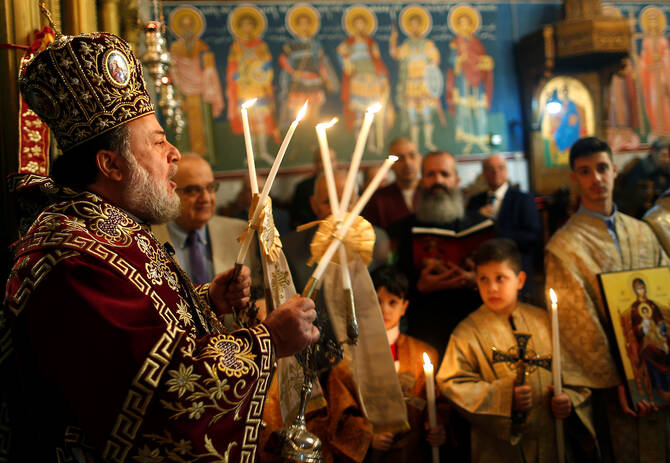
xmas2025Now based in Ramallah, Isaac continues his pastoral work amid new opportunities and challenges. Lighting a red Advent candle as part of a global church campaign, he emphasized continuity and presence.
“The message is simple,” he said. “We are still here.”
While Ramallah offers greater diplomatic and media exposure, Isaac insisted his priorities remain pastoral — especially youth ministry.
“I don’t want to be known only as a public figure.” He said: “What matters to me is being a good pastor.”
From Beit Sahour’s nonviolent resistance to Gaza’s rubble, Munther Isaac’s journey reflects a theology forged not in abstraction, but in lived Palestinian reality — a faith that insists God is found not in power, but in solidarity.


