

Pakistani, Bahraini commanders discuss maritime security, vow to boost naval cooperation

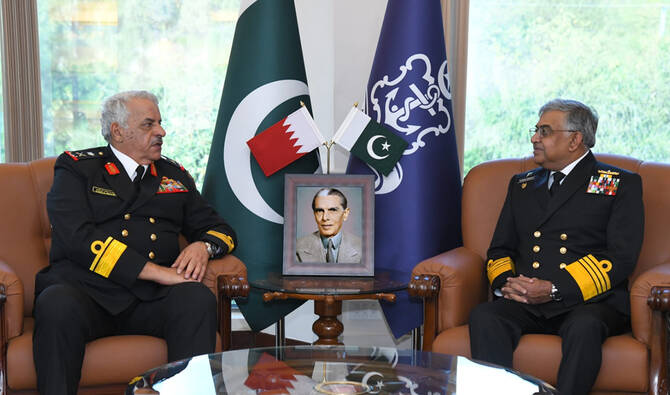
Pakistan Naval Chief Admiral Naveed Ashraf meets Royal Bahrain Naval Force Commander Rear Admiral Ahmed Mohamed Ebrahim Al bin Ali (left) at the Naval Headquarters in Islamabad, Pakistan, on December 23, 2025. (Pakistan Navy)
Short Url
Updated 24 December 2025
Follow

Pakistani, Bahraini commanders discuss maritime security, vow to boost naval cooperation

  • Pakistan and Bahrain have maintained close diplomatic, security, trade and defense relations
  • Both sides reaffirm commitment to further enhance professional interaction, defense collaboration

ISLAMABAD: Pakistani and Bahraini naval officials have discussed regional maritime security and reaffirmed their commitment to strengthening cooperation between the two navies, Pakistan Navy said on Tuesday.

The statement came after a meeting between Pakistan Naval Chief Admiral Naveed Ashraf and Royal Bahrain Naval Force Commander Rear Admiral Ahmed Mohamed Ebrahim Al bin Ali at the Naval Headquarters in Islamabad.

Pakistan and Bahrain have maintained close diplomatic, security, trade and defense relations and have undertaken joint training and security initiatives, besides regular high-level exchanges.

“During the meeting with Chief of the Naval Staff, matters of mutual interest, regional maritime security and avenues for bilateral naval cooperation were discussed,” Pakistan Navy said in a statement.

“Both sides reaffirmed their commitment to further enhance professional interaction and defense collaboration between the two navies.”

Earlier upon arrival at the Naval Headquarters, a smartly turned out contingent of Pakistan Navy presented Guard of Honour to the Bahraini commander, according to the statement.

The visiting dignitary laid a floral wreath at Pakistan Navy martyrs’ monument and was introduced with principal staff officers at the headquarters.

“The visit underscores the strong and friendly relations between Pakistan and Bahrain and reflects the shared resolve to promote peace and stability in the region,” Pakistan Navy said.

Earlier in Sept., Pakistan and Bahrain agreed to enhance cooperation in naval training and regional maritime security operations. During the same month, the Bahraini Chief of Defense Staff Lt. Gen. Thiab Saqer Abdulla Al-Nuaimi met with

Pakistan’s Air Chief Marshal Zaheer Ahmed Baber Sidhu and expressed Bahrain’s interest in learning from the PAF’s experience in multi-domain operations.

In July, Pakistan’s Interior Minister Mohsin Naqvi also met his Bahraini counterpart General Sheikh Rashid bin Abdullah Al-Khalifa to further strengthen security collaboration between both countries.


Pakistani students stuck in Afghanistan permitted to go home

Updated 12 January 2026
Follow

Pakistani students stuck in Afghanistan permitted to go home

  • The border between the countries has been shut since Oct. 12
  • Worries remain for students about return after the winter break

JALALABAD: After three months, some Pakistani university students who were stuck in Afghanistan due to deadly clashes between the neighboring countries were “permitted to go back home,” Afghan border police said Monday.

“The students from Khyber Pakhtunkhwa (northwest Pakistan) who were stuck on this side of the border, only they were permitted to cross and go to their homes,” said Abdullah Farooqi, Afghan border police spokesman.

The border has “not reopened” for other people, he said.

The land border has been shut since October 12, leaving many people with no affordable option of making it home.

“I am happy with the steps the Afghan government has taken to open the road for us, so that my friends and I will be able to return to our homes” during the winter break, Anees Afridi, a Pakistani medical student in eastern Afghanistan’s Nangarhar province, told AFP.

However, worries remain for the hundreds of students about returning to Afghanistan after the break ends.

“If the road is still closed from that side (Pakistan), we will be forced to return to Afghanistan for our studies by air.”

Flights are prohibitively expensive for most, and smuggling routes also come at great risk.

Anees hopes that by the time they return for their studies “the road will be open on both sides through talks between the two governments.”