

Pakistan, China ink 24 agreements to develop digital corridor for IT cooperation

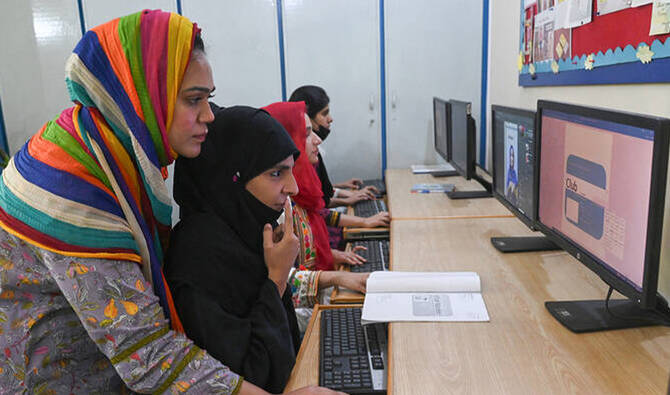
This photograph taken on May 6, 2024 shows hearing-impaired youths attending a computer class at a school run by the charity Deaf Reach, a non-profit organisation working to empower disadvantaged deaf children and youths, in Lahore. (AFP/File)
Short Url
Updated 22 December 2025
Follow

Pakistan, China ink 24 agreements to develop digital corridor for IT cooperation

  • Both countries sign one government-to-government, seven government-to-business and 16 business-to-business MoUs
  • Digital corridor will create new avenues for Pakistani tech companies, expand cooperation with China in ICT, says state media

ISLAMABAD: Pakistan and China have signed 24 agreements to develop a digital corridor aimed at enhancing information technology (IT) cooperation between the two states, state-run media reported on Monday. 

The memoranda of understanding between the two sides were signed in Beijing, according to the state-owned Associated Press of Pakistan (APP). 

The MoUs include one government-to-government, seven government-to-business and 16 business-to-business agreements.

“The initiative focuses on developing an innovative and pragmatic digital corridor to enhance cooperation in the IT industry,” APP reported. 

APP said the digital corridor will create new avenues for Pakistani tech companies and expand bilateral cooperation with China in the information and communication technology infrastructure development.

The development is in line with Pakistan’s recent efforts to boost IT exports and enhance digital cooperation with regional allies. 

In November, Pakistan highlighted the “Digital Silk Road” as the next major phase of the China–Pakistan Economic Corridor (CPEC) while proposing new technology partnerships with Beijing, including joint ventures in 5G/6G, hardware manufacturing and ICT components. 

Launched in 2015, CPEC is a multibillion-dollar connectivity program linking western China to the Arabian Sea. The initiative has historically focused on energy projects, highways, power plants and the Gwadar port, with committed investments estimated at around $60 billion. 

As the two countries enter CPEC’s second phase, cooperation is expanding beyond physical infrastructure into technology, digital governance, manufacturing and skills development.

The Digital Silk Road is Beijing’s framework for cross-border connectivity in fiber, cloud services, data routing, smart manufacturing and emerging technologies. It is increasingly positioned as the backbone of CPEC’s next stage. 


Pakistan interior minister urges FIA to intensify crackdown against money launderers

Updated 5 sec ago
Follow

Pakistan interior minister urges FIA to intensify crackdown against money launderers

  • Pakistan’s Interior Minister Mohsin Naqvi holds high-level meeting at Federal Investigation Agency Karachi Zone 
  • FIA launched nationwide crackdown against illegal currency dealers in August to curb financial corruption, “terrorism”

KARACHI: Pakistan’s Interior Minister Mohsin Naqvi ordered a “comprehensive crackdown” against money launderers and human smugglers, his ministry said on Sunday amid Islamabad’s efforts to curb financial corruption and illegal migration. 

The directives from Naqi came as he visited the Federal Investigation Agency (FIA) Karachi Zone and held a special meeting to review the institution’s performance. 

‎“Interior Minister Mohsin Naqvi ordered a comprehensive crackdown against the money-laundering mafia and directed that major money launderers be dealt with firmly,” the ministry said. 

“He instructed that the entire money trail of those involved in money laundering be exposed.”

Since August 2025, the FIA has been targeting illegal currency dealers, including operators of hundi and hawala, informal money transfer systems that operate outside official banking channels. The government launched the crackdown after concerns over a sharp decline in the value of the rupee, which fell to a 22-month low against the US dollar in August.

While commonly used for remittances, informal money transfer systems are also prone to abuse for money laundering and terror financing.

Naqvi also ordered effective action against agent mafias involved in human smuggling, his ministry said. He said elements who deceive innocent people with false promises of employment abroad do not deserve any leniency. 

The minister said that the shortage of human resources in the FIA Karachi Zone would be addressed on a priority basis.

During the briefing, the minister was told that over the past four months, 20 agents involved in human smuggling have been arrested, and non-custom-paid goods and drugs worth Rs140 million [$500,173] have been seized.

“The interior minister sought performance reports from in-charge officers regarding their respective circles and directed them to work with greater diligence,” the statement said.