

Nine Afghan citizens killed, 10 injured in accident in southwestern Pakistan— police 

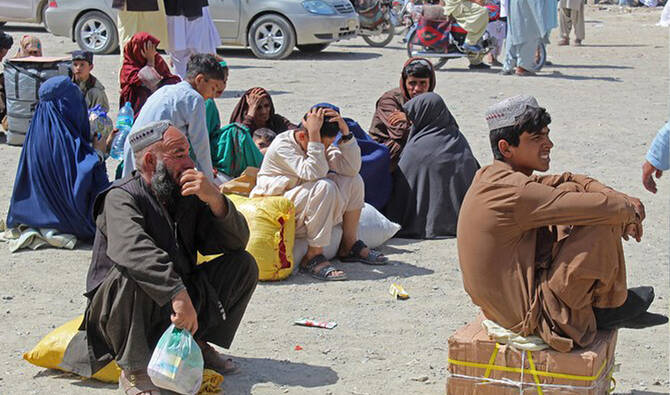
Afghanistan's and Pakistani nationals gather to enter Afghanistan as they wait for the reopening of the Pakistan-Afghanistan border crossing point in Chaman on September 2, 2021. (AFP/File)
Short Url
Updated 22 December 2025
Follow

Nine Afghan citizens killed, 10 injured in accident in southwestern Pakistan— police 

  • Pickup truck carrying Afghan nationals collided with oil tanker in Nokundi town, says police official
  • Says Afghan nationals were attempting to enter Europe illegally via Iran as per preliminary probe

QUETTA: At least nine Afghan nationals were killed and 10 others injured in southwestern Pakistan on Sunday when the pickup truck they were traveling in collided with an oil tanker, a police official said.

The collision occurred in Nokundi, a town located on Pakistan’s border with Iran in the southwestern Balochistan province. District Police Officer Muhammad Shareef Kalhoro told Arab News that the Zamyad vehicle (a pickup truck made by Iranian automobile manufacturer Zamyad Co.) was transporting Afghan nationals illegally when the accident took place.

“Twenty-one illegal Afghan migrants were onboard the Zamyad vehicle when it was hit by an oil tanker in the kacha [remote] area of Nokundi,” Kalhoro said.

“Nine Afghans were killed on the spot and 10 were injured in the serious accident,” he added.

The police official said the bodies and injured persons were sent back to Afghanistan through cross-border coordination and in accordance with legal protocol.

Kalhoro said preliminary investigations indicate the Afghan nationals were attempting to enter Europe illegally from Afghanistan via Iran, facilitated by an organized human smuggling network.

“All legal proceedings have been initiated, and the human smuggling network is being traced for further action,” he said.

Pakistan launched a nationwide crackdown against people living in the country illegally in 2023, with Afghan refugees bearing the brunt of the deportation drive. Pakistan says it has deported over 1.5 million Afghans since then. The crackdown was launched after a spate of suicide attacks in the country that Islamabad blamed on Afghan nationals without providing proof.

Thousands of migrants travel illegally through the desolate areas of Chaghi district in Balochistan every year in an attempt to reach Europe via Iran.

Balochistan, home to the multi-billion-dollar China-Pakistan Economic Corridor project, is considered by experts to be Pakistan’s most underdeveloped province across almost all social and economic indicators.

The province is also home to multi-billion-dollar mineral projects such as Saindak and Reko Diq. However, most districts in Balochistan have dilapidated roads, which often lead to fatal accidents.


Pakistan party calls Sindh resolution against new provinces ‘unconstitutional’

Updated 5 sec ago
Follow

Pakistan party calls Sindh resolution against new provinces ‘unconstitutional’

  • The development follows calls to separate Karachi from Sindh amid governance concerns intensified by a deadly mall fire last month
  • Muttahida Qaumi Movement-Pakistan calls for a referendum in urban areas of Sindh for the establishment of a new administrative unit

ISLAMABAD: The Muttahida Qaumi Movement-Pakistan (MQM-P) political party on Sunday criticized the Sindh provincial government for adopting a resolution in the provincial assembly against the creation of new provinces, describing it as “illegal, unconstitutional.”

The resolution was adopted on Saturday after fresh demands by the MQM-P and other voices to grant Karachi a provincial or federal status following governance challenges highlighted by a deadly mall fire earlier this year that killed 80 people.

Karachi, Pakistan’s largest city that is home to more than 20 million, is the country’s main commercial hub and contributes a significant share to the national economy.

Speaking at a press conference, MQM-P’s Khalid Maqbool Siddiqui said the Constitution of Pakistan provided procedure for establishing new provinces, but a province had “carried itself as if it were a separate country,” referring to Saturday’s resolution.

“Anything in contrast with the constitution cannot be adopted. This is illegal, unconstitutional, undemocratic,” he said, calling for a referendum in urban areas of Sindh for the establishment of a new administrative unit in the region.

Sindh Chief Minister Syed Murad Ali Shah had tabled the resolution in the assembly on Saturday, condemning what he described as “divisive statements” about breaking up Sindh or detaching Karachi.

“The province that played a foundational role in the creation of Pakistan cannot allow the fragmentation of its own historic homeland,” Shah told lawmakers, citing Article 239 of Pakistan’s 1973 Constitution, which requires the consent of not less than two-thirds of a provincial assembly to alter provincial boundaries.

“If any such move is attempted, it is this Assembly — by a two-thirds majority — that will decide,” he said.

The resolution reaffirmed that Karachi would “forever remain” an integral part of Sindh and directed the provincial government to forward the motion to the president, prime minister and parliamentary leadership for record.

Calls to alter Karachi’s status have periodically surfaced amid longstanding complaints over governance, infrastructure and administrative control in the megacity, though no formal proposal to redraw provincial boundaries has been introduced at the federal level.

Taha Ahmed Khan, a senior MQM-P member, acknowledged that his party had “presented its demand openly on television channels with clear and logical arguments” to separate Karachi from Sindh.

“It is a purely constitutional debate,” he told Arab News on Saturday. “We are aware that the Pakistan Peoples Party, which rules the province, holds a two-thirds majority and that a new province cannot be created at this stage. But that does not mean new provinces can never be formed.”