

US ‘grateful’ for Pakistan’s offer to be part of Gaza stabilization force, Rubio says

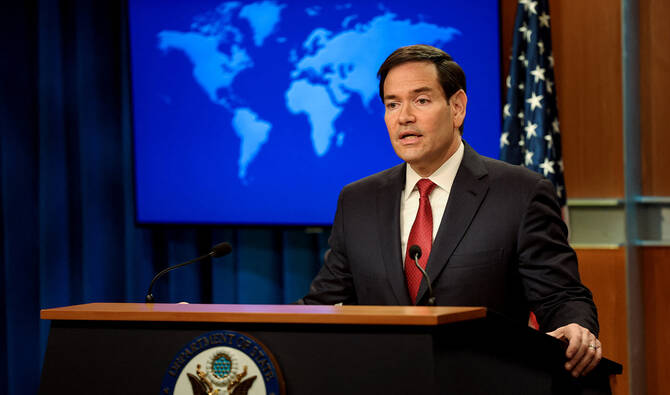
US Secretary of State Marco Rubio speaks during his end-of-year press conference at the State Department in Washington, D.C., US, on December 19, 2025. (REUTERS/File)
Short Url
Updated 20 December 2025
Follow

US ‘grateful’ for Pakistan’s offer to be part of Gaza stabilization force, Rubio says

  • The international stabilization force is a cornerstone of President Donald Trump’s peace plan for Gaza announced in September
  • Islamabad has previously said it is willing to join the Gaza peace force but ‘not ready’ to play any role in disarming Hamas

ISLAMABAD: The United States (US) is grateful for Pakistan’s offer to take part in a potential international stabilization force for Gaza, Secretary of State Marco Rubio said on Friday, as diplomatic efforts continue over the Palestinian enclave’s post-war security arrangements.

The statement came days after Pakistan among dozens of countries attended a conference in Qatar, hosted by the US, to discuss command structure and other unresolved operational issues relating to the Gaza stabilization force.

Top officials of Qatar and Egypt — key mediators of the ceasefire — and regional power Turkiye headed Friday to Miami to meet US envoys including Steve Witkoff, President Donald Trump’s friend and roving envoy.

Speaking at a news conference in Washington, Rubio was hopeful that countries would send troops as part of the force in Gaza and pointed to Pakistan which does not recognize Israel but is considering a troop deployment.

“I feel very confident that we have a number of nation states acceptable to all sides in this who are willing to step forward and be a part of that stabilization force,” Rubio said.

“We’re very grateful to Pakistan for their offer to be a part of it, or at least their offer to consider being a part of it.”

Islamabad has previously said that it is willing to join the Gaza peace force but “not ready” to play any role in disarming Palestinian group Hamas. Hamas’s Gaza chief Khalil Al-Hayya said Sunday the militant group had a “legitimate right” to hold weapons. Israel has repeatedly insisted that Hamas will be disarmed.

The international stabilization force, which is to be composed of troops from Muslim countries, is a cornerstone of President Donald Trump’s peace plan for Gaza announced on Sept. 29 this year.

The United Nations Security Council last month approved Washington’s plan, which called for a yet-to-be-established Board of Peace as a transitional authority that Trump would head, and the stabilization force, which would be empowered to oversee borders, provide security and demilitarize the territory.

Rubio said he thought they owe these nations a few more answers before asking them to commit to the Gaza peace force.

“We are trying to make a lot more progress here with them,” he shared. “The next step here is announcing the border peace, announcing the Palestinian technocratic group that will help provide daily governance... I think that will allow us to firm up the stabilization force, including how it’s going be paid for, what the rules of engagement are, what their role in demilitarization will be and so forth.”


Pakistan non-bank financial sector assets rose 21% in second half of 2025 — SECP

Updated 4 sec ago
Follow

Pakistan non-bank financial sector assets rose 21% in second half of 2025 — SECP

  • Mutual fund assets reached $16.1 billion, accounting for 66% of total industry assets
  • NBFC lending assets jumped 65% as Shariah-compliant assets grew to 36% of the sector

ISLAMABAD: Pakistan’s non-bank financial sector expanded in the second half of 2025, with total assets rising 21% to Rs6.84 trillion ($24.4 billion) by Dec. 31, the Securities and Exchange Commission of Pakistan (SECP) said on Wednesday.

The growth, up from Rs5.635 trillion ($20.1 billion) in June 2025, was driven by strong performance in fund management and lending segments, according to the regulator’s latest report, reflecting increased investor participation and expansion of Shariah-compliant assets.

“The fund management sector recorded solid growth of 17% during the period,” the SECP said in the statement.

“Mutual funds remained the largest sub-sector, managing assets of Rs. 4.5 trillion [$16.1 billion], which account for 66.3% of total industry assets.”

“The number of funds and plans increased from 369 to 409,” it continued. “Mutual fund investments remained well diversified, with 44% allocated to money market funds, 23% to income funds, and 14% to equity funds.”

The statement said investor participation also witnessed an increase, with mutual fund investor accounts reaching 845,000 by the end of December, an 8 percent rise since June 2025 and double the level recorded in December 2022.

Participation in voluntary pension schemes rose to 143,154 accounts, marking a 30% increase over six months and a 170% rise compared with December 2022.

The lending segment of non-bank financial companies (NBFCs) posted particularly strong growth, with assets climbing 65% over the six-month period to Rs824 billion ($2.9 billion).

Shariah-compliant assets totaled Rs2.47 trillion ($8.8 billion), accounting for 36% of overall industry assets, the report said.

The number of registered NBFCs and Modaraba entities rose to 185 from 174 in June 2025, underscoring continued sector expansion.

Pakistan’s non-bank financial sector plays a growing role in capital formation and savings mobilization, complementing the banking system in a country where financial inclusion remains a policy priority.