

Pakistan telecom infrastructure and VC firms flag tax, regulatory constraints, propose remedies

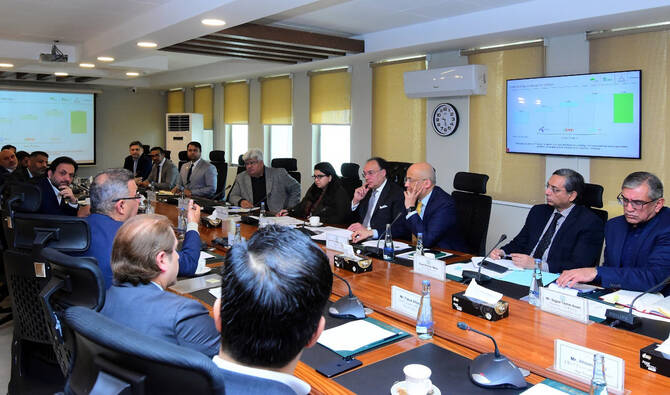
Federal Minister for Finance and Revenue, Muhammad Aurangzeb, holding meeting with a delegation comprising telecommunication infrastructure companies (TOWERCO Pakistan) and Venture Capital Firms (VCs) at the Finance Division in Islamabad, on December 19, 2025. (Ministry of Finance)
Short Url
Updated 19 December 2025
Follow

Pakistan telecom infrastructure and VC firms flag tax, regulatory constraints, propose remedies

  • Finance minister agrees to set up working group to examine proposals, develop recommendations
  • Development comes as Pakistan seeks investment in digital connectivity and technology-led growth

KARACHI: Federal Minister for Finance and Revenue Muhammad Aurangzeb met a delegation of telecom infrastructure companies and venture capital firms on Friday to review sectoral issues, including taxation and regulatory challenges, as the government looks to support investment in digital connectivity and technology-led growth.

Unlike mobile operators that sell voice and data services to consumers, telecom infrastructure companies own and operate physical assets such as mobile towers, which they lease to network operators. The firms operate capital-intensive businesses that rely on long-term investment and face regulatory approvals for tower deployment, power supply and right-of-way permissions.

Tower-related businesses in Pakistan also face tax issues alongside high upfront costs, import duties on equipment and complex provincial and local approval processes as constraints on expansion.

“During the meeting, participants shared an overview of their respective business models, operational dynamics, and on-ground challenges, particularly those related to physical infrastructure deployment and regulatory compliance,” the finance division said in a statement after the meeting.

“Members of the delegation presented a number of proposals aimed at rationalizing and relaxing elements of the existing tax regime to help facilitate further growth, enhance investment flows and support expansion in both the telecommunications infrastructure and venture capital sectors,” it continued.

The finance minister said the government was committed to facilitating private sector-led growth while maintaining fiscal discipline, and stressed the importance of predictable and transparent policies to attract long-term investment in technology and infrastructure.

“It was agreed that a dedicated working group would be constituted, comprising representatives from the Tax Policy Office and other relevant stakeholders, to undertake a detailed examination of the proposals and recommendations presented by the delegation,” the statement said.

“The working group will assess the proposals in detail and develop actionable recommendations,” it added.


Pakistan’s Engro executes $475 million Islamic financing deal to expand telecom infrastructure

Updated 6 sec ago
Follow

Pakistan’s Engro executes $475 million Islamic financing deal to expand telecom infrastructure

  • Islamic banking accounts for over a fifth of Pakistan’s banking assets amid a shift toward Shariah-compliant finance
  • The deal brings more than 10,000 telecom towers under Engro’s control, enabling their shared use by multiple operators

KARACHI: Pakistan’s largest conglomerate Engro Corp. has completed a Rs133 billion ($475 million) Islamic financing deal to acquire telecom tower company Deodar, expanding its telecom infrastructure business as the country seeks to strengthen digital connectivity, the company said on Friday.

The transaction, structured entirely through Shariah-compliant financing, brings more than 10,000 telecom towers under Engro’s control and marks one of the largest Islamic financing deals in Pakistan’s infrastructure sector.

Engro, which has major interests in energy, fertilizers, food and petrochemicals, said the acquisition would allow it to scale shared telecom infrastructure, under which a single tower can host multiple mobile network operators, lowering costs and reducing duplication as Pakistan prepares for next-generation digital services.

“My congratulations to the Dawood family and Engro, the Islamic bankers and conventional banks through their Islamic windows on being able to put together a deal of this size,” State Bank of Pakistan Governor Jameel Ahmed said at a ceremony marking the transaction, referring to the company and its chairman. “This is a great achievement which has been supported by the banks.”

The deal was supported by a group of local banks, including United Bank Limited and Meezan Bank, Engro said, highlighting the increasing role of Islamic financing in funding long-term investment in Pakistan.

Islamic banking, which operates without interest and is based on profit-and-loss sharing structures, accounts for more than a fifth of Pakistan’s banking assets, and authorities have said they aim to transition the financial system toward Shariah compliance over the coming years.

The acquisition of Deodar, which was originally carved out of mobile operator Jazz, also aligns with government efforts to digitize the economy by expanding broadband access and supporting digital payments, e-commerce and online public services, though progress has remained uneven due to infrastructure and regulatory challenges.