

ALKHOBAR: In a crowded refugee hospital in southern Lebanon, artificial intelligence has become an unexpected ally for exhausted doctors struggling to manage overwhelming patient loads.
At Al-Hamshari Hospital, near Sidon’s Ein El-Hilweh camp, the scent of antiseptic mingles with diesel fumes from backup generators. Serving more than 4,000 patients each month with just 56 doctors and 31 nurses, many of them Palestinians excluded from Lebanon’s national healthcare system, the hospital is perpetually stretched thin.
Yet amid the chaos, a small innovation is reshaping care: a generative AI assistant that listens, writes, and guides.

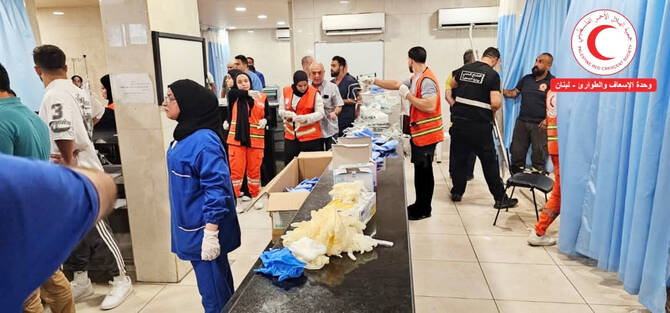
Doctors examine young patients inside a pediatric ward at Al-Hamshari Hospital. (Supplied)
The pilot, led by UK-Qatar healthtech startup Rhazes AI, represents the first structured trial of an AI clinical assistant in a conflict-affected healthcare system. Operating in Al-Hamshari’s outpatient and emergency departments under the Palestine Red Crescent Society, it tests whether AI can ease the crushing workload of frontline doctors.
“AI tools shouldn’t be confined to developed health systems,” said Dr. Zaid Al-Fagih, co-founder and CEO of Rhazes AI, who once served in the UK’s NHS and volunteered in Syrian war zones. “They should start where the need is greatest.”
The decision to deploy the system in Lebanon’s most under-resourced hospital wasn’t symbolic — it was strategic. Rhazes aimed to see if its technology could function under the harshest conditions: unreliable power, weak internet, limited digital literacy, and no room for error.
Inside Al-Hamshari, even basic digital care is rare. “A pediatrics ward in Dubai might have dozens of computers,” Al-Fagih said. “At Al-Hamshari, there are just two — one per floor. So, we deployed Rhazes on smartphones and supplied mini-printers that weren’t available before. That’s how we introduced not just AI, but entirely new digital processes.”

Rhazes acts as an end-to-end AI assistant. It records consultations in real time, generates structured notes, suggests diagnoses, and provides treatment guidance in multiple languages. It can also produce discharge summaries, billing codes, and patient instructions — condensing a full clinical workflow into a single mobile interface.
For doctors who often see 60 patients a day, this support is critical. Many are generalists covering specialties—from pediatrics to surgery, internal medicine, and infectious disease — that would normally require separate training. Rhazes delivers on-demand, evidence-based guidance to help bridge those gaps.
“Imagine treating a child with suspected meningitis when you have no pediatrician to consult,” Al-Fagih said. “Rhazes can provide the same clinical guidance a specialist might — instantly, in the doctor’s language, on their phone.”

Surgeons and medical staff review scans and discuss a case inside Al-Hamshari Hospital. (Supplied)
For Al-Fagih, the project is deeply personal. During the Syrian civil war, he volunteered in makeshift clinics where language barriers, exhaustion, and a lack of specialists often had tragic consequences.
“I’ve seen what happens when frontline doctors have to make split-second decisions without support,” he said. “Every delay, every misdiagnosis carries a cost. Rhazes was built to reduce that uncertainty — to bring calm and structure to moments of chaos.”
At Al-Hamshari, that calm is beginning to take hold. Doctors report that the system streamlines paperwork and eases decision fatigue. Early data shows strong engagement, with most staff using Rhazes daily for documentation and guidance.
The pilot, which began in August 2025, will run through November, with researchers measuring its impact on documentation time, diagnostic accuracy, and patient flow.
Opinion
This section contains relevant reference points, placed in (Opinion field)
Introducing AI in fragile environments raises tough questions about privacy and control, but Al-Fagih emphasizes these concerns are central to the project.
“Rhazes is an assistant, not a replacement,” he said. “The doctor always makes the final decision.”
Digitizing patient records, he adds, improves security in low-resource hospitals that still rely on paper. “Paper files can be lost or damaged. By moving to password-protected digital systems, we’re improving patient privacy, not risking it.”
The system can operate offline when needed, syncing data only when connectivity returns—a crucial safeguard in conflict zones with frequent power outages.
Beyond Lebanon, Al-Fagih envisions Rhazes as a model for regional resilience. “Our vision is for Rhazes to be in the hands of every doctor in the world — including across the Arab region,” he said. “We’ve proven it can work in advanced hospitals in Doha or Dubai. Now we’re proving it can succeed in fragile ones too.”

Zaid Al-Fagih, co-founder and CEO of Rhazes AI. (Supplied)
He sees this adaptability as essential for the Middle East, where AI-driven innovation coexists with humanitarian crises. “Some countries are building world-class hospitals. Others are rebuilding from rubble. The same AI system can support both.”
Rhazes plans to expand its humanitarian model to Syria, Yemen, and Sudan, tailoring it to each country’s conditions. The long-term goal is an interconnected layer of clinical intelligence that maintains continuity of care even when infrastructure collapses.
For many at Al-Hamshari, the project is about more than efficiency — it’s about dignity.
“Doctors here don’t just treat patients,” said Rola Soboh, a Rhazes associate supporting the pilot on-site. “They carry entire communities. When we talk about easing their load, it’s not just administrative — it’s emotional, physical, everything. To see technology actually serve people like this gives me hope.”
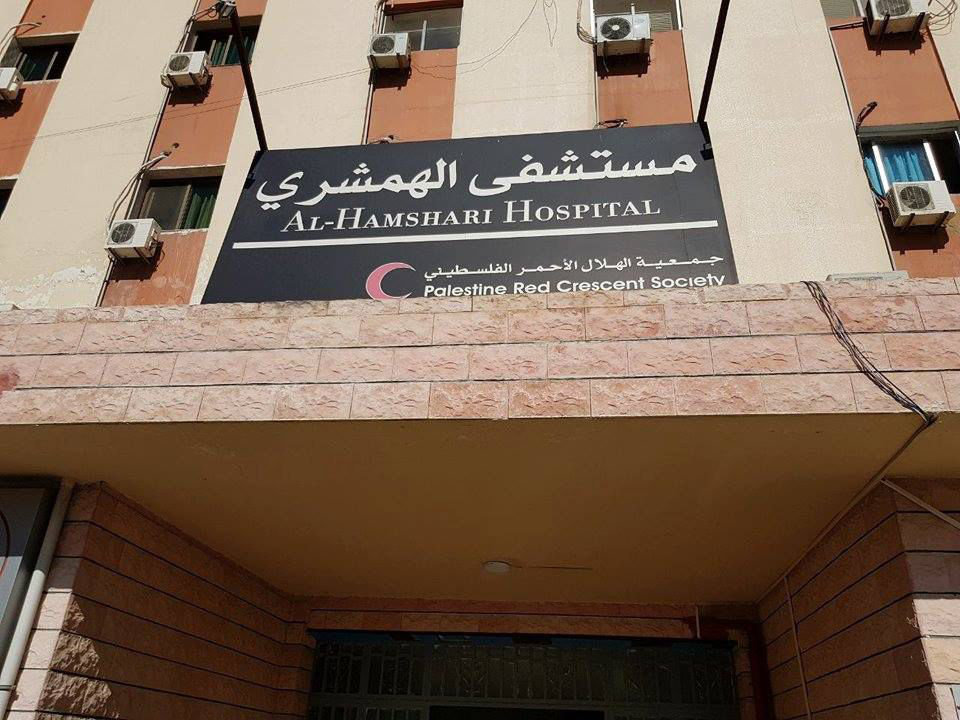
The entrance of Al-Hamshari Hospital, operated by the Palestine Red Crescent Society. (Supplied)
That hope is tangible in every corridor, from the emergency wing to the dialysis unit serving southern camps. It appears in the brief silence between cases, when a doctor glances at a phone, prints a treatment plan, and calmly explains it to a patient.
In an era when AI often symbolizes excess — billion-dollar labs, polished demos, luxury tech — Rhazes offers a different vision: one where innovation moves from boardrooms to borderlands, from privilege to purpose.
“This is what it looks like when AI closes a gap instead of widening it,” Al-Fagih said. “Technology doesn’t have to wait for perfect conditions. It just has to start where it’s needed most.”
At Al-Hamshari Hospital, amid flickering lights and humming generators, that vision is already alive.