US says it will lift some trade sanctions on Russia’s ally Belarus

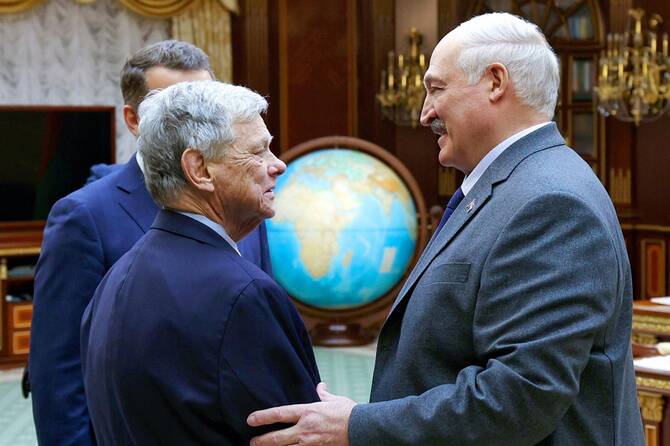
Belarusian President Alexander Lukashenko and U.S. Presidential envoy John Coale shake hands during their meeting in Minsk, Belarus. (Belarusian Presidential Press Service/AP)
Short Url
Updated 13 December 2025
Follow

US says it will lift some trade sanctions on Russia’s ally Belarus

  • A close ally of Russia, Minsk has faced Western isolation and sanctions for years
  • Coale described the two-day talks as “very productive”

VILNIUS: The United States says it is lifting sanctions on Belarusian potash in the latest sign of a thaw between Washington and the isolated autocracy.
John Coale, the US special envoy for Belarus, made the announcement after meeting the country’s authoritarian leader Alexander Lukashenko in the Belarusian capital of Minsk on Friday and Saturday.
A close ally of Russia, Minsk has faced Western isolation and sanctions for years. Lukashenko has ruled the nation of 9.5 million with an iron fist for more than three decades, and the country has been repeatedly sanctioned by Western countries both for its crackdown on human rights and for allowing Moscow to use its territory in the invasion of Ukraine in 2022.
Speaking with journalists, Coale described the two-day talks as “very productive,” Belarus’ state news agency Belta reported Saturday.
The US envoy said that normalizing relations between Washington and Minsk was “our goal.”
“We’re lifting sanctions, releasing prisoners. We’re constantly talking to each other,” he said, according to Belta. He also said that the relationship between the countries was moving from “baby steps to more confident steps” as they increased dialogue.
The last time US officials met with Lukashenko in September 2025, Washington announced easing some of the sanctions against Belarus while Mink released more than 50 political prisoners into Lithuania. Overall, Belarus released more than 430 political prisoners since July 2024, in what was widely seen as an effort at a rapprochement with the West.
Belarusian opposition leader Sviatlana Tsikhanouskaya told The Associated Press on Saturday that sanctions relief was part of a deal between Minsk and Washington, in which another large group of political prisoners in Belarus were expected to be released.
“The freeing of political prisoners means that Lukashenko understands the pain of Western sanctions and is seeking to ease them,” Tsikhanouskaya said.
She added: “But let’s not be naive: Lukashenko hasn’t changed his policies, his crackdown continues and he keeps on supporting Russia’s war against Ukraine. That’s why we need to be extremely cautious with any talk of sanctions relief, so that we don’t reinforce Russia’s war machine and encourage continued repressions.”
Tsikhnouskaya also described European Union sanctions against Belarusian potash fertilizers as far more painful for Minsk that those imposed by the U.S, saying that while easing US sanctions could lead to the release of political prisoners, European sanctions should push for longterm, systemic changes in Belarus and the end of Russia’s war in Ukraine.
The latest round discussions also touched on Venezuela, as well as Russia’s ongoing invasion of Ukraine, Belta said.
Coale told reporters that Lukashenko had given “good advice” on how to address the conflict, saying that Lukashenko and Russian President Vladimir Putin were “longtime friends” with “the necessary level of relationship to discuss such issues.”
“Naturally, President Putin may accept some advice and not others,” Coale said.


Single ‘digital nation-state’ is not a far-fetched notion, Melania Trump tells UN Security Council

Updated 5 sec ago
Follow

Single ‘digital nation-state’ is not a far-fetched notion, Melania Trump tells UN Security Council

  • US first lady argues that AI and global connectivity could reshape education, help reduce conflict and empower children worldwide
  • Societies rooted in knowledge foster innovation, tolerance and moral reasoning, while those shaped by ignorance risk disorder and conflict, she says

NEW YORK CITY: The idea of a single digital nation-state is “not so far-fetched,” US First Lady Melania Trump told the UN Security Council on Monday.
She argued that artificial intelligence and global connectivity could reshape education, help reduce conflict and empower children worldwide.
The US holds the rotating presidency of the council for March, and as she presided over its first meeting of the month Trump said technology was erasing borders and creating what she described as a shared intellectual future.
“Perhaps this idea isn’t so far-fetched,” she said, pointing to the rise of digital currencies, blockchain-based payment systems, and AI-driven databases she argued were already transforming media and financial markets.
Trump thanked the US’s fellow council members — the UK, France, Russia, China, Greece, the Democratic Republic of Congo, Denmark, Panama, Liberia, Somalia, Colombia, Pakistan, Bahrain and Latvia — for their role in efforts to maintain international security.
The responsibility for preventing conflict “must be applied evenly and should never be carried out lightly,” she said. Her remarks focused in particular on the role of education as the foundation of peace and stability.
“A nation that makes learning sacred protects its books, its language, its science and its mathematics. It protects its future,” Trump said, arguing that societies rooted in knowledge foster innovation, tolerance and moral reasoning, while those shaped by ignorance risk disorder and conflict.
Education is widely recognized as a fundamental human right, she added, yet many children and young adults around the world remain barred from the chance to attend high school or university. The losses arising from this squandered potential, from potential medical breakthroughs to possible advances in food security and technology, are borne not only by the individual countries involved but by humanity as a whole, she said.
Trump called for the expansion of global access to technology to help bridge the digital divide, noting that about 6 billion people, 70 percent of the world’s population, now use mobile devices and the internet.
“If our nations band together, we can close the technological divide,” she said, describing a world in which a farmer on a remote Greek island, a student in Somalia and a resident of New York City can all tap into centuries of accumulated human knowledge.
AI was democratizing access to information once confined to university libraries, she added, and redefining participation in the global “economy of ideas.”
She continued: “Conflict arises from ignorance. Knowledge creates understanding, replacing fear with peace and unity.”
Trump called on council members to safeguard learning and promote access to higher education, urging them to “build a future generation of leaders who embrace peace through education.”
She added: “The path to peace depends on us taking responsibility to empower our children through education and technology.”