

Pakistan to discuss regional issues, economic ties at UAE summit this week

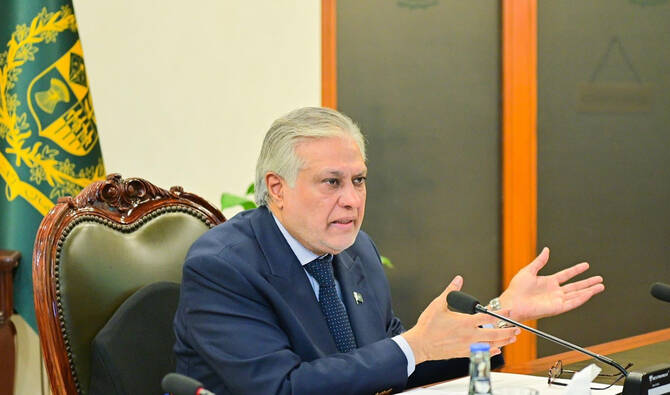
Deputy Prime Minister and Foreign Minister Ishaq Dar chairs a meeting at the Ministry of Foreign Affairs in Islamabad, Pakistan, on December 8, 2025. (MOFA/File)
Short Url
Updated 12 December 2025
Follow

Pakistan to discuss regional issues, economic ties at UAE summit this week

  • Deputy PM Ishaq Dar to attend Sir Bani Yas Forum from Dec. 12-14, says Pakistan foreign office
  • Senior statemen, policymakers expected to discuss security and economic cooperation at summit

ISLAMABAD: Pakistan’s Deputy Prime Minister Ishaq Dar will attend the Sir Bani Yas Forum in the UAE from Dec. 12-14 to discuss regional issues with world leaders and explore economic partnerships, the foreign ministry said on Friday. 

The three-day summit features senior statesmen, policymakers and global experts from around the world with discussions likely to revolve around key regional and international issues such as peace, security and economic cooperation.

Dar, who is also Pakistan’s foreign minister, attended the 15th edition of the Bani Yas Forum last year. He is attending this year’s summit at the invitation of his UAE counterpart, Sheikh Abdullah bin Zayed Al Nahyan, the foreign office said. 

“During the Forum, the Deputy Prime Minister/Foreign Minister will engage with international leaders and experts on matters related to regional stability, sustainable development, and the expansion of economic partnerships,” the statement said. 

“He will also present Pakistan’s perspectives on promoting dialogue, addressing regional challenges, and fostering enhanced opportunities for economic cooperation.”

The Forum is expected to feature important discussions on Israel’s war in Gaza and the fragile ceasefire in the Middle East. 

Pakistan has consistently criticized Israel for violating the ceasefire in Gaza and has called on the international community to intervene and ensure the fragile agreement does not collapse. 

Islamabad has also been eyeing economic partnerships with regional allies, particularly Gulf countries, at such global summits in recent months. 

It has entered into economic, defense, trade and investment agreements with traditional allies such as China, Saudi Arabia, UAE, Qatar and Central Asian states in recent months.


Pakistan launches second indigenous EO-2 satellite from China, SUPARCO says

Updated 12 February 2026
Follow

Pakistan launches second indigenous EO-2 satellite from China, SUPARCO says

  • Earth observation satellite launched from Yangjiang Seashore Launch Center in China
  • EO-2 to enhance disaster response, governance, resource management capabilities

KARACHI: Pakistan has successfully launched its second indigenous Earth Observation satellite, EO-2, from China’s Yangjiang Seashore Launch Center, the national space agency SUPARCO said on Thursday.

The launch marks a significant step in Pakistan’s efforts to strengthen its domestic space and remote sensing capabilities, with the satellite expected to improve imaging continuity, disaster monitoring, agricultural planning and strategic resource management.

In a statement, Pakistan’s SUPARCO said the EO-2 satellite would enhance the country’s earth observation and imaging capabilities and support governance and planning functions across multiple sectors.

“Pakistan’s second indigenous EO-2 satellite has been successfully launched,” SUPARCO said, adding that the mission represents a “milestone” in the expansion of the country’s satellite fleet.

According to the agency, EO-2 will provide critical data for planning and resource management while improving the continuity and accuracy of national earth observation systems.

The satellite is expected to support disaster management, urban planning, environmental monitoring and infrastructure development by supplying updated geospatial imagery and data.

SUPARCO said the launch demonstrates growing indigenous capability in satellite development and reflects Pakistan’s broader objective of strengthening its national space program through locally developed platforms.

Pakistan has gradually expanded its space cooperation with China in recent years, including satellite launches and joint missions, as Islamabad seeks to build technical capacity and reduce reliance on external data sources.

The EO-2 satellite is expected to play a key role in improving data availability for federal and provincial authorities, particularly in areas vulnerable to floods, climate stress and rapid urbanization.