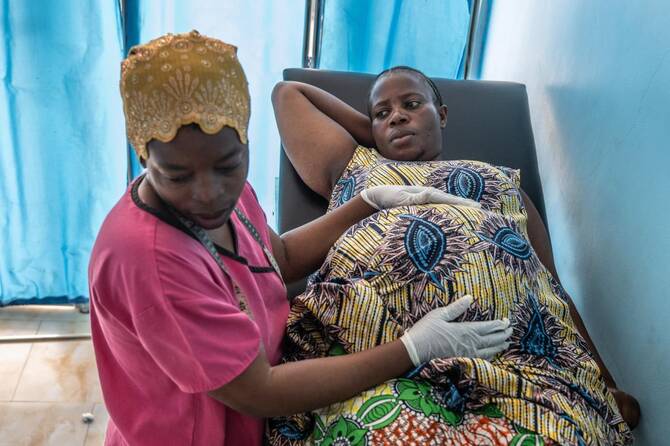
GOMA, Congo: In a maternity ward in eastern Congo, Irene Nabudeba rested her hands on her bulging midsection, worried about giving birth in a city under rebel control.
The conflict that flared this year has left many medical supplies stranded beyond the front line. Infrastructure like running water has collapsed, along with the economy in Goma, the region’s humanitarian and commercial hub.
And now the one glimmer of hope for mothers — a free maternity care program offered by Congo’s government — has ended after it was not renewed in June. It was not clear why, and Congolese did not respond to questions.
Nabudeba has five children and wonders whether the sixth will survive.
“At the hospital, they ask us for money that we don’t have. I’m pushing myself to come to the consultations, but for the delivery ... I don’t know where I’ll find the money,” she said at the Afia Himbi health center.
Women are losing access to maternal care
Several women told The Associated Press they cannot afford maternal care after Congo’s program that was aimed at reducing some of the world’s highest maternal and neonatal death rates ended earlier this year. The program launched in 2023 offered free consultations and treatment for illnesses and at-risk pregnancies at selected health facilities across the country.
Congo ranked second in maternal deaths globally with 19,000 in 2023, behind Nigeria’s 75,000 deaths, according to UN statistics.
Health workers said more women in Goma are now giving birth at home without skilled help, sometimes in unsanitary conditions, leaving them vulnerable to hemorrhage, infection or death.
Clinics and hospitals were already struggling after the M23 rebels, backed by neighboring Rwanda, seized Goma in an escalation of fighting in January.
Essential services are cut off as fighting continues
Although clashes subsided amid US- and Qatar-led peace efforts, fighting escalated again in recent days and the conflict has collapsed public institutions, disrupted essential services and displaced more than 700,000 people, according to the UN humanitarian office.
In Goma, the armed rebels are seen everywhere, making a pregnant woman’s walk to clinics another source of anxiety.
Freddy Kaniki, deputy coordinator of M23, asserted to the AP that the free maternal care “was not renewed because it was a failure,” without elaborating. Congolese officials did not respond to questions.
Rwanda denies supporting the M23 despite UN experts saying they have evidence of it. Rwanda prides itself on health care and recently signed a five-year deal with the US for investment of up to $158 million in its own health care sector.
The collapse of essential services in rebel-held areas, combined with mass displacement and insecurity, has left civilians struggling to access even basic care.
An International Committee of the Red Cross assessment in September found that at least 85 percent of health facilities were experiencing medicine shortages, and nearly 40 percent have seen an exodus of staff after the conflict surged in the provinces of North Kivu and South Kivu.
The ICRC in October said 200 health facilities in eastern Congo had run out of medicines because of looting and supply disruptions. Doctors Without Borders, or MSF, has reported hospitals attacked, ambulances blocked and medical staff threatened or killed.
Few can afford to pay even $5 for medical assistance
Childbirth at a clinic in Goma now costs $5 to $10, out of reach for many families in a region where over 70 percent of the population lives on less than $2.15 a day, according to the World Bank.
Franck Ndachetere Kandonyi, chief nurse at the Afia Himbi health center, said the number of births there under the free program had jumped from around five a month to more than 20. But the program ended in June.
Facing a table of statistics in his office, Kandonyi said the number of births per month is now down to nine.
“When a parent cannot even pay 10,000 Congolese francs ($4.50) for their wife’s or child’s care, it’s a real problem,” the nurse said.
Meanwhile, banks have closed in Goma, prices have soared and the dollar has depreciated.
Nabudeba’s husband, a driver, has been unemployed since January. She said her family is barely surviving.
“When the war broke out, we lost all our resources,” she said. “Lately, the situation has not been favorable, and we are suffering greatly.”
Across town at the Rehema Health Center, Ernestine Baleke waited for help with her ninth pregnancy, with concern on her face. She said she doesn’t know where she will get money for the delivery.
Her husband lost a factory job when the place was looted earlier in the conflict, she said. Then their house burned.
“I don’t even have 100 francs (45 cents) in my pocket,” Baleke said.
She walks more than half a mile to the hospital because she cannot afford transportation. Three months remain before her delivery.
“The authorities must restore free health care,” Baleke said. “We risk dying in our homes while giving birth.”


A free childbirth program ends in eastern Congo at the worst of times
https://arab.news/43yhg
A free childbirth program ends in eastern Congo at the worst of times

- Women are losing access to maternal care
- 200 health facilities in eastern Congo had run out of medicines


Ukraine, US, Europe still seeking common ground in peace talks, French official says
- French presidency official: “The European perspective of Ukraine is clear and it’s a realistic perspective”
PARIS: Ukraine, the United States and European powers are still working to find a joint position that would outline the contours of a peace deal, including security guarantees for Kyiv, that could be taken to Russia, a French presidency official said on Friday.
“Our goal is to have a common foundation that is solid for negotiation. This common ground must unite Ukrainians, Americans and Europeans,” the official told reporters in a briefing.
“It should allow us, together, to make a negotiating offer, a solid, lasting peace offer that respects international law and Ukraine’s sovereign interests, an offer that American negotiators are willing to bring to the Russians.”
The official said there was no joint document yet, but all sides would carry on negotiations in the coming days through various calls and meetings. He did not say whether Washington had set a deadline.
Kyiv is under pressure from the White House to secure a quick peace but is pushing back on a US-backed plan proposed last month that many see as favorable to Moscow.
Britain, France and Germany, along with other European partners and Ukraine, have been working frantically in the last few weeks to refine the original US proposals that envisaged Kyiv giving up swathes of its territory to Moscow, abandoning its ambition to join NATO and accepting limits on the size of its armed forces.
The French official said the talks aimed at narrowing differences with the United States and centered on territory and potential security guarantees for Ukraine once there is a peace accord.
Those discussions include the possibility of a NATO Article-5 type clause involving Washington that would seek to reassure Kyiv in case it was once again attacked by Russia, the official said.
The Europeans have also faced pressure in recent weeks with some American proposals touching on elements that concern NATO and the European Union, including suggestions on fast-tracking Ukraine’s accession to the bloc.
“The European perspective of Ukraine is clear and it’s a realistic perspective,” the official said. “That is what we are committed to and it is up to the Europeans and the Ukrainians to agree on how to proceed.”