

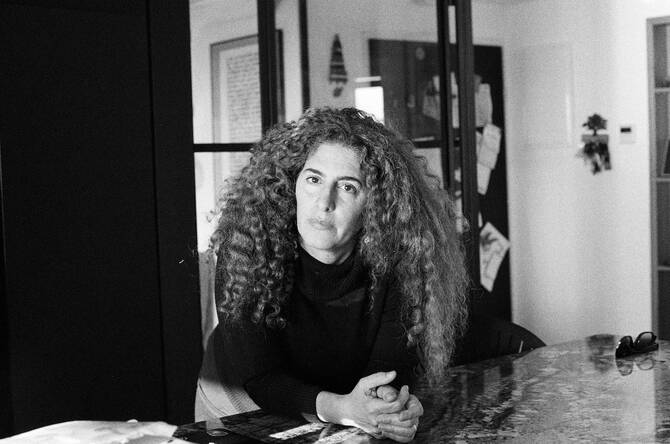

JEDDAH: Filmmaker Annemarie Jacir’s “Palestine 36,” which screened at this month’s Red Sea International Film Festival, is more than a historical drama. The film — Palestine’s official entry to the Oscars this year — is a deep exploration of resistance, resilience and the struggle of the Palestinian people.
Jacir — who lived in Saudi Arabia until the age of 16 — recalls the spark for the film: the discovery of archival photographs of British checkpoints where Palestinian men and women were systematically searched, a scene that felt hauntingly familiar.
“My grandparents were searched at checkpoints. My parents were searched at checkpoints. I am searched at checkpoints. My child is now searched at checkpoints,” she told Arab News. “The events of the film are from almost a century ago but it is still so incredibly relevant to my daily life in Palestine. Somehow, it was erased from the narrative that the British were in Palestine — a lot of people don’t know that — and they really set up the system of occupation that I deal with today on a regular basis.”

Jacir on the set of 'Palestine 36' with Jeremy Irons. (Supplied)
What makes “Palestine 36” stand out is its approach to storytelling. Rather than a grand, heroic narrative of revolution, Jacir focuses on ordinary people confronting extraordinary circumstances.
“I’m interested in regular people who are suddenly involved in a situation in which they have to make a choice,” she said.
The film follows five interconnected narratives as villages across Palestine confront British colonial rule. With rising numbers of Jewish immigrants escaping antisemitism in Europe, and the Palestinian population uniting against Britain’s 30-year dominion, all sides spiral towards inevitable collision in a decisive moment for the British Empire and the future of the entire region.

A still from “Palestine 36.” (Supplied)
The production of the film itself became a testament to Palestinian resilience, Jacir explained. The crew spent over a year meticulously preparing — even restoring an entire village using traditional methods. They planted crops, built military equipment, and created an authentic historical landscape. However, the events of Oct. 7, 2023 dramatically altered their plans, forcing a relocation to Jordan. Despite the difficulties, Jacir and her team refused to abandon the project.
“We needed it because of all this darkness around us,” she said.
International support was crucial, with financiers standing firm and stars including Jeremy Irons and Liam Cunningham offering unwavering commitment.
“Jeremy was the first person to send me an email. He just said, ‘Annemarie, do not worry. Tell me where to be and when, and I’m there,’” she recalled. “I lost everything in the first part of this film. But I never lost my cast, and I’m really grateful for that.”

A still from “Palestine 36.” (Supplied)
For the local cast, Jacir sought out actors who could embody the complexity of the Palestinian experience. Several of them, including Yafa Bakri, are first-time performers, selected for their depth and authenticity.
“The minute I saw her, I knew she was the one,” Jacir said of Bakri, who brings a profound combination of sadness and strength to her role as Rabab.
The film’s emotional landscape shifted dramatically during production. Originally conceived as a lighter, more experimental film, the ongoing geopolitical context transformed the narrative.
“I became more straightforward,” said Jacir. “I wasn’t interested in being too clever with the script anymore. I wanted to stay with the emotional part of the story.”
Central to Jacir’s vision was recovering the Palestinian narrative, a story frequently marginalized or entirely deleted. “Our lives have been erased,” she said.
The film challenges the notion that history began on Oct. 7, 2023, instead presenting a continuum of struggle and resilience.
Jacir — whose three previous feature films “Salt of this Sea,” “When I Saw You” and “Wajib” were also official Palestinian Oscar entries — hopes “Palestine 36” will serve as a mirror for audiences, particularly those from colonized or war-affected countries.
“I hope people see themselves in the film,” she said. “I don’t want to teach anyone anything. There’s a lot of history in the film and there’s a lot of history that’s been erased. I hope that’s something that comes through.”


