BISSAU: Guinea-Bissau’s military junta adopted a 12-month transitional charter that bars the interim president and prime minister from running in the next elections, two weeks after officers staged a coup that suspended the constitution.
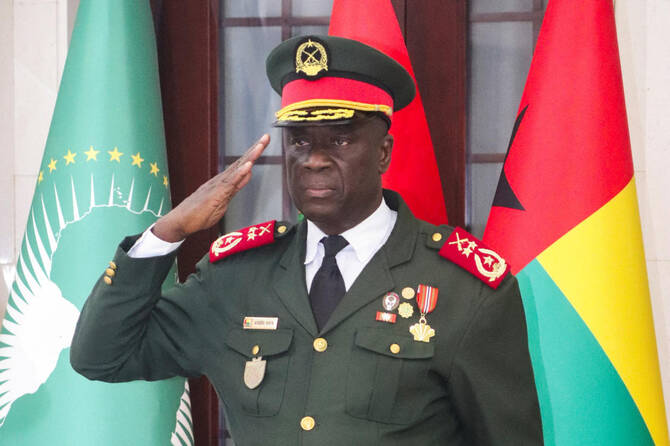
The 29-article charter, published on Tuesday, requires presidential and legislative elections to be held at the end of the one-year transitional period, with the polling date to be set by the transitional president. Army officers in Guinea-Bissau, branding themselves the Military High Command, toppled President Umaro Sissoco Embalo on November 26 and installed Maj. Gen. Horta Inta-a as interim president the following day.
Ilidio Vieira Te, a civil servant and former finance minister, was named prime minister a day later.
The coup came one day before the electoral commission was due to announce the results of presidential and legislative elections.
The Military High Command will control legal and institutional reforms during the transition, including drafting revisions to the suspended constitution, setting up a new Constitutional Court, changing regulations for political parties and overseeing the appointment of new electoral officials, according to the charter.
A 65-member National Transition Council, including 10 senior army officers representing the Military High Command, will serve as a transitional legislative body, the charter says.
Guinea-Bissau, a small West African coastal nation wedged between Senegal and Guinea, has experienced repeated instability since gaining independence from Portugal in 1974, with only one president ever completing a full term in office.
Following a coup in Guinea in 2021, a transitional charter stipulated that coup leader Mamady Doumbouya would not be able to run in that country’s next elections.
However the country adopted a new constitution in September that dropped that provision, and Doumbouya is on the ballot in an election scheduled for December 28.

Guinea-Bissau’s transitional military adopts charter barring leaders from elections
https://arab.news/nnpg7
Guinea-Bissau’s transitional military adopts charter barring leaders from elections
- The 29-article charter requires presidential and legislative elections to be held at the end of the one-year transitional period
- Guinea-Bissau has experienced repeated instability since gaining independence from Portugal in 1974
US will respond to Rwanda’s violation of peace pact, says Rubio
- Waltz told the Security Council meeting that the US “is deeply concerned and increasingly disappointed” by this resurgence of violence
WASHINGTON: Top US diplomat Marco Rubio said on Saturday that Rwanda had clearly violated the peace agreement it signed with the Democratic Republic of Congo in Washington last week and vowed unspecified “action” in response.
The Rwandan-backed M23 armed group advanced in eastern DRC and seized the key border city of Uvira, just days after the leaders signed the “Washington Accords” on Dec. 4.
“Rwanda’s actions in eastern DRC are a clear violation of the Washington Accords, and the US will take action to ensure promises made to the President are kept,” Secretary of State Rubio wrote on X.
FASTFACT
UN peacekeeping chief Jean-Pierre Lacroix warned the new offensive ‘has revived the specter of a regional conflagration with incalculable consequences.’
The capture of Uvira, along the border with Burundi, has raised fears that the conflict could escalate into a regional war.
As part of an offensive launched at the beginning of December in South Kivu province, the armed group’s takeover follows its earlier this year capture of Goma and Bukavu, other major cities in the DRC’s mineral-rich east.
On Friday, US Ambassador to the UN Mike Waltz accused Rwanda of “leading the region toward more instability and toward war.”
“The Rwandan defense forces have provided materiel, logistics, and training support to M23 as well as fighting alongside M23 in DRC with roughly 5,000 to 7,000 troops,” not including possible reinforcements during the latest offensive, Waltz told the UN Security Council.
The Rwandan firepower has included surface-to-air missiles, drones, and artillery, he added.
Since taking up arms again in 2021, the M23 has seized swaths of territory, displacing tens of thousands and leading to a spiraling humanitarian crisis.
Earlier this month, UN experts said Rwanda’s army and the M23 had carried out summary executions and forced mass displacements of people in the region.
Waltz told the Security Council meeting that the US “is deeply concerned and increasingly disappointed” by this resurgence of violence.
The envoy denounced “the scale and sophistication” of Rwanda’s involvement in eastern DRC.
UN peacekeeping chief Jean-Pierre Lacroix warned the new offensive “has revived the specter of a regional conflagration with incalculable consequences.”
“Recent developments pose a serious risk of the progressive fragmentation of the Democratic Republic of Congo, particularly its eastern part,” he said.
Burundi on Friday accused Rwanda of bombing its territory, and its ambassador, Zephyrin Maniratanga, told the council it “reserves the right to use self-defense.”
He warned that if the attacks continue, it would be extremely difficult to avoid an escalation between the two African countries.
“Rwanda is not waging war against the Republic of Burundi and has no intention of doing that,” Ambassador Martin Ngoga said.
Meanwhile, Congolese Foreign Minister Therese Kayikwamba Wagner criticized the Security Council for its “lack of action” and called for sanctions against Rwanda.
Despite a resolution adopted in February demanding the withdrawal of Rwandan troops and a ceasefire, “the situation is undeniable: another city has fallen, a parallel administration has consolidated itself, thousands more families have fled, and others have been killed, raped, and terrorized,” she said.


