

West Africa’s ECOWAS suspends Guinea-Bissau over coup

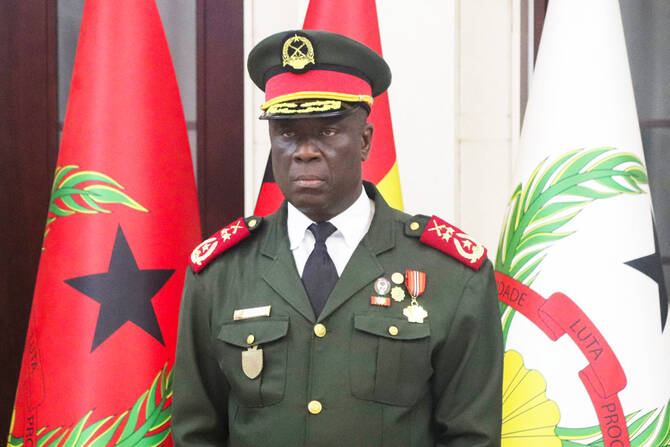
Major-General Horta Inta-a was installed by the military high command in Guinea-Bissau as the head of the military government, which will oversee a one-year transition period. (REUTERS)
Short Url
Updated 28 November 2025
Follow

West Africa’s ECOWAS suspends Guinea-Bissau over coup

  • Soldiers in Guinea-Bissau forced President Umaro Sissoco Embaló out of power after a disputed presidential election
  • The coup is the latest military takeover in West Africa, where democracy recently has been challenged by disputed elections 


DAKAR/BISSAU: West Africa’s ECOWAS regional bloc leaders on Thursday suspended Guinea-Bissau from all its decision-making bodies following a coup in the country, according to a statement that followed an emergency summit.
The bloc condemned the takeover and urged coup leaders to allow the national election commission to declare the results of the disputed presidential election.
Soldiers in Guinea-Bissau announced a new junta leader, cementing a forceful takeover of power that began after this week’s disputed presidential election and led to deposed President Umaro Sissoco Embaló departing for neighboring Senegal.
The military high command in the West African nation inaugurated Gen. Horta Inta-a as the head of the military government, which will oversee a one-year transition period, according to a declaration broadcast on state television.
Embaló, meanwhile, arrived in Senegal with a flight chartered by the Senegalese government which has been “in direct communication with all concerned Guinea-Bissau actors,” Senegal’s Ministry of Foreign Affairs said in a statement, as the country promised to work with partners to restore democracy in Guinea-Bissau.
Guinea-Bissau, one of the world’s poorest countries, has been dogged by coups and attempted coups since its independence from Portugal more than 50 years ago, including a coup attempt in October. The country of 2.2 million people is known as a hub for drug trafficking between Latin America and Europe, a trend that experts say has fueled its political crises.
Opposition calls for protests against coup
Hours after the opposition called for protests against the coup and to demand the publication of election results earlier scheduled for Thursday, the military authorities issued a statement banning public protests and “all disturbing actions of peace and stability in the country.”
In an earlier statement, Inta-a, who was the army chief of staff until the coup and a close ally of the deposed president, said: “The inability of political actors to stem the deterioration of the political climate ultimately prompted the intervention of the armed forces.”
The military authorities earlier said Embaló and other prominent people arrested during the coup were in good health and would remain in custody. It was not immediately clear the terms of Embaló’s departure to Senegal.
The Chairperson of the African Union Commission Mahmoud Ali Youssouf condemned the coup, calling for unconditional release of Embaló and other detained officials and for the respect of the electoral process.
West Africa’s regional bloc known as ECOWAS also held an virtual meeting of heads of state where it condemned the coup and Embalo’s “unlawful detention.” “Our response will be firm, principled, and consistent with our history,” said Sierra Leone President Julius Maada Bio, who serves as ECOWAS chairman.
Several other countries including France condemned the coup and called for respect for the constitutional order.
The opposition, meanwhile, purported that Embaló had “fabricated” the coup to avoid an election defeat in Sunday’s closely contested presidential vote. The military takeover and the reported arrest of Embaló were manufactured to disrupt election results, according to his rival Fernando Dias, who, like Embaló, claimed to have won the vote.
The Associated Press could not independently verify the claims by Dias, a member of the Social Renewal Party.
Activities returned to normal in the capital Bissau on Thursday, with businesses and public transport gradually picking up.
The latest in a string of coups
The coup is the latest in a surge of military takeovers in West Africa, where democracy recently has been challenged by disputed elections that analysts say could embolden militaries.
It followed presidential and legislative elections which were held at a critical time for the African country as Embaló, a 53-year-old former army general, faced a legitimacy crisis. The opposition said his tenure had long expired and refused to recognize him as president.
The coup and past ones in Guinea-Bissau are tied to “how much (state) institutions have been undermined and weakened,” said Beverly Ochieng, a senior security analyst at the consultancy Control Risks. Under Embaló, she said, “the legislature was dissolved unilaterally, the judiciary was operating under capacity, and there were deep-seated sentiments around political influence.”
Gunshots rang out in the main city of Bissau on Wednesday just days after the tense presidential election, which Embaló and Dias both claimed to have won.
In a scene that has become familiar in the region, military officers appeared on state television and claimed they had seized power while the election commission’s office was sealed.
Dias, 47, said in a video statement that he escaped custody “through a back door” after reports he was arrested by soldiers. He vowed to fight back.
The military officers who announced they had deposed the president cited the “discovery of an ongoing plan ... to manipulate electoral results,” according to a spokesperson, Dinis N’Tchama, who was flanked by others during the televised statement.
The “scheme was set up by some national politicians with the participation of a well-known drug lord, and domestic and foreign nationals,” N’Tchama said.


Former Hong Kong pro-democracy media mogul Jimmy Lai convicted in landmark national security trial

Updated 3 sec ago
Follow

Former Hong Kong pro-democracy media mogul Jimmy Lai convicted in landmark national security trial

  • Three government-vetted judges on Monday found Lai, 78, guilty of conspiring with others to collude with foreign forces to endanger national security and conspiracy to publish seditious articles
HONG KONG: Jimmy Lai, the pro-democracy former Hong Kong media mogul and outspoken critic of Beijing, was convicted in a landmark national security trial in the city’s court on Monday, which could send him to prison for the rest of his life.
Three government-vetted judges found Lai, 78, guilty of conspiring with others to collude with foreign forces to endanger national security and conspiracy to publish seditious articles. He pleaded not guilty to all charges.
Lai, 78, was arrested in August 2020 under a Beijing-imposed national security law that was implemented following massive anti-government protests in 2019. During his five years in custody, much of it in solitary confinement, Lai has been convicted of several lesser offenses and appears to have grown more frail and thinner.
Lai’s trial, conducted without a jury, has been closely monitored by the US, Britain, the European Union and political observers as a barometer of media freedom and judicial independence in the former British colony, which returned to Chinese rule in 1997.
Court said Lai spent years plotting against Beijing
Reading from an 855-page verdict, Judge Esther Toh said that Lai had extended a “constant invitation” to the US to help bring down the Chinese government with the excuse of helping Hong Kongers.
Lai’s lawyers admitted during the trial that he had called for sanctions before the law took effect, but insisted he dropped these calls to comply with the law.
But the judges ruled that Lai had never wavered in his intention to destabilize the ruling Chinese Communist Party, “continuing though in a less explicit way.”
Toh said the court was satisfied that Lai was the mastermind of the conspiracies and that Lai’s evidence was at times contradictory and unreliable. The judges ruled that the only reasonable inference from the evidence was that Lai’s only intent, both before and after the security law, was to seek the downfall of the ruling Communist Party even at the sacrifice of the people of China and Hong Kong.
“This was the ultimate aim of the conspiracies and secessionist publications,” they wrote.
Among the attendees were Lai’s wife and son, and Hong Kong’s Roman Catholic Cardinal Joseph Zen. Lai pressed his lips and nodded to his family before being escorted out of the courtroom by guards.
His verdict is also a test for Beijing’s diplomatic ties. US President Donald Trump said he has raised the case with China, and UK Prime Minister Keir Starmer has said his government has made it a priority to secure the release of Lai, who is a British citizen.
Lai could face life in prison
The founder of the now-defunct pro-democracy newspaper Apple Daily will be sentenced on a later day.
Under the security law, the collusion charge could result in a sentence ranging from three years in jail to life imprisonment, depending on the offense’s nature and his role in it. Hearings were set to begin Jan. 12 for Lai and other defendants in the case to argue for a shorter sentence.
The Apple Daily, a vocal critic of the Hong Kong government and Beijing, was forced to shut in 2021 after police raided its newsroom and arrested its senior journalists, with authorities freezing its assets.
During Lai’s 156-day trial, prosecutors accused him of conspiring with senior executives of Apple Daily and others to request foreign forces to impose sanctions or blockades and engage in other hostile activities against Hong Kong or China.
The prosecution also accused Lai of making such requests, highlighting his meetings with former US Vice President Mike Pence and former Secretary of State Mike Pompeo in July 2019 at the height of the protests.
It also presented 161 publications, including Apple Daily articles, to the court as evidence, as well as social media posts and text messages.
Lai testified for 52 days in his own defense, arguing that he had not called for foreign sanctions after the sweeping security law was imposed in June 2020.
His legal team also argued for freedom of expression.
Health concerns raised during marathon trial
As the trial progressed, Lai’s health appeared to be deteriorating.
Lai’s lawyers in August told the court that he suffered from heart palpitations. After the verdict, lawyer, Robert Pang, said his client is doing okay as the legal team studies the verdict.
Before the verdict, his daughter Claire told The Associated Press that her father has become weaker and lost some of his nails and teeth. She also said he suffered from infections for months, along with constant back pain, diabetes, heart issues and high blood pressure.
“His spirit is strong but his body is failing,” she said.
Hong Kong’s government said no abnormalities were found during a medical examination that followed Lai’s complaint of heart problems. It added this month that the medical services provided to him were adequate.
Steve Li, chief superintendent of Hong Kong police’s National Security Department, welcomed the guilty verdict and disputed claims of Lai’s worsening health.
“Lai’s conviction is justice served,” he told reporters.
Before sunrise, dozens of residents queued outside the court building to secure a courtroom seat.
Former Apple Daily employee Tammy Cheung arrived at 5 a.m., saying she wanted to know about Lai’s condition after reports of his health.
She said she felt the process was being rushed since the verdict date was announced only last Friday, but added, “I’m relieved that this case can at least conclude soon.”
Rights groups, including global media watchdog Reporters Without Borders and Amnesty International, criticized the verdict.
“It is not an individual who has been on trial — it is press freedom itself, and with this verdict that has been shattered,” said Reporters Without Borders’ director general Thibaut Bruttin.
Originally scheduled to start in December 2022, Lai’s trial was postponed to 2023 as authorities blocked a British lawyer from representing him, citing national security risks.
In 2022, Lai was sentenced to five years and nine months in prison over separate fraud charges involving lease violations, in addition to other cases related to the 2019 protests.
