TOKYO: The number of people injured in a 7.5-magnitude earthquake in Japan rose to 51 on Wednesday, authorities said, after warning an even bigger tremor was possible in coming days.
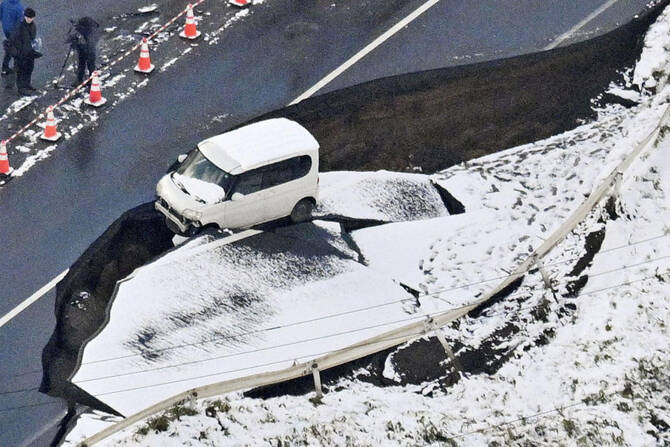
The quake late Monday off the coast of the northern region of Aomori shook buildings, tore apart roads, smashed windows and triggered tsunami waves up to 70 centimeters (28 inches) high.
The country’s Fire and Disaster Management Agency said on Wednesday the injury toll was 51, rising from 30 initially reported by the prime minister a day earlier.
The Japan Meteorological Agency (JMA) had published a rare special advisory early on Tuesday, warning that another quake of similar or greater size was possible for another week.
“Due to the occurrence of this earthquake, it is believed that the relative likelihood of a new large-scale earthquake has increased compared to normal times” in the area, the JMA said the second time it has issued such a warning.
“If a large-scale earthquake occurs in the future, there is a possibility of a massive tsunami reaching the area or experiencing strong shaking,” it said.
The agency put the chance at around one in 100 for the next seven days, local media reported.
The advisory covered the Sanriku area on the northeastern tip of Japan’s main island of Honshu and the northern island of Hokkaido, facing the Pacific.
In August 2024, the JMA issued its first special advisory, for the southern half of Japan’s Pacific coast warning of a possible “megaquake” along the Nankai Trough.
The 800-kilometer undersea trench is where the Philippine Sea oceanic tectonic plate is “subducting” — or slowly slipping — underneath the continental plate that Japan sits atop.
The government has said that a quake in the Nankai Trough and subsequent tsunami could kill as many as 298,000 people and cause up to $2 trillion in damages.
The JMA lifted last year’s advisory after a week but it led to panic-buying of staples like rice and prompted holidaymakers to cancel hotel reservations.
Geologists Kyle Bradley and Judith A. Hubbard said this week that there was no way to tell whether a strong earthquake will be followed by a similarly strong, or even stronger, one.
“Instead, we must rely on historical statistics, which tell us that very few large earthquakes are soon followed by even larger events,” they said in their Earthquake Insights newsletter.
“It does happen, just not very often.”


![]()

51 hurt in Japan quake as warning persists
Short Url
https://arab.news/zt57x
51 hurt in Japan quake as warning persists
- Japan authorities warned an even bigger tremor was possible in coming days
- The agency put the chance at around one in 100 for the next seven days


Latest updates


Recommended


© 2026 SAUDI RESEARCH & PUBLISHING COMPANY, All Rights Reserved And subject to Terms of Use Agreement.