Koshary, a spicy Egyptian staple, wins UNESCO recognition

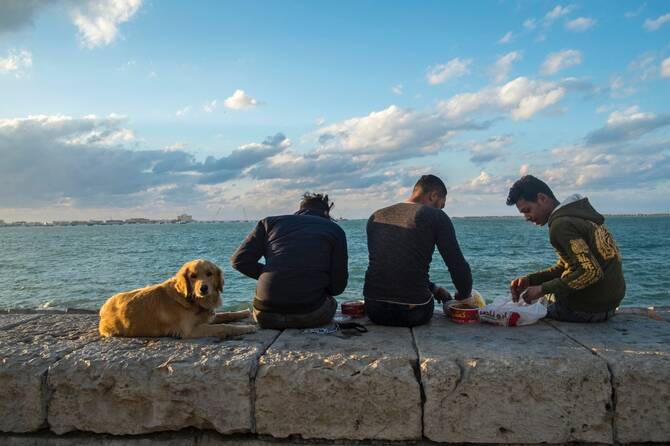
A dog sits next to youths having a meal of "koshari" as they sit along the Mediterranean waterfront in the historic harbour of Egypt's northern city of Alexandria. (AFP)
Short Url
Updated 10 December 2025
Follow

Koshary, a spicy Egyptian staple, wins UNESCO recognition

  • Egypt’s nomination of koshary for UNESCO’s “Intangible Cultural Heritage” list comes a little over a month after its opening of a sprawling new antiquities museum

CAIRO: Koshary – a spicy dish of lentils, rice and pasta available at countless Egyptian food stalls – won recognition as a cultural treasure from the UN’s cultural agency on Wednesday, as Cairo makes a broad push to promote its cultural and historical identity abroad.
Egypt’s nomination of koshary for UNESCO’s “Intangible Cultural Heritage” list comes a little over a month after its opening of a sprawling new antiquities museum – another move officials hope will highlight the country’s rich history and lure more tourists.
One popular legend claims koshary originated in northern India and was brought to Egypt by soldiers during the British occupation. But the dish’s origins can in fact be traced through a farther-flung, millennia-old lineage of migration, trade and conquest, food researcher and archaeobotanist Hala Barakat said.

EGYPTIAN DISH, WITH GLOBAL INFLUENCES
Lentils arrived from the Fertile Crescent more than 5,800 years ago, and rice was introduced from East Asia. Tomatoes and chilli peppers were brought from the Americas centuries later, while pasta noodles were a more modern addition.
“These components came together over thousands of years,” Barakat said. “Its name may be Indian, but the Egyptian dish has its own form – and even that varies from Alexandria to Aswan.”
“Koshary in its current form is the koshary Egyptians made their own,” she added.
Egypt’s nomination makes note of this diversity, highlighting the fact that yellow lentils are used on the coast, compared with black lentils in Cairo and Upper Egypt. Some households add boiled eggs, while in Sinai a similar dish called ma’dous is common.
Each of these variations is united by “the special flavour provided by condiments such as vinegar, garlic, and hot sauce, which are added according to preference,” the nomination says.

COUSCOUS, CEVICHE ALSO ON LIST
Making the intangible heritage list is mostly symbolic, and does not bring any direct financial benefit. Other dishes such as couscous – common across the Maghreb region – and the South American dish ceviche are on the list. Italian cuisine was also set to be inscribed this year.
Koshary’s popularity surged in the 20th century as restaurants and brightly decorated street carts proliferated near schools and stations. The absence of animal products has also made it a staple among fasting Coptic Christians and younger Egyptians who are going vegetarian.
Today, the dish is one of Egypt’s most recognizable features, according to Ahmed Shaker, the public relations officer at Abou Tarek Koshary, a popular Cairo restaurant that dates back to 1963.
“Any foreigner or visitor who comes to Egypt visits the Pyramids, visits the museum, and comes to Abou Tarek to eat koshary,” Shaker said.
The dish joins Egypt’s 10 previous “inscriptions,” which include tahteeb, an ancient martial art using sticks, and the Sirat Bani Hilal, an epic oral poem.
UNESCO’s new director-general, Khaled El-Enany, previously served as Egypt’s minister of tourism and antiquities, and has vowed to use his tenure to safeguard cultural traditions.


Oman and Lebanon call for full Israeli withdrawal, urge end to attacks

Updated 6 sec ago
Follow

Oman and Lebanon call for full Israeli withdrawal, urge end to attacks

  • Joseph Aoun and Sultan Haitham bin Tariq make a joint call for an immediate halt to Israeli attacks on Lebanese territory
  • Reaffirmation of the unified Arab position on ending the Israeli occupation and establishing an independent Palestinian state based on the 1967 borders

BEIRUT: Lebanese President Joseph Aoun and his Omani counterpart Sultan Haitham bin Tariq on Wednesday made a joint call for an immediate halt to Israeli attacks on Lebanese territory and a full withdrawal from all occupied Arab lands, warning that continued violations pose a direct threat to regional stability.

The statement came during a high-level summit in Muscat, where both leaders voiced “serious concern over the ongoing Israeli aggression” and described the occupation as a “clear violation” of UN Security Council Resolution 1701 and other international resolutions.

The two sides also expressed support for international efforts to de-escalate tensions, stabilize the situation on the ground, facilitate the return of displaced persons, and advance post-conflict reconstruction.

Aoun led a Lebanese ministerial delegation to Oman that included Lebanon’s ministers of foreign affairs, interior, defense, health, and agriculture for talks with Omani officials.

The joint statement emphasized the strengthening of bilateral ties and expanding cooperation in key sectors including politics, the economy, investment, banking, tourism, transport, and logistics.

Both sides called for early preparations to hold the first session of the Omani-Lebanese Joint Committee, chaired by the two foreign ministers in Muscat, and to pursue new agreements and memorandums of understanding intended to enhance collaboration in trade, culture, and science. The statement also highlighted the need to boost private sector engagement in shared development opportunities.

The Omani side reaffirmed its full support for Lebanon’s sovereignty, independence, and territorial integrity, as well as for strengthening Lebanese state institutions, particularly the army and legitimate security forces, and backing the country’s ongoing economic, financial, and administrative reforms.

The two sides reaffirmed the unified Arab position on ending the Israeli occupation and establishing an independent Palestinian state based on the 1967 borders, with East Jerusalem as its capital. They also underscored the importance of strengthening Arab solidarity, respecting the sovereignty of states, and upholding the principles of good neighborliness and international law.

Aoun’s official visit to Oman took place within the context of Muscat’s established role as a regional and international mediator. During his meetings, Aoun praised Oman’s diplomatic standing and approach, describing it as “wise and responsible.”

He commended Oman’s foreign policy, grounded in dialogue, mediation, balance, and good neighborliness, saying it had earned the sultanate a “distinguished status and a pivotal role in promoting stability and resolving conflicts through peaceful means.”

Aoun said that, in Lebanon, “we hold this wise approach in high regard and deeply value the sultanate’s steadfast support for Lebanon in various international forums, as well as its support as we confront the challenges before us.”

For his part, Sultan Haitham bin Tariq reaffirmed Oman’s continued commitment to Lebanon’s stability and its close monitoring of the latest developments in the country.

He emphasized the deep-rooted relations between the two countries and the importance of strengthening bilateral cooperation and coordination. The sultan also praised the positive contributions of the Lebanese community in Oman.

On the sidelines of the visit, Lebanese Interior Minister Ahmed Al-Hajjar held a meeting with his Omani counterpart Hamoud bin Faisal Al-Busaidi at Al-Alam Palace in Muscat. They underlined the enhancement of joint cooperation, particularly in security and policing.

According to a joint statement, the discussions also covered Lebanon’s efforts to consolidate internal security and maintain stability.

Participating on the Omani side in the expanded talks were Al-Busaidi; Shihab bin Tarik Al-Said, deputy prime minister for defense affairs; Badr bin Hamad Al-Busaidi, foreign minister of Oman; Hamad bin Said Al-Aufi, head of the private office; Mahad bin Said Ba’owain, minister of labor and head of the honorary mission; Saud bin Hamoud Al-Habsi, minister of agricultural, fisheries and water resources; and Hilal bin Ali Al-Sabti, minister of health.