

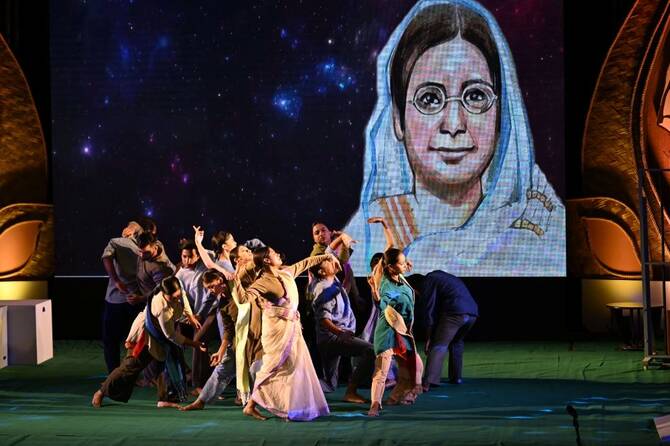

DHAKA: Bangladeshis marked Rokeya Day on Tuesday, remembering a 19th-century pioneer of women’s liberation and education in the Indian subcontinent and author of one of the world’s first feminist science-fiction utopias.
Begum Rokeya, also known as Begum Rokeya Sakhawat Hossain, was a writer and social reformer born on Dec. 9, 1880 in colonial India, in the Rangpur district of present-day Bangladesh.
Widely regarded as one of the earliest voices for women’s rights in South Asia, she is best known for her work promoting education.
“She went door to door to convince the guardians to send their girls to school. Nowadays, it seems very easy, but in the early 20th century, it was something beyond imagination,” said Afsana Rahman, a 21-year-old student at BRAC University.
She started reading Rokeya’s works at the age of 12, when the school authorities honored her as the best student with a set of books that included “Sultana’s Dream” — one of the world’s earliest works of feminist science fiction.
Rokeya wrote “Sultana’s Dream” in English in 1905, setting the story in Ladyland, a country ruled entirely by women.
In Ladyland, women managed administration, science, and education, while men lived in seclusion, reversing the traditional system. The country was peaceful, free of crime, and developed. Powered by solar energy, it used science for social development and innovation, rather than violence or warfare.
“I was amazed by her thoughts — how a woman could imagine a women-led society more than 100 years ago, when women were not allowed to go outside their homes,” Rahman told Arab News.
“Actually, her thoughts were far ahead of her time. Since then, Begum Rokeya has become my source of inspiration and has taught me to think beyond stereotypical ideas.”
Rokeya received no formal schooling and learned Bengali and English privately at home. She advocated that women could thrive when given freedom and education, which are essential not only for their personal growth but also for the progress of society as a whole.
Her main supporter was her husband, Khan Bahadur Sakhawat Hossain, whose role, too, is seen as part of Rokeya’s legacy, as her personal life “demonstrates that men can break the cycle of patriarchal oppression and work as equal partners in the struggle for women’s rights,” said Nayma Jannat, a 23-year-old who studies international relations at Dhaka University.
“Her legacy represents courage, vision and the hope for a more equal society … Rokeya’s works and thoughts remain relevant even after nearly 150 years because the fundamental structures she critiqued continue to shape our society today.”
In 1911, Rokeya founded the Sakhawat Memorial Girls’ School in Calcutta — one of the first schools founded specifically by and for Muslim girls in Bengal. Later moved to Dhaka, the school remains influential and is still active today.
By establishing schools, Rokeya “established women’s education as a center of real liberation,” and by challenging the patriarchal society and its cultural norms, strengthened the foundation for women’s self-identity, paving the way for “decolonized feminism,” said Rawank Jahan Rakamoni, 25, who is graduating in information science.
“Rokeya did not see women’s liberation as a personal outrage. She envisioned it as a structural social transformation … This integrated approach has established her as a pioneer of women’s liberation in the subcontinent.”
Bangladesh celebrates Rokeya on her birthday every Dec. 9. Her legacy remains influential among the younger generation of both men and women.
For Ashraful Alam Khan, 24-year-old anthropology student from Dhaka University, while Rokeya “inspired generations,” the work she started is still incomplete.
“Women in Bangladesh or South Asia in general are still deprived of many rights … I think that’s the main idea why she is still relevant because we still somehow face the same difficult realities,” he said.
Prokriti Shyamolima, who lives at Begum Rokeya Hall — one of the largest and most prominent women’s dormitories at Dhaka University — wants to see herself and other female students as Rokeya’s successors.
“Today, our women are working in every sphere, and women are delivering simultaneously at home and outside. Where did the women get this courage? It began with the initiatives of Begum Rokeya,” she said.
“The legacy of Begum Rokeya will continue as long as we survive.”


