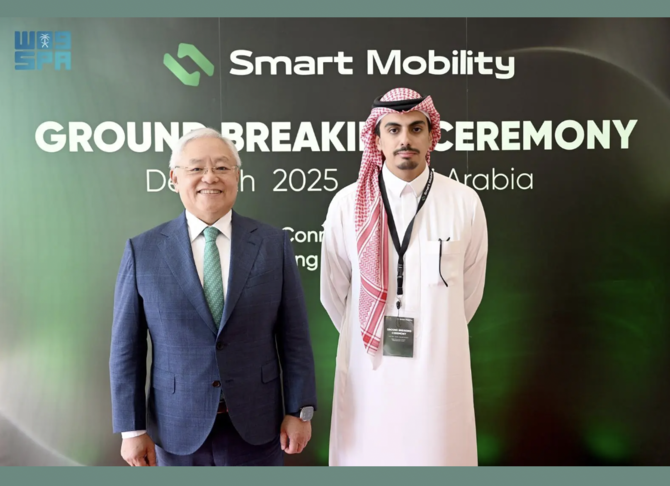
SPARK inaugurates Smart Mobility plant for manufacturing EV chargers

The project represents an important step in advancing the Kingdom’s industrial localization strategy, supporting the Made in Saudi Program. SPA.
Short Url
Updated 09 December 2025
Follow

SPARK inaugurates Smart Mobility plant for manufacturing EV chargers

RIYADH: King Salman Energy Park, known as SPARK, has inaugurated the Smart Mobility plant, specializing in manufacturing electric vehicle chargers, along with the first electric vehicle charging station within SPARK.

The launch was attended by SPARK CEO Mishal Al-Zughaibi and Smart Mobility CEO Prince Fahad bin Nawaf at SPARK headquarters in Abqaiq.

The project represents an important step in advancing the Kingdom’s industrial localization strategy, supporting the Made in Saudi Program under local-content policies overseen by the Local Content and Government Procurement Authority.

Al-Zughaibi affirmed that SPARK is positioned to become the region’s central platform for advanced industrial and energy technologies, indicating that SPARK’s proximity to the Kingdom’s core energy infrastructure and its access to ports on the Arabian Gulf are designed to create an integrated manufacturing and export corridor for the region.

SPARK’s mandate is to enable investors to build long-term industrial capabilities within the Kingdom, he noted.

Meanwhile, Prince Fahad said the decision to establish the plant at SPARK was deliberate and strategically planned, stressing that EV charging should be treated as national infrastructure and developed in parallel with Saudi Arabia’s broader energy system.

The CEO added that SPARK serves as the Kingdom’s primary hub for energy, logistics, and industrial innovation.

For the EV-charging network to expand reliably, he said it must be integrated with Saudi Arabia’s key national energy assets.

Moreover, he noted the global shift underway in the mobility sector and said discussions at the recent EV Auto Show in Riyadh underscored the importance of moving toward EVs.



Middle East aviation sector ‘champion of net profit’ — IATA 

Updated 8 sec ago
Follow

Middle East aviation sector ‘champion of net profit’ — IATA 

GENEVA: Net passenger profit in the Middle East’s aviation sector is the highest globally, providing “a great model for other areas of the world,” according to the International Air Transport Association’s director general.

Speaking at IATA’s global media day in Geneva, Switzerland, Willie Walsh praised the region’s focus on long-haul travel as well as its increasing efficiency in the industry.

In its latest financial outlook for the global airline industry, IATA announced that 2026 is set to be a record-breaking year in terms of net profit, with a forecast total of $41 billion.

Airlines are expected to achieve a record-breaking combined total net profit of $41 billion in 2026, up from $39.5 billion in 2025.

The Middle East is set to be the strongest region in terms of net profit margin and profit per passenger in 2026, as it was over the previous 12-month period.

In 2025, net profit was $28.90 per passenger, totaling $6.6 billion and leading to a net profit margin of 9.3 percent. For 2026, the IATA forecast the Middle East’s net profit margin will remain the same, but net profit per passenger will be $28.60, equating to $6.8 billion.

In contrast, Europe’s aviation sector saw net profit of $13.2 billion in 2025 but the margin was considerably smaller — 4.8 percent, working out at $10.60 per passenger. North America posted a net profit of $10.8 billion, working out to $9.50 per passenger with a net profit margin of 3.3 percent.

When asked to clarify which factors contributed to the region’s ranking as the highest for net profit, Walsh told Arab News: “The Middle East has clearly a much stronger focus on long-haul travel, strong premium demand, very good infrastructure availability, clear coordination between airports, suppliers, and regulators —  all working together to ensure the effective operation of the industry,”

He added: “I think it is a great model for other areas of the world to look at.” 

International Air Transport Association’s Director General Wille Walsh. IATA

Reflecting on the role played by the Gulf in contributing to these figures, Walsh said he was “pleased to see the GCC look at a common safety regulator.”

He added: “Working together can enhance the overall benefit and security of operation. So, I think it’s a great example of where everybody is working in the same direction.”

The director general continued: “You’ve got alignment between all of the key players, and that helps to ensure that the operation of the industry there is as efficient as possible.”

He also said he was “very encouraged” by the investments that are being made by airlines, airports, and air navigation service providers in the Middle East.

According to the report, passenger demand continues to be robust, driven by long haul traffic and the expansion of hub carriers.

The global net profit margin is set to remain at 3.9 percent in 2026, the same level as the previous 12-month period.

Saudi Arabia will develop its aviation sector in 2026, with its newest airline Riyadh Air continuing to roll out. The company is expected to contribute over $20 billion to the non-oil gross domestic product and create more than 200,000 direct and indirect jobs. 

The IATA report highlights how governments in the Middle East are doubling down on aviation infrastructure investments.

Saudi Arabia is seeking to boost its aviation capacity with the construction of King Salman International Airport, set to accommodate up to 120 million passengers by 2030 and 185 million passengers by 2050, and Red Sea International Airport.

Other developments in the region include expansion of Al Maktoum International Airport in the UAE.