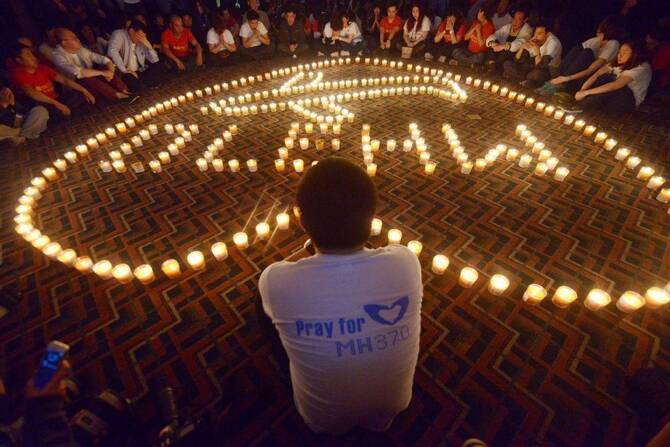
Beijing court orders Malaysia Airlines to pay damages to families of MH370 victims

A Beijing court ordered Malaysia Airlines on Dec. 8, 2025 to pay compensation to the families of eight passengers from flight MH370, more than a decade after the plane disappeared. (AFP)
Short Url
Updated 09 December 2025
Follow

Beijing court orders Malaysia Airlines to pay damages to families of MH370 victims

  • Court orders airline to pay each family compensation for the death of their loved one, funeral expense and damages stemming from emotional distress

BEIJING: A Beijing court has ruled that Malaysia Airlines must pay 2.9 million yuan ($410,000) each to the families of eight passengers who went missing in the mysterious disappearance of the MH370 flight more than a decade ago.
The court ordered the airline to pay each family compensation for the death of their loved one, funeral expenses and damages stemming from emotional distress, it said in a statement Monday. Although it is not known what happened to the passengers, they have been declared legally dead.
There were 239 passengers and crew members on the flight that disappeared after departing Kuala Lumpur for Beijing in 2014. Despite years of searches, it’s unknown why the plane went down or what happened to the people on board. Most of the passengers were Chinese, and their families in China have continued to seek answers.
The court said that another 23 cases remain pending. In 47 other cases, families have reached agreements with the airlines and withdrawn their suits.
Last Wednesday, the Malaysian government said it would resume a search for the missing plane starting Dec. 30.


Climate activist group files second lawsuit against Sweden

Updated 5 sec ago
Follow

Climate activist group files second lawsuit against Sweden

  • Sweden’s Supreme Court in February 2025 ruled that the complaint filed against the state was inadmissible
  • “We still have a chance to get out of the planetary crises and build a safe and fair world,” Edling said

STOCKHOLM: A group of climate activists said Friday they were filing another lawsuit against the Swedish state for alleged climate inaction, after the Supreme Court threw out their case last year.
The group behind the lawsuit, Aurora, first tried to sue the Swedish state in late 2022.
Sweden’s Supreme Court in February 2025 ruled that the complaint filed against the state — brought by an individual, with 300 other people joining it as a class action lawsuit — was inadmissible.
The court at the time noted the “very high requirements for individuals to have the right to bring such a claim” against a state.
“We still have a chance to get out of the planetary crises and build a safe and fair world. But this requires that rich countries that emit as much as Sweden stop breaking the law,” Aurora spokesperson Ida Edling said in a statement Friday.
The group, which said the lawsuit had been filed with the Stockholm District Court Friday, said it believes the Swedish state is obligated “to reduce Sweden’s emissions as much and as quickly as necessary in order for the country to be in line with its fair share.”
“This means that emissions from several sectors must reach zero before 2030,” the group said, while noting this was 15 years before Sweden’s currently set targets.
The Swedish Environmental Protection Agency as well as the OECD warned last year that Sweden was at risk of not reaching its own goal of net zero emissions by 2045.
While the first lawsuit was unsuccessful, the group noted that international courts had made several landmark decisions since the first suit was filed, spotlighting two in particular.
In an April 2024 decision, Europe’s top rights court, the European Court of Human Rights, ruled that Switzerland was not doing enough to tackle climate change, the first country ever to be condemned by an international tribunal for not taking sufficient action to curb global warming.
In 2025, the International Court of Justice issued an advisory opinion stating that countries violating their climate obligations were committing an “unlawful” act.