

Saudi Arabia signs $53m deal to build a food logistics hub at Dammam port 

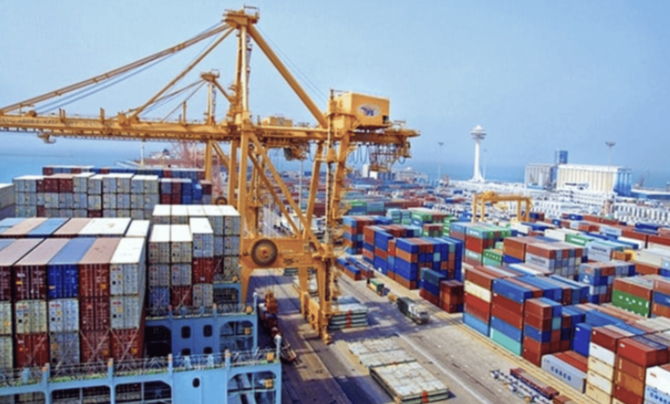
King Abdulaziz Port in Dammam is the primary entryway for cargo headed to the country’s eastern and central regions from all over the world. File
Short Url
Updated 08 December 2025
Follow

Saudi Arabia signs $53m deal to build a food logistics hub at Dammam port 

RIYADH: Saudi Arabia is set to enhance food-supply infrastructure and expand logistics capacity at King Abdulaziz Port after signing a SR200 million ($53.2 million) agreement with Arabian Agricultural Services Co., or Arasco. 

The contract, signed by Suliman bin Khalid Al-Mazroua, president of the Saudi Ports Authority, also known as Mawani, and Arasco CEO Ziyad A. Alsheikh, supports the National Transport and Logistics Strategy and strengthens the Kingdom’s positioning as a global logistics hub. 

A press release from the authority stated: “This contract aligns with Mawani’s efforts to strengthen national supply chains and boost operational efficiency at King Abdulaziz Port in Dammam.”  

It added: “It also reflects Mawani’s commitment to supporting private-sector partnerships and providing world-class infrastructure that advances the goals of Saudi Vision 2030 while solidifying the Kingdom’s standing as a global logistics hub bridging the three continents.”  

The new facility is set to span 40,000 sq. meters and enhance the port’s capacity for handling vital food commodities. 

A core component of the project is the development of advanced grain storage silos with a total capacity of up to 100,000 tonnes, significantly boosting the Kingdom’s strategic grain reserve infrastructure. 

The integrated logistics center will feature a dedicated vehicle-loading facility, advanced conveyor belt systems, and specialized ship-unloading equipment to connect Berths 37 and 39.  

This development is expected to streamline port operations, ensure seamless integration within the broader transport network, and reduce turnaround times for cargo. 

Beyond infrastructure, the project promises substantial economic and social impact. It is projected to create more than 3,000 direct and indirect employment opportunities, contributing to local job creation and skills development.  

Furthermore, the center will fortify both national and regional supply and distribution networks, offering value-added services that stimulate broader economic growth. 

King Abdulaziz Port in Dammam, a critical gateway linking Saudi Arabia to international markets, is already one of the region’s most formidable maritime facilities. It boasts 43 fully operational berths and an annual handling capacity exceeding 105 million tonnes of various cargo and containers.  

This new partnership with Araso is poised to further elevate its status, attracting leading global logistics firms and solidifying Saudi Arabia’s role as a leading regional logistics center. 


Acwa signs key terms to develop 5GW of renewable energy capacity in Turkiye

Updated 23 February 2026
Follow

Acwa signs key terms to develop 5GW of renewable energy capacity in Turkiye

JEDDAH: Saudi utility giant Acwa has signed key investment agreements with Turkiye’s Ministry of Energy and Natural Resources to develop up to 5 gigawatts of renewable energy capacity, starting with 2GW of solar power across two plants in Sivas and Taseli.

Under the investment agreement, Acwa will develop, finance, and construct, as well as commission and operate both facilities, according to a press release.

The program builds on the company’s first investment in Turkiye, the 927-megawatt Kirikkale Independent Power Plant, valued at $930 million, which offsets approximately 1.8 million tonnes of carbon dioxide annually, the statement added.

A separate power purchase agreement has been concluded with Elektrik Uretim Anonim Sirketi for the sale of electricity generated by each facility.

Turkiye aims to boost solar and wind capacity to 120GW by 2035, supported by around $80 billion in investment, while recent projects have already helped prevent 12.5 million tonnes of CO2 emissions and reduced reliance on imported natural gas.

Turkiye’s energy sector has undergone a rapid transformation in recent years, with renewable power emerging as a central pillar of its strategy.

Raad Al-Saady, vice chairman and managing director of ACWA, said: “The signing of the IA (implementation agreement) and PPA key terms marks a pivotal moment in Acwa’s partnership with Turkiye, reflecting the country’s strong potential as a clean energy leader and manufacturing powerhouse.”

He added: “Building on our long-standing presence, including the 927MW Kirikkale Power Plant commissioned in 2017, this step elevates our partnership to a new level,” Al-Saady said.

In its statement, Acwa said the 5GW renewable energy program will deliver electricity at fixed prices, enhancing predictability for grid planning and supporting long-term industrial investment.

By replacing imported fossil fuels with domestically generated clean energy, the initiative is expected to reduce Turkiye’s exposure to global energy market volatility, strengthening energy security and lowering long-term power costs.

The company added that the economic impact will extend beyond the anticipated investment of up to $5 billion in foreign direct investment, with thousands of jobs expected during the construction phase and hundreds of high-skilled roles created during operations.

The energy firm concluded that its existing progress in Turkiye reflects a strong appreciation for Turkish engineering, construction, and manufacturing capacity, adding that localization has been a strategic priority, and it has already achieved 100 percent local employment at its developments in the country.