

Starvation fears as flood toll passes 900 in Indonesia

1 / 3
Flood survivors carry relief goods distributed by an Indonesian Air Force helicopter in Central Aceh, Indonesia, on Dec. 6, 2025. (AP Photo/Reza Saifullah)
2 / 3
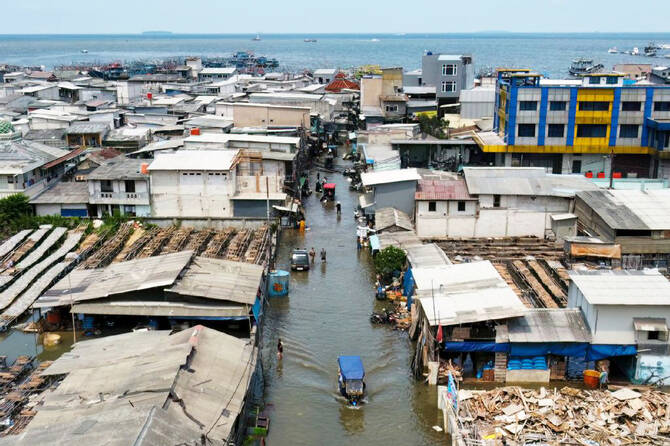
This aerial picture shows a settlement submerged by high tide in Muara Baru, Jakarta on December 6, 2025. (AFP)
3 / 3
Children play as high tide floods their residential area in Muara Baru, Jakarta on December 6, 2025. (AFP)
Short Url
Updated 06 December 2025
Follow

Starvation fears as flood toll passes 900 in Indonesia

  • More than 1,790 people have been killed in natural disasters unfolding across Southeast Asia over the past week
  • Floods have swept away roads, smothered houses in silt, and cut off supplies in Indonesia's provinces of Aceh and North Sumatra

BANDA ACEH, Indonesia: Ruinous floods and landslides have killed more than 900 people on Indonesia’s island of Sumatra, the country’s disaster management agency said Saturday, with fears that starvation could send the toll even higher.
A chain of tropical storms and monsoonal rains has pummelled Southeast and South Asia, triggering landslides and flash floods from the Sumatran rainforest to the highland plantations of Sri Lanka.
More than 1,790 people have been killed in natural disasters unfolding across Indonesia, Sri Lanka, Malaysia, Thailand and Vietnam over the past week.
In Indonesia’s provinces of Aceh and North Sumatra, floods have swept away roads, smothered houses in silt, and cut off supplies.
Aceh governor Muzakir Manaf said response teams were still searching for bodies in “waist-deep” mud.
However, starvation was one of the gravest threats now hanging over remote and inaccessible villages.
“Many people need basic necessities. Many areas remain untouched in the remote areas of Aceh,” he told reporters.
“People are not dying from the flood, but from starvation. That’s how it is.”
Entire villages had been washed away in the rainforest-cloaked Aceh Tamiang region, Muzakir said.
“The Aceh Tamiang region is completely destroyed, from the top to the bottom, down to the roads and down to the sea.
“Many villages and sub-districts are now just names,” he said.
Aceh Tamiang flood victim Fachrul Rozi said he had spent the past week crammed into an old shop building with others who had fled the rising waters.
“We ate whatever was available, helping each other with the little supplies each resident had brought,” he told AFP. “We slept crammed together.”
Aceh resident Munawar Liza Zainal said he felt “betrayed” by the Indonesian government, which has so far shrugged off pressure to declare a national disaster.
“This is an extraordinary disaster that must be faced with extraordinary measures,” he told AFP, echoing frustrations voiced by other flood victims.
“If national disaster status is only declared later, what’s the point?“
Declaring a national disaster would free up resources and help government agencies coordinate their response.
Analysts have suggested Indonesia could be reluctant to declare a disaster — and seek additional foreign aid — because it would show it was not up to the task.
Indonesia’s government this week insisted it could handle the fallout.

Climate calamity

The scale of devastation has only just become clear in other parts of Sumatra as engorged rivers shrink and floodwaters recede.
AFP photos showed muddy villagers salvaging silt-encrusted furniture from flooded houses in Aek Ngadol, North Sumatra.
Humanitarian groups worry that the scale of the calamity could be unprecedented, even for a nation prone to natural disasters.
Indonesia’s death toll rose to 908 on Saturday, according to the disaster management agency, with 410 people missing.
Sri Lanka’s death toll jumped on Friday to 607, as the government warned that fresh rains raised the risk of new landslides.
Thailand has reported 276 deaths and Malaysia two, while at least two people were killed in Vietnam after heavy rains triggered a series of landslides.
Seasonal monsoon rains are a feature of life in Southeast Asia, flooding rice fields and nourishing the growth of other key crops.
However, climate change is making the phenomenon more erratic, unpredictable and deadly throughout the region.
Environmentalists and Indonesia’s government have also suggested that logging and deforestation exacerbated landslides and flooding in Sumatra.


Poland withdraws from treaty banning antipersonnel mines and will use them to defend against Russia

Updated 4 sec ago
Follow

Poland withdraws from treaty banning antipersonnel mines and will use them to defend against Russia

  • 1997 Anti-Personnel Mine Ban Treaty prohibits signatories from keeping or using antipersonnel mines
  • Poland will begin domestic production of both antipersonnel and anti-tank land mines
WARSAW: Poland will use antipersonnel as well as anti-tank land mines to defend its eastern border against the growing threat from Russia, Poland’s deputy defense minister said on Friday as the country officially left an international convention banning the use of the controversial weapons.
The 1997 Anti-Personnel Mine Ban Treaty, also known as the Ottawa Convention, prohibits signatories from keeping or using antipersonnel mines, which can last for years and are known for having caused large-scale suffering among civilians in former conflict zones in countries including Cambodia, Angola and Bosnia and Herzegovina.
Poland, which ratified the document in 2012 and completed the destruction of its domestic anti-personnel mine stockpile in 2016, withdrew from the treaty on Friday and says it plans to renew manufacturing weapons.
“These mines are one of the most important elements of the defense structure we are constructing on the eastern flank of NATO, in Poland, on the border with Russia in the north and with Belarus in the east,” Paweł Zalewski, Poland’s deputy defense minister, said.
He said Poland needed to defend itself against Russia, a country which “has very aggressive intentions vis a vis its neighbors” and which itself never committed to the international land mine ban treaty.
Since Russia’s full-scale invasion of Ukraine, nearby countries have been reassessing their participation in the international treaty. Last year, Warsaw joined Finland, the three Baltic states of Estonia, Latvia and Lithuania, and Ukraine to announce it would leave the treaty.
Russia is one of nearly three dozen countries that have never acceded to the Ottawa treaty, alongside the United States.
Poland vows to make its own mines
Zalewski said that Poland will begin domestic production of both antipersonnel and anti-tank land mines, adding that the government would cooperate with Polish producers. He said Poland was aiming for self-sufficiency.
Land mines are an explosive weapon that’s placed on or just under the ground and blows up when a person or a vehicle crosses over them. Anti-tank mines, which are designed not to be triggered by a person’s weight, are not forbidden by the Ottawa Convention.
Speaking on Thursday after attending a demonstration of Bluszcz, an unmanned vehicle designed to distribute anti-tank mines produced by Polish company Belma SA and a military research institute, Polish Prime Minister Donald Tusk said Poland would “soon” have the ability to mine its eastern borders within 48 hours in case of a threat.
Given the length of the country’s eastern borders, he said, “a lot” of land mines will be needed.
Poland says it will only use mines in case of ‘realistic threat of Russian aggression’
Poland plans to prepare mine stockpiles as part of the so-called Eastern Shield, a system of enhanced fortifications Poland has been building on its borders with Belarus and Russia since 2024, Zalewski said.
But he said that Poland would only deploy the mines along its borders “when there is a realistic threat of Russian aggression.”
“We very much respect our territory and we don’t want to exclude it from day to day use for the Polish citizens,” Zalewski said.
Human rights groups have condemned moves to withdraw from the Ottawa Convention, arguing that anti-personnel mines are too dangerous to civilians.
But Zalewski responded that the country is striking a balance by keeping the mines in reserve unless the country faces attack.
“We are not an aggressive country,” he said, “but we have to use all means to deter Russia.”