

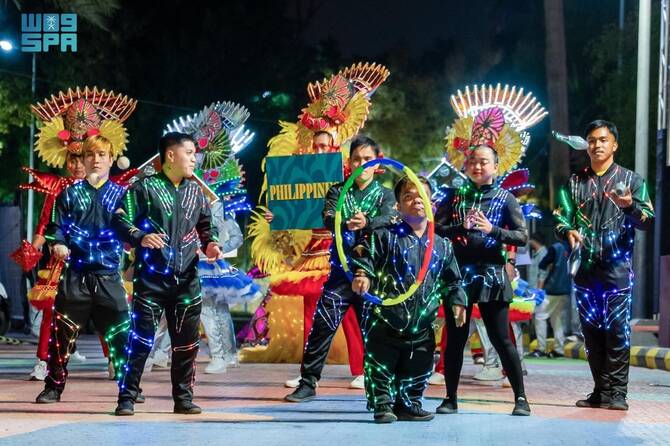

Saudi capital celebrates Philippine culture with music, art, tradition 

1 / 3
The event is being staged at Al-Suwaidi Park, one of Riyadh Season’s zones, from Dec. 5-8, and has already welcomed thousands of visitors. (SPA)
2 / 3
The event is being staged at Al-Suwaidi Park, one of Riyadh Season’s zones, from Dec. 5-8, and has already welcomed thousands of visitors. (SPA)
3 / 3
The event is being staged at Al-Suwaidi Park, one of Riyadh Season’s zones, from Dec. 5-8, and has already welcomed thousands of visitors. (SPA)
Short Url
Updated 06 December 2025
Follow

Saudi capital celebrates Philippine culture with music, art, tradition 

  • Festival spotlights Filipino creativity through live performances, crafts, authentic cuisine, and community’s cultural contributions

RIYADH: The Philippine Culture Days launched on Friday evening as part of the Global Harmony 2 initiative organized by the Ministry of Media, in cooperation with the General Entertainment Authority and supported by the Quality of Life Program. 

The event is being staged at Al-Suwaidi Park, one of Riyadh Season’s zones, from Dec. 5-8, and has already welcomed thousands of visitors, according to the Saudi Press Agency. 

It offers an immersive cultural journey highlighting the richness of Philippine culture and its traditional arts, while also showcasing the success stories of Filipino residents in the Kingdom, their social, economic, and cultural roles, and their diverse contributions. 

The program includes musical performances by leading Filipino artists and influencers, as well as cultural pavilions that introduce visitors to everyday Filipino life through bazaars of traditional clothing, popular food stalls, and themed photo-shoot experiences with folkloric costumes, creating a vivid celebration of Philippine identity. 

Filipino artisans also present live demonstrations of traditional crafts, including shellcrafting, accessory-making, and handcrafted art, giving visitors a close look at the intricate craftsmanship involved. 

The opening day featured the first musical concert with Filipino performers, along with more than 70 exhibitors and artistic performers presenting musical and folk shows that blend traditional arts with modern rhythms, drawing strong audience engagement. 

The four-day Philippine Culture Days event is part of a broader series of global cultural activities aimed at fostering cultural exchange and highlighting the Kingdom’s embrace of diversity. 

The Global Harmony 2 initiative continues to offer more than 200 children’s activities over 49 days, with steady turnout from families throughout the week. This year’s initiative aims to celebrate 14 world cultures, each representing a different community in the Kingdom. 

So far, more than 2 million visitors have taken part in the cultural initiative, with only three exhibitions remaining in the Global Harmony 2 initiative. 

Following Philippine Culture Days are Uganda (Dec. 9-10), Ethiopia (Dec. 11-13), and Sudan (Dec. 14-20). 

Officials hope to shed light on the lives of expatriates living in Saudi Arabia, celebrating their social and recreational activities, contributions to the Kingdom’s economy, and personal success stories. 


Rebuilding lives: Saudi initiative gives fresh hope to amputees

Updated 08 December 2025
Follow

Rebuilding lives: Saudi initiative gives fresh hope to amputees

  • Baitureh Health Association has provided life-changing support to more than 1,000 people
  • Prosthetic limbs can cost up to $76,000

MAKKAH: The Baitureh Health Association for the Care of Amputees has quickly become one of Saudi Arabia’s most impactful humanitarian initiatives, transforming support for people with lost limbs.

Established in 2020, the association deals with people’s physical, psychological and social needs and fills a long-standing gap in the national health system.

CEO Badr bin Alyan told Arab News that the initiative was created in response to a growing need, driven by amputations linked to accidents, blood disorders, occupational injuries and other causes.

Its operations were “based on service integration rather than fragmentation, enabling beneficiaries to return to their lives with confidence, ability and independence,” he said.

This holistic process covers everything from initial evaluations to psychological and physical rehabilitation, family support, prosthetic fitting and ongoing maintenance.

Its psychological support programs include group sessions led by certified mentors who have undergone similar experiences, as well as field visits to support patients before and after amputation.

More than 1,000 people across the Kingdom have so far benefitted from the association’s work, about 10 percent of them children, whom Alyan said were “the most sensitive and the most in need of intensive psychological and family support.”

Its specialist programs for children — My First Step and Therapeutic Entertainment — help young people adapt to prosthetics, overcome trauma and build confidence in a safe and supportive setting.

The association has completed more than 300 prosthetic fittings, including silicone cosmetic limbs, mechanical, hydraulic, electronic and 3D-printed models. 

Alyan said the type of prosthetic selected depended on a number of factors, such as age, lifestyle, type of amputation, activity level and psychological readiness.

Children also have to undergo frequent adjustments to their new limbs to account for their growth.

Each prosthetic cost between SR20,000 ($5,300) and SR285,000, Alyan said.

The association funds its work through sponsorships, community contributions and strategic partnerships.

Despite its success, Alyan said there were still challenges to be faced, including the lack of a consolidated base for the provision of psychological support and therapy services and prosthetics development and maintenance.

There was also a shortage of local experts, he said.

In response, the association set up a rehabilitation center, which Alyan said would help to localize prosthetics manufacturing, reduce costs and accelerate fitting processes and create opportunities for local experts to develop their knowledge and experience.

But providing prosthetics was only part of the association’s work, he said.

“Rebuilding a human life is the deeper goal.”