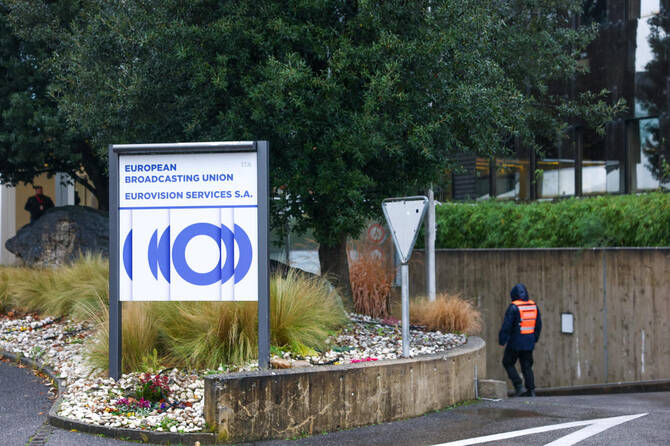
GENEVA: Members of the body that organizes the Eurovision Song Contest will meet on Thursday to discuss and potentially vote on whether Israel can compete next year, as some countries threaten to withdraw if it is not excluded over the Gaza war.
The meeting at the European Broadcasting Union headquarters in Geneva will address new rules intended to discourage governments and third parties from disproportionately promoting songs to sway voters, following allegations that Israel unfairly boosted its entrant to the contest this year.
Israel, which came second in the contest, has not responded to these accusations, but frequently argues it has faced a global smear campaign.
The contest faces a “watershed moment,” said Eurovision expert Paul Jordan. Public broadcasters from Slovenia, Ireland, Spain and the Netherlands are threatening to boycott the May 2026 event, to be hosted by Austria, if Israel is allowed to compete.
Critics of Israel’s participation cite concerns over the Palestinian death toll in Gaza, which has surpassed 70,000, according to Gaza health authorities.
If members are not convinced that the new rules, which aim to protect the contest’s neutrality and impartiality, are adequate, there will be a vote on participation, the EBU said.
Germany could withdraw and not broadcast Eurovision if Israel is not allowed to participate, a broadcasting industry source told Reuters. German broadcaster ARD did not comment. Austrian host broadcaster ORF wants Israel to compete.
Israeli public broadcaster KAN said it is preparing for next year’s contest and will soon release changes to its selection process for choosing Israel’s entry. KAN said it will present its position on possible disqualification at the meeting.

National broadcasters consider Israel Eurovision participation amid boycott threats
https://arab.news/zm4cq
National broadcasters consider Israel Eurovision participation amid boycott threats
- Israel, which came second in the contest, has not responded to these accusations, but frequently argues it has faced a global smear campaign
Israel arrests 2 Turkish CNN journalists over live broadcast outside IDF HQ
- Police said reporter Emrah Cakmak and cameraman Halil Kahraman were detained on suspicion of filming a sensitive security facility
- Since the Gaza war began, restrictions have expanded significantly, including tighter limits on filming soldiers on duty and sensitive or strategic sites
LONDON: Israeli police have arrested two Turkish CNN journalists who were broadcasting live outside the Israel Defense Forces’ headquarters in Tel Aviv.
Police said the pair were detained on suspicion of filming a sensitive security facility, according to the Israel Police Spokesperson’s Unit.
Reporter Emrah Cakmak and cameraman Halil Kahraman, from the network’s Turkish-language channel, had been reporting near the IDF’s Kirya military headquarters on Tuesday after Iran launched another missile barrage at Tel Aviv and other parts of central Israel.
During the live broadcast, two men believed to be soldiers approached the crew and seized the reporter’s phone, according to initial reports and a video circulating online that could not be independently verified.
Police said officers were dispatched after receiving reports of two people carrying cameras and allegedly broadcasting in real time for a foreign outlet.
עיתונאים של CNN טורקיה נעצרו לאחר שצילמו את בסיס הקרייה@NoamIhmels pic.twitter.com/t8a5P9yXfw
— גלצ (@GLZRadio) March 3, 2026
Israel’s long-standing military censorship system, overseen by the IDF Military Censor, has long barred journalists and civilians from publishing material deemed harmful to national security.
Since the Gaza war began, restrictions have expanded significantly, including tighter limits on filming soldiers on duty and sensitive or strategic sites.
After a series of similar incidents involving foreign media — most of them Palestinian citizens of Israel working for Arab-language and international media, along with foreign journalists — during the 12-Day War, Israeli police halted live international broadcasts from missile impact sites, citing concerns that exact locations were being revealed.
The Government Press Office later imposed a blanket ban on live coverage from crash and impact areas.
Communications Minister Shlomo Karhi and National Security Minister Itamar Ben-Gvir subsequently ordered that all foreign journalists obtain prior written approval from the military censor before broadcasting — live or recorded — from combat zones or missile strike locations.
Police said that when officers asked the CNN Turk crew to identify themselves, they presented expired press cards and were taken in for questioning.
Burhanettin Duran, head of Turkiye’s Directorate of Communications, condemned the arrests as an attack on the press and said Ankara is working to secure the journalists’ release.


