Lebanon ‘far from’ diplomatic normalization or economic relations with Israel, prime minister says

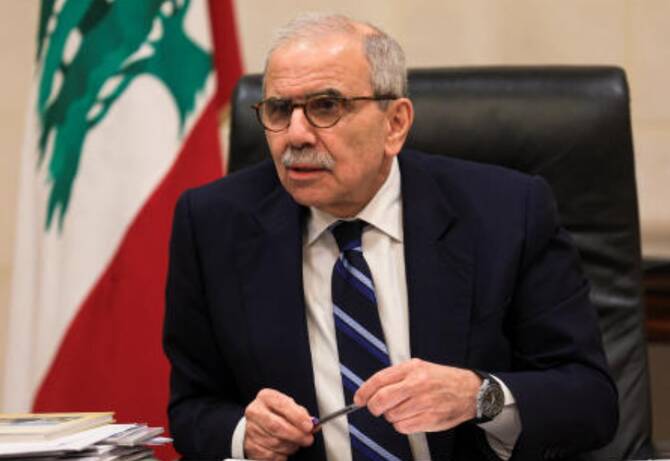
Lebanese Prime Minister Nawaf Salam speaks to journalists at the government headquarters in Beirut, Dec. 3, 2025. (Reuters)
Short Url
Updated 03 December 2025
Follow

Lebanon ‘far from’ diplomatic normalization or economic relations with Israel, prime minister says

  • Salam said Lebanon is still committed to the 2002 Arab peace plan
  • “Economic relations would be part of such normalization, so then obviously anyone following the news would know that we are not there at all”

BEIRUT: Lebanon’s prime minister said Wednesday that his country was “far from” diplomatic normalization or economic relations with Israel, despite a move toward direct negotiations between the two countries aimed at defusing tensions.
Prime Minister Nawaf Salam’s comments to a small group of journalists in Beirut came in contradiction to a statement by Israeli Prime Minister Benjamin Netanyahu that Israel would send an envoy to talks with Lebanese diplomatic and economic officials, which he described as an “initial attempt to create a basis for relations and economic cooperation” between the two countries.
Lebanon and Israel both announced the appointment of civilian members to a previously military-only committee monitoring enforcement of the US-brokered ceasefire that halted the latest war between Israel and the Lebanese militant group Hezbollah a year ago.
The civilian members — Simon Karam, an attorney and former Lebanese ambassador to the US, and Uri Resnick, the Israeli National Security Council’s deputy director for foreign policy — took part in Wednesday’s meeting of the mechanism.
Along with Israel and Lebanon, the committee includes representatives of the US, France and the UN peacekeeping force known as UNIFIL.
Lebanon and Israel don’t have diplomatic relations and have been officially in a state of war since 1948. The move to hold civilian talks appeared to be a step toward the direct bilateral talks between Israel and Lebanon that Washington has pushed for.
However, Salam said Lebanon is still committed to the 2002 Arab peace plan that conditions normalization of diplomatic relations with Israel on the creation of a Palestinian state — a prospect to which Netanyahu’s administration has been adamantly opposed.
“Economic relations would be part of such normalization, so then obviously anyone following the news would know that we are not there at all,” Salam said.
A debate over weapons
His comments also come amid fears of a new escalation by Israel against Hezbollah in Lebanon. Since the November 2024 ceasefire, Israel has continued to launch near-daily attacks in Lebanon that it says aim to stop the group from rebuilding its capabilities after suffering heavy blows in the recent war.
Lebanon has been deeply divided over calls for Hezbollah to disarm. In August, the Lebanese government announced a plan to consolidate all weapons in the hands of the state by the end of the year, but it later backed off of the deadline.
Hezbollah officials have said the group will not consider disarmament until Israel withdraws from all Lebanese territory and halts its attacks.
Salam said Lebanon is on track to implement the first phase of the disarmament plan — under which the Lebanese army should have a monopoly on arms in the area south of the Litani river, near the border with Israel — by the end of the year. The exception is several border points that Israeli forces are still occupying, he said.
The remaining phases of the five-phase plan, which would cover the rest of the country, currently “don’t have a time frame,” he said.
The lack of a firm timeline is unlikely to satisfy Israel, which has been threatening to escalate its military actions in Lebanon if Hezbollah is not fully disarmed.
Salam said that Lebanon had appointed a civilian representative to the ceasefire committee at the request of the US and Israel.
“We are ready to negotiate with civilian participation,” he said. “I hope that this will help defuse the tension.”
A ceasefire with vague enforcement
Salam also said Lebanon is ready to put in place a “verification mechanism” to investigate alleged violations of the ceasefire.
The November 2024 agreement required Lebanon to stop armed groups from attacking Israel and Israel to halt “offensive” military actions in Lebanon. It said Israel and Lebanon can act in “self-defense,” without elaborating.
Under the ceasefire agreement, both sides can report violations to the monitoring committee, but the deal is vague on enforcement.
In practice, Israel has largely taken enforcement into its own hands and has maintained that its ongoing strikes are in self-defense. Hezbollah has claimed one attack since the ceasefire.
Salam said that in many cases, Israel strikes without reporting violations via the monitoring committee.
“Clearly, we cannot be responsible for information that wasn’t shared with us,” he said. He added that Lebanon is willing to have US and French troops on the ground to investigate and verify reported violations.
Salam said that Israel should fully implement its part of the ceasefire by withdrawing from several points on the Lebanese side of the border that its forces are still occupying and should release Lebanese citizens captured during and after the war who are currently detained in Israel.
While he insisted that Hezbollah is required to disarm under the ceasefire and in accordance with the plan adopted by the government, the Lebanese state’s options appear to be limited if the group refuses to do so.
“We have lived civil war — civil wars — in Lebanon. I don’t think anyone is tempted to repeat that,” Salam said.
Meanwhile, the country is facing the end of UNIFIL’s peacekeeping mandate in southern Lebanon, which expires in just over a year, leaving greater uncertainty over the situation in the border area.
Salam said he would be discussing “what will come post-UNIFIL” with a delegation of representatives of the UN Security Council that is set to visit Lebanon later this week.


US raid allegedly killed Syrian undercover agent instead of Daesh group official

Updated 2 sec ago
Follow

US raid allegedly killed Syrian undercover agent instead of Daesh group official

  • Neither US nor Syrian government officials have commented on the death, an indication that neither side wants the incident to derail improving ties
  • Weeks after the raid, interim President Ahmad Al-Sharaa visited Washington and announced Syria would join the global coalition against Daesh
DUMAYR, Syria: A raid by US forces and a local Syrian group aiming to capture an Daesh (IS) group official instead killed a man who had been working undercover gathering intelligence on the extremists, family members and Syrian officials have told The Associated Press.
The killing in October underscores the complex political and security landscape as the United States begins working with interim Syrian President Ahmad Al-Sharaa in the fight against remnants of IS.
According to relatives, Khaled Al-Masoud had been spying on IS for years on behalf of the insurgents led by Al-Sharaa and then for Al-Sharaa’s interim government, established after the fall of former President Bashar Assad a year ago. Al-Sharaa’s insurgents were mainly Islamists, some connected to Al-Qaeda, but enemies of IS who often clashed with it over the past decade.
Neither US nor Syrian government officials have commented on Al-Masoud’s death, an indication that neither side wants the incident to derail improving ties. Weeks after the Oct. 19 raid, Al-Sharaa visited Washington and announced Syria would join the global coalition against IS.
Still, Al-Masoud’s death could be “quite a setback” for efforts to combat IS, said Wassim Nasr, a senior research fellow with the Soufan Center, a New York-based think tank focused on security issues.
Al-Masoud had been infiltrating IS in the southern deserts of Syria known as the Badiya, one of the places where remnants of the extremist group have remained active, Nasr said.
The raid targeting him was a result of “the lack of coordination between the coalition and Damascus,” Nasr said.
In the latest sign of the increasing cooperation, the US Central Command said Sunday that American troops and forces from Syria’s Interior Ministry had located and destroyed 15 IS weapons caches in the south.
Confusion around the raid
The raid occurred in Dumayr, a town east of Damascus on the edge of the desert. At around 3 a.m., residents woke to the sound of heavy vehicles and planes.
Residents said US troops conducted the raid alongside the Syrian Free Army, a US-trained opposition faction that had fought against Assad. The SFA now officially reports to the Syrian Defense Ministry.
Al-Masoud’s cousin, Abdel Kareem Masoud, said he opened his door and saw Humvees with US flags on them.
“There was someone on top of one of them who spoke broken Arabic, who pointed a machine gun at us and a green laser light and told us to go back inside,” he said.
Khaled Al-Masoud’s mother, Sabah Al-Sheikh Al-Kilani, said the forces then surrounded her son’s house next door, where he was with his wife and five daughters, and banged on the door.
Al-Masoud told them that he was with General Security, a force under Syria’s Interior Ministry, but they broke down the door and shot him, Al-Kilani said.
They took him away, wounded, Al-Kilani said. Later, government security officials told the family he had been released but was in the hospital. The family was then called to pick up his body. It was unclear when he had died.
“How did he die? We don’t know,” his mother said. “I want the people who took him from his children to be held accountable.”
Faulty intelligence
Al-Masoud’s family believes he was targeted based on faulty intelligence provided by members of the Syrian Free Army.
Representatives of the SFA did not respond to requests for comment.
Al-Masoud had worked with Al-Sharaa’s insurgent group, Hayat Tahrir Al-Sham, in its northwestern enclave of Idlib before Assad’s fall, his cousin said. Then he returned to Dumayr and worked with the security services of Al-Sharaa’s government.
Two Syrian security officials and one political official, who spoke on condition of anonymity because they were not authorized to comment publicly, confirmed that Al-Masoud had been working with Syria’s interim government in a security role. Two of the officials said he had worked on combating IS.
Initial media reports on the raid said it had captured an IS official. But US Central Command, which typically issues statements when a US operation kills or captures a member of the extremist group in Syria, made no announcement.
A US defense official, when asked for more information about the raid and its target and whether it had been coordinated with Syria’s government, said, “We are aware of these reports but do not have any information to provide.” The official spoke on condition of anonymity in accordance with regulations.
Representatives of Syria’s defense and interior ministries, and of US envoy to Syria Tom Barrack, declined to comment.
Increased coordination could prevent mistakes
At its peak in 2015, IS controlled a swath of territory across Iraq and Syria half the size of the United Kingdom. It was notorious for its brutality against religious minorities as well as Muslims not adhering to the group’s extreme interpretation of Islam.
After years of fighting, the US-led coalition broke the group’s last hold on territory in late 2019. Since then, US troops in Syria have been working to ensure IS does not regain a foothold. The US estimates IS still has about 2,500 members in Syria and Iraq. US Central Command last month said the number of IS attacks there had fallen to 375 for the year so far, compared to 1,038 last year.
Fewer than 1,000 US troops are believed to be operating in Syria, carrying out airstrikes and conducting raids against IS cells. They work mainly alongside the Kurdish-led Syrian Democratic Forces in the northeast and the Syrian Free Army in the south.
Now the US has another partner: the security forces of the new Syrian government.
Airwars, a London-based conflict monitor, has reported 52 incidents in which civilians were harmed or killed in coalition operations in Syria since 2020.
The group classified Al-Masoud as a civilian.
Airwars director Emily Tripp said the group has seen “multiple instances of what the US call ‘mistakes,’” including a 2023 case in which the US military announced it had killed an Al-Qaeda leader in a drone strike. The target later turned out to be a civilian farmer.
It was unclear if the Oct. 19 raid went wrong due to faulty intelligence or if someone deliberately fed the coalition false information. Nasr said that in the past, feuding groups have sometimes used the coalition to settle scores.
“That’s the whole point of having a hotline with Damascus, in order to see who’s who on the ground,” he said.