

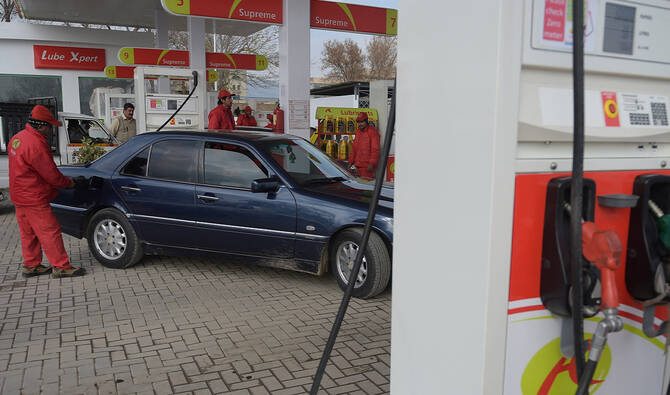

KARACHI: Pakistan’s oil marketing companies have asked the government to create a “financially viable” cost-recovery mechanism before requiring the industry to digitize fuel stations nationwide, an initiative expected to exceed Rs50 billion ($178 million) in total investment, the Oil Companies Advisory Council (OCAC) said in a letter shared with Arab News on Wednesday.
The digitization program, centered on installing Auto Tank Gauging (ATG) systems and digital fuel dispensers at all retail outlets, is part of a government push to modernize Pakistan’s fuel-supply chain. ATG systems allow real-time monitoring of underground fuel tanks to curb leakages, theft and misreporting, and are widely used in more regulated markets.
OCAC represents Pakistan’s downstream oil industry and includes both local and foreign firms such as Wafi Energy of Saudi Arabia and Parco Gunvor Limited, a joint venture with Switzerland-based Gunvor Group.
In a letter dated Dec. 2, OCAC Chairman Adil Khattak asked the Oil and Gas Regulatory Authority (OGRA), Pakistan’s federal energy regulator, to finalize how companies will be compensated for the new capital expenditure.
“OCAC strongly urges OGRA to take up the matter in its complete scope and immediately finalize a clear, implementable, and financially viable cost recovery mechanism,” Khattak wrote.
The appeal followed a Dec. 1 meeting in Islamabad in which OGRA called chief executives of oil marketing companies to discuss the rollout of ATG systems and digital monitoring tools across thousands of fuel stations.
While supporting the government’s objective of tightening oversight at the retail level, OCAC said implementation must be gradual.
“Given the scale of the task and the total number of retail outlets nationwide, the industry requires a realistic implementation window of at least five years to execute this transition effectively,” the group said.
OCAC emphasized that ATG systems are custom-built for each site, requiring specialized procurement, installation and calibration, making the nationwide rollout both complex and expensive.
Khattak noted that “the cost of a single digital dispenser is approximately Rs2.5 million ($8,914), while an ATG system costs up to Rs5 million ($17,828) per outlet with two storage tanks.”
He warned that imposing the requirement before establishing how costs will be recovered would strain an already pressured industry.
“Without a confirmed cost recovery framework, OMCs will remain unable to commit to such large-scale financial exposure,” Khattak said, adding that companies’ fuel-retail margins “have remained stagnant for the past two years, severely limiting the industry’s capacity to absorb additional financial burdens.”
OCAC urged OGRA to share the “cost recovery framework at the earliest as well as schedule a dedicated meeting to hear the industry’s viewpoint and operational constraints.”


